Department of Earth Sciences, Uppsala University, Uppsala, Sweden.
Australian Age of Dinosaurs Museum of Natural History, The Jump-Up, Winton, Queensland, Australia.
Sci Rep. 2016 Oct 20;6:34467. doi: 10.1038/srep34467.
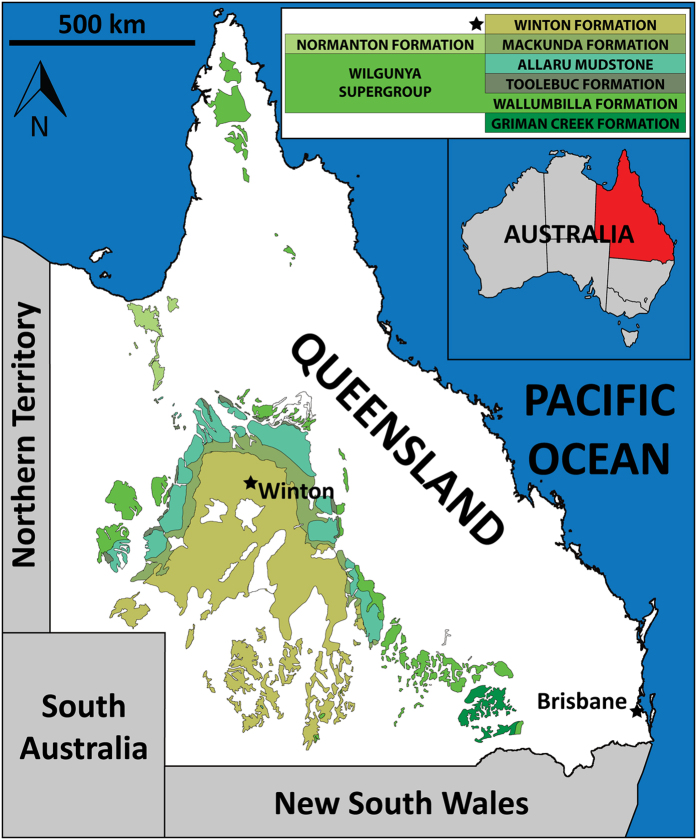
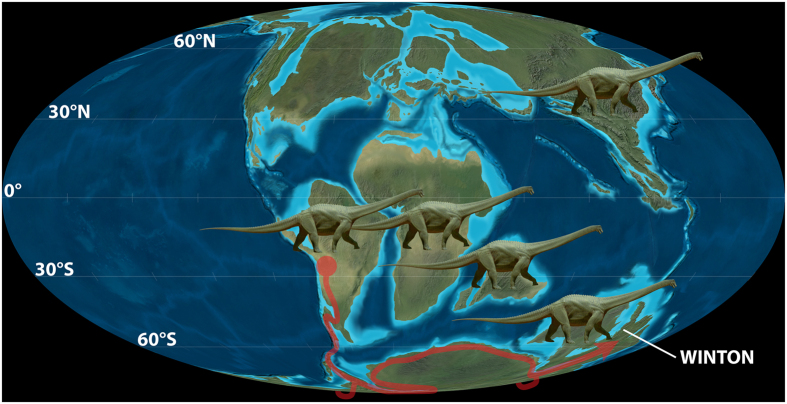
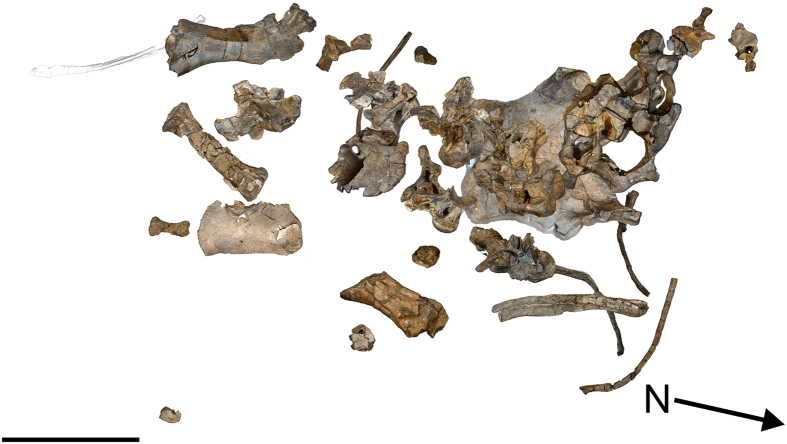
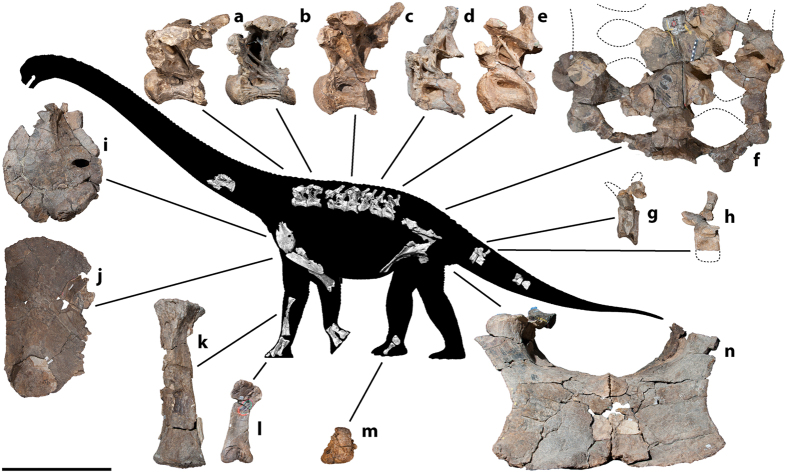
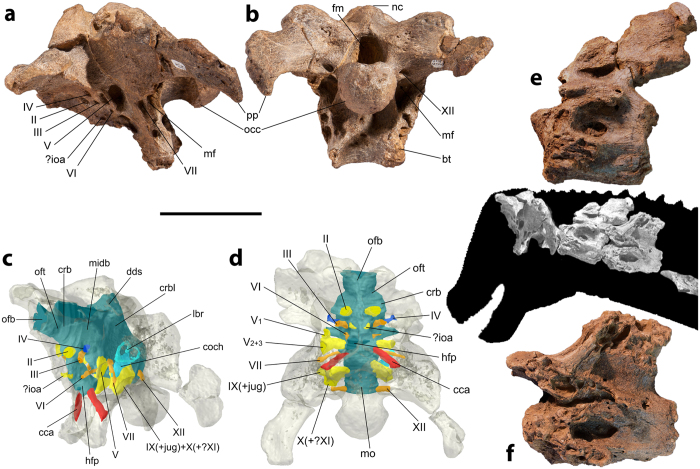
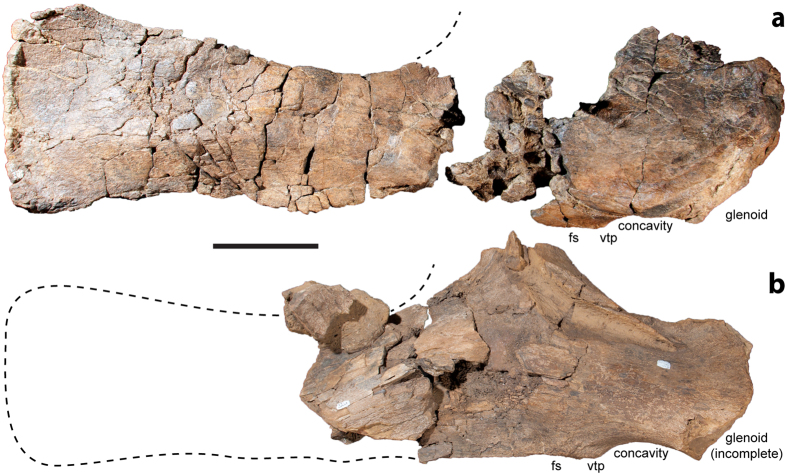
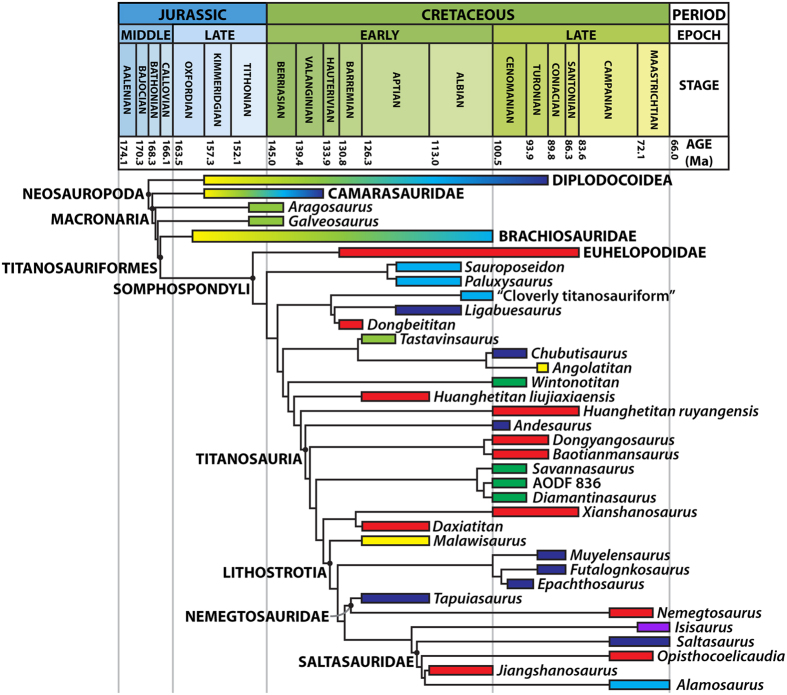
Australian dinosaurs have played a rare but controversial role in the debate surrounding the effect of Gondwanan break-up on Cretaceous dinosaur distribution. Major spatiotemporal gaps in the Gondwanan Cretaceous fossil record, coupled with taxon incompleteness, have hindered research on this effect, especially in Australia. Here we report on two new sauropod specimens from the early Late Cretaceous of Queensland, Australia, that have important implications for Cretaceous dinosaur palaeobiogeography. Savannasaurus elliottorum gen. et sp. nov. comprises one of the most complete Cretaceous sauropod skeletons ever found in Australia, whereas a new specimen of Diamantinasaurus matildae includes the first ever cranial remains of an Australian sauropod. The results of a new phylogenetic analysis, in which both Savannasaurus and Diamantinasaurus are recovered within Titanosauria, were used as the basis for a quantitative palaeobiogeographical analysis of macronarian sauropods. Titanosaurs achieved a worldwide distribution by at least 125 million years ago, suggesting that mid-Cretaceous Australian sauropods represent remnants of clades which were widespread during the Early Cretaceous. These lineages would have entered Australasia via dispersal from South America, presumably across Antarctica. High latitude sauropod dispersal might have been facilitated by Albian-Turonian warming that lifted a palaeoclimatic dispersal barrier between Antarctica and South America.
澳大利亚恐龙在冈瓦纳大陆分裂对白垩纪恐龙分布影响的争论中扮演了一个罕见但有争议的角色。冈瓦纳大陆白垩纪化石记录在时空上存在重大差距,加上分类群不完全,这阻碍了对这一影响的研究,尤其是在澳大利亚。在这里,我们报告了来自澳大利亚昆士兰州晚白垩世的两个新蜥脚类恐龙标本,它们对白垩纪恐龙古生物地理学有重要意义。Savannasaurus elliottorum gen. et sp. nov. 是在澳大利亚发现的最完整的白垩纪蜥脚类恐龙骨架之一,而 Diamantinasaurus matildae 的一个新标本包括了澳大利亚蜥脚类恐龙的第一个颅后骨骼。新系统发育分析的结果表明,Savannasaurus 和 Diamantinasaurus 都属于泰坦巨龙类,这为大型蜥脚类恐龙的定量古生物地理学分析提供了依据。泰坦巨龙类至少在 1.25 亿年前就已经实现了全球分布,这表明中白垩世的澳大利亚蜥脚类恐龙代表了在早白垩世广泛分布的分支的残余。这些谱系可能是通过从南美洲扩散进入澳大利亚,大概是穿过南极洲。阿尔比阶-土仑阶的变暖可能为高纬度的蜥脚类恐龙的扩散提供了便利,因为这消除了南极洲和南美洲之间的古气候扩散障碍。