Dacic Sanja, Villaruz Liza C, Abberbock Shira, Mahaffey Alyssa, Incharoen Pimpin, Nikiforova Marina N
University of Pittsburgh Medical Center, Department of Pathology, Pittsburgh, PA, USA.
University of Pittsburgh Cancer Institute, Pittsburgh, PA, USA.
Oncotarget. 2016 Dec 13;7(50):82943-82952. doi: 10.18632/oncotarget.12705.
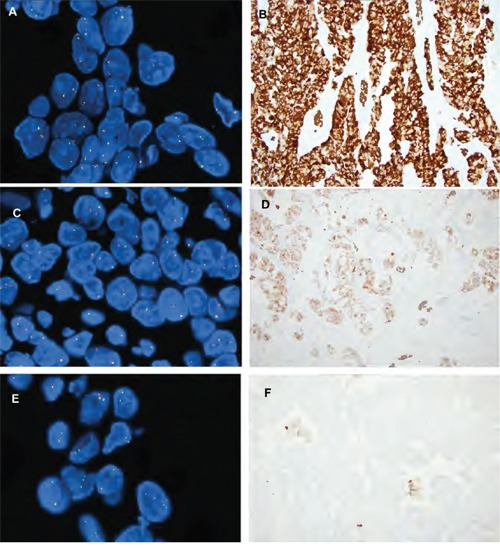
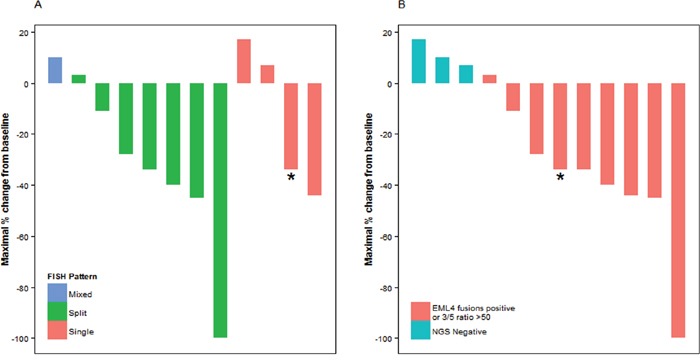
Break-apart ALK FISH probe is the FDA approved approach for detection of ALK rearrangements in lung carcinoma patients who may benefit from ALK kinase inhibitors. The FISH assay can be technically challenging and difficult to interpret. ALK immunohistochemistry and next generation sequencing have been proposed as alternative approaches. In this study, we compared various ALK -FISH patterns to next -generation sequencing (NGS) for gene fusion detection, ALK immunohistochemistry (IHC) and tumor responses to crizotinib. 72 (4%) of 2116 lung adenocarcinoma were positive by ALK- FISH. Of 28 ALK-FISH positive cases selected for the study, FISH patterns included 15 (54%) cases with split signal, 10 (36%) with single orange signal and 3 (10%) with "mixed pattern". 12 (80%) cases with split signal and 4 (40%) cases with single orange signal were positive by NGS and IHC, while mixed cases were all negative. Mutation analysis of discordant cases revealed multiple mutations including oncogenic mutations in EGFR, KRAS, BRAF and ATM genes. All discordant cases in groups with split and mixed signal showed a lower number of cells with rearrangement (mean 28.5%; range 20.5-36.9%). No statistically significant association between response to crizotinib and FISH patterns was observed (p=0.73). In contrast, NGS fusion positive cases were associated with more responses to crizotinib than NGS negative cases (p= 0.016). Our study suggests that ALK FISH alone may not be the most reliable assay for detection of ALK gene rearrangements, and probably should be used in parallel with ALK IHC and NGS for detection of gene fusions and mutations.
断裂型ALK FISH探针是美国食品药品监督管理局(FDA)批准的用于检测肺癌患者中ALK重排的方法,这些患者可能从ALK激酶抑制剂中获益。FISH检测在技术上可能具有挑战性且难以解读。ALK免疫组织化学和下一代测序已被提议作为替代方法。在本研究中,我们比较了各种ALK -FISH模式与下一代测序(NGS)用于基因融合检测、ALK免疫组织化学(IHC)以及肿瘤对克唑替尼的反应。2116例肺腺癌中有72例(4%)ALK-FISH呈阳性。在为该研究挑选的28例ALK-FISH阳性病例中,FISH模式包括15例(54%)信号分离、10例(36%)单个橙色信号和3例(10%)“混合模式”。12例(80%)信号分离病例和4例(40%)单个橙色信号病例通过NGS和IHC呈阳性,而混合病例均为阴性。对不一致病例的突变分析揭示了多种突变,包括EGFR、KRAS、BRAF和ATM基因中的致癌突变。信号分离和混合信号组中的所有不一致病例显示重排细胞数量较少(平均28.5%;范围20.5 - 36.9%)。未观察到克唑替尼反应与FISH模式之间存在统计学显著关联(p = 0.73)。相比之下,NGS融合阳性病例比NGS阴性病例对克唑替尼的反应更多(p = 0.016)。我们的研究表明,单独的ALK FISH可能不是检测ALK基因重排最可靠的检测方法,可能应与ALK IHC和NGS并行使用以检测基因融合和突变。