Évain Andéol, Argelaguet Ferran, Casiez Géry, Roussel Nicolas, Lécuyer Anatole
Université de Rennes 1 Rennes, France.
Inria Rennes Rennes, France.
Front Neurosci. 2016 Oct 7;10:454. doi: 10.3389/fnins.2016.00454. eCollection 2016.
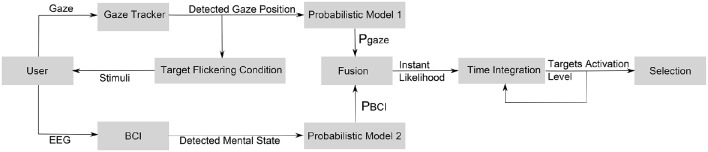
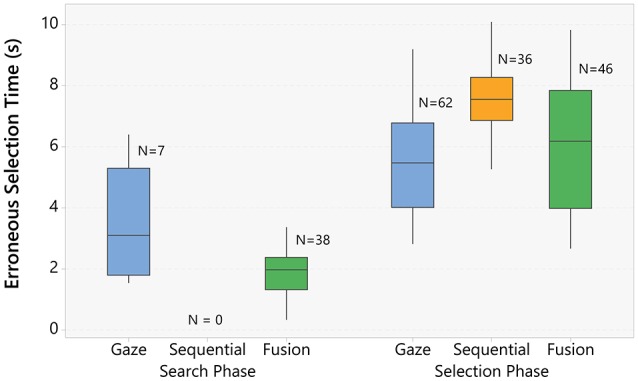
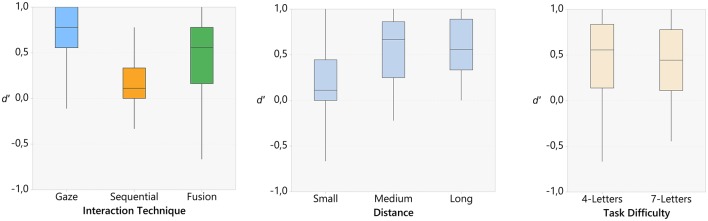
Gaze-based interfaces and Brain-Computer Interfaces (BCIs) allow for hands-free human-computer interaction. In this paper, we investigate the combination of gaze and BCIs. We propose a novel selection technique for 2D target acquisition based on input fusion. This new approach combines the probabilistic models for each input, in order to better estimate the intent of the user. We evaluated its performance against the existing gaze and brain-computer interaction techniques. Twelve participants took part in our study, in which they had to search and select 2D targets with each of the evaluated techniques. Our fusion-based hybrid interaction technique was found to be more reliable than the previous gaze and BCI hybrid interaction techniques for 10 participants over 12, while being 29% faster on average. However, similarly to what has been observed in hybrid gaze-and-speech interaction, gaze-only interaction technique still provides the best performance. Our results should encourage the use of input fusion, as opposed to sequential interaction, in order to design better hybrid interfaces.
基于注视的界面和脑机接口(BCI)实现了免手动人机交互。在本文中,我们研究了注视与脑机接口的结合。我们提出了一种基于输入融合的二维目标获取新选择技术。这种新方法结合了每个输入的概率模型,以便更好地估计用户意图。我们将其性能与现有的注视和脑机交互技术进行了评估。12名参与者参与了我们的研究,他们必须使用每种评估技术搜索并选择二维目标。结果发现,对于12名参与者中的10名,我们基于融合的混合交互技术比之前的注视和脑机接口混合交互技术更可靠,同时平均速度快29%。然而,与在注视与语音混合交互中观察到的情况类似,仅注视交互技术仍然提供最佳性能。我们的结果应鼓励使用输入融合而非顺序交互,以设计更好的混合界面。