Hu Liwen, Yao Xinyue, Shen Yi
Department of Cardiothoracic Surgery, Jinling Hospital, School of Clinical Medicine, Nanjing University, Nanjing, Jiangsu Province, P. R. China.
Institute of Laboratory Medicine, Jinling Hospital, School of Clinical Medicine, Nanjing University, Nanjing, Jiangsu Province, P. R. China.
Sci Rep. 2016 Oct 24;6:35859. doi: 10.1038/srep35859.
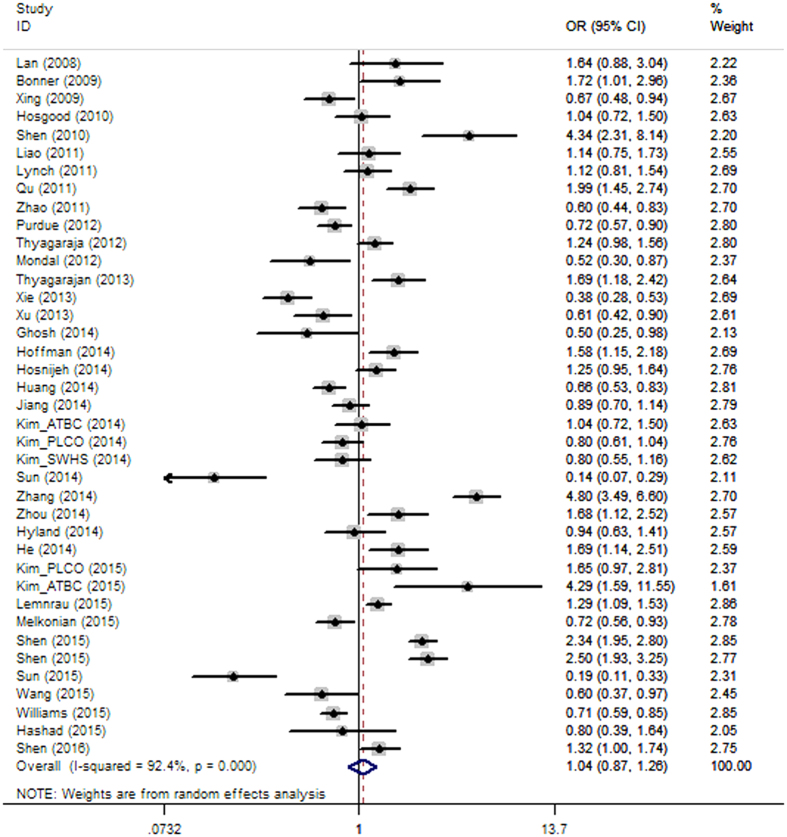
Accumulating epidemiological evidence indicates that the quantitative changes in human mitochondrial DNA (mtDNA) copy number could affect the genetic susceptibility of malignancies in a tumor-specific manner, but the results are still elusive. To provide a more precise estimation on the association between mtDNA copy number and risk of diverse malignancies, a meta-analysis was conducted by calculating the pooled odds ratios (OR) and the 95% confidence intervals (95% CI). A total of 36 case-control studies involving 11,847 cases and 15,438 controls were finally included in the meta-analysis. Overall analysis of all studies suggested no significant association between mtDNA content and cancer risk (OR = 1.044, 95% CI = 0.866-1.260, P = 0.651). Subgroup analyses by cancer types showed an obvious positive association between mtDNA content and lymphoma and breast cancer (OR = 1.645, 95% CI = 1.117-2.421, P = 0.012; OR = 1.721, 95% CI = 1.130-2.622, P = 0.011, respectively), and a negative association for hepatic carcinoma. Stratified analyses by other confounding factors also found increased cancer risk in people with drinking addiction. Further analysis using studies of quartiles found that populations with the highest mtDNA content may be under more obvious risk of melanoma and that Western populations were more susceptible than Asians.
越来越多的流行病学证据表明,人类线粒体DNA(mtDNA)拷贝数的定量变化可能以肿瘤特异性方式影响恶性肿瘤的遗传易感性,但结果仍不明确。为了更精确地估计mtDNA拷贝数与各种恶性肿瘤风险之间的关联,我们通过计算合并优势比(OR)和95%置信区间(95%CI)进行了一项荟萃分析。最终,共有36项病例对照研究,涉及11847例病例和15438例对照被纳入荟萃分析。对所有研究的总体分析表明,mtDNA含量与癌症风险之间无显著关联(OR = 1.044,95%CI = 0.866 - 1.260,P = 0.651)。按癌症类型进行的亚组分析显示,mtDNA含量与淋巴瘤和乳腺癌之间存在明显的正相关(OR分别为1.645,95%CI = 1.117 - 2.421,P = 0.012;OR为1.721,95%CI = 1.130 - 2.622,P = 0.011),而与肝癌呈负相关。按其他混杂因素进行的分层分析也发现,酗酒者患癌风险增加。使用四分位数研究的进一步分析发现,mtDNA含量最高的人群可能面临更明显的黑色素瘤风险,并且西方人群比亚洲人群更易患癌。