Toomey Sinead, Madden Stephen F, Furney Simon J, Fan Yue, McCormack Mark, Stapleton Carragh, Cremona Mattia, Cavalleri Gianpiero L, Milewska Malgorzata, Elster Naomi, Carr Aoife, Fay Joanna, Kay Elaine W, Kennedy Susan, Crown John, Gallagher William M, Hennessy Bryan T, Eustace Alex J
Medical Oncology Group, Department of Molecular Medicine, Royal College of Surgeons in Ireland, Ireland.
Population Health Sciences Division, Royal College of Surgeons in Ireland, Ireland.
Oncotarget. 2016 Nov 15;7(46):75518-75525. doi: 10.18632/oncotarget.12782.
Trastuzumab treatment for women with HER2-positive breast cancer (BC) resulted in the significant improvement of both relapse free survival (RFS) and overall survival (OS). However, many women who are classified as HER2-positive do not respond. Many studies have focused on the role of somatic mutations rather than germline polymorphisms in trastuzumab resistance.
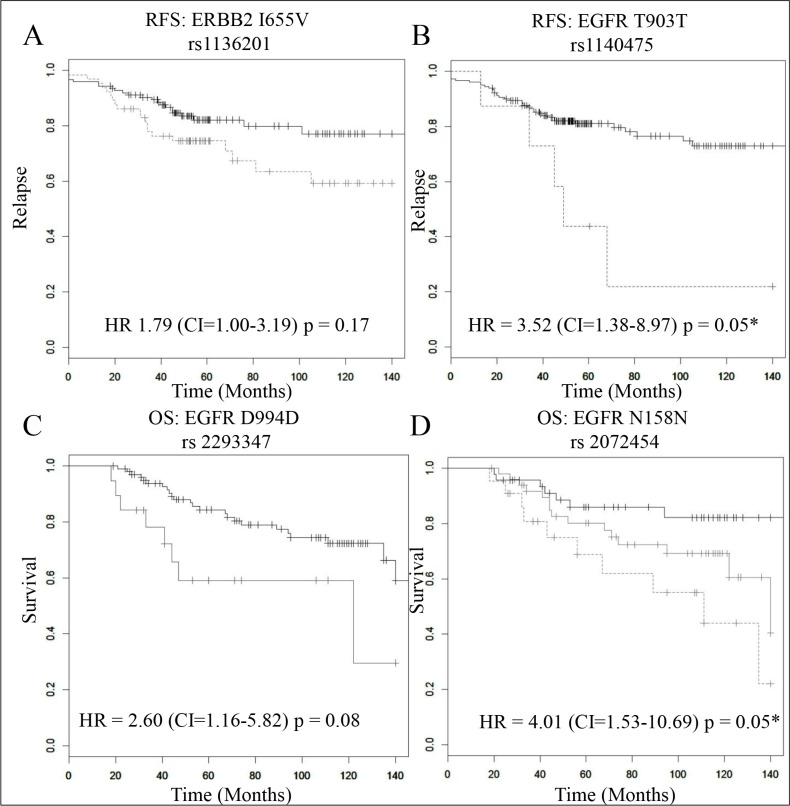
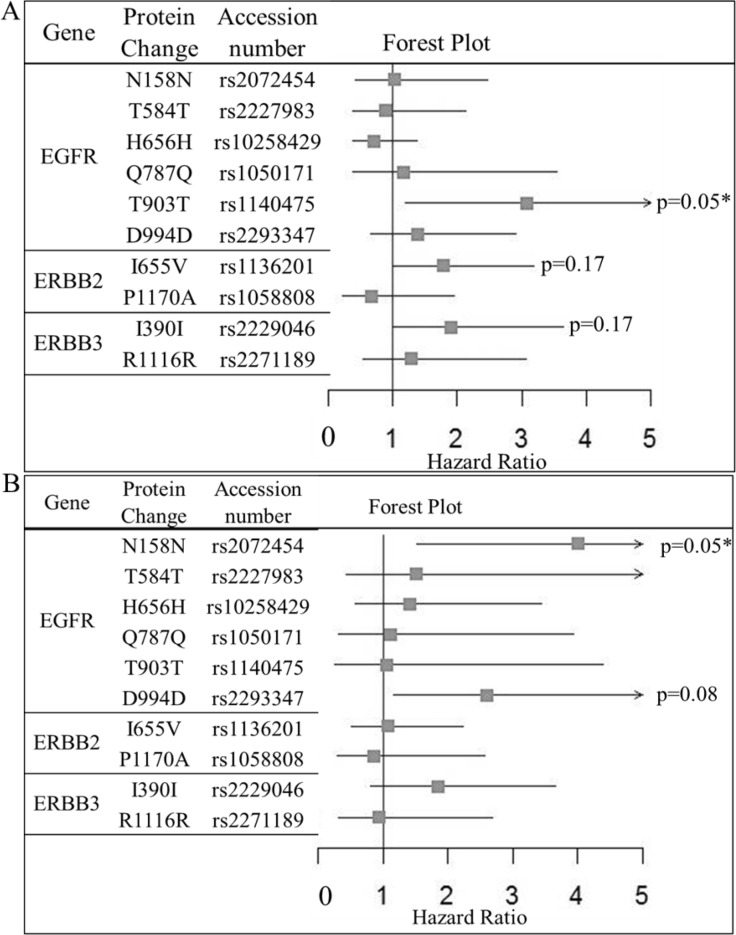
We completed an Agena MassArray screen of 10 ERBB-family single nucleotide polymorphisms (SNPs) in 194 adjuvant trastuzumab treated HER2-positive BC patients. SNPs in EGFR genes have a significant association with RFS and OS. Patients with the minor allele of EGFR N158N had significantly worse OS (hazard ratio (HR) = 4.01, (confidence interval (CI) = 1.53- 10.69), p = 0.05) relative to those with either the heterozygous or wild-type (WT) allele. Patients with the minor allele of EGFR T903T (HR = 3.52, (CI = 1.38- 8.97), p = 0.05) had worse RFS relative to those with either the heterozygous or WT allele.
Using next generation sequencing (NGS) we identified ERBB-family (EGFR, HER2, HER3 and HER4) single nucleotide polymorphisms (SNPs) that occurred in 2 or more patients of a 32 HER2-positive BC patient cohort. Agena MassArray analysis confirmed the frequency of these SNPs in 194 women with HER2-positive BC who received trastuzumab in the adjuvant setting. Using Kaplan-Meier estimates and Cox regression analysis we correlated the presence of ERBB-family SNPs with both RFS and OS.
The presence of germline ERBB-family SNPs may play an important role in how a patient responds to adjuvant trastuzumab, and clinical assessment of these SNPs by targeted genetic screening of patients' blood may be important to stratify patients for treatment.
曲妥珠单抗治疗HER2阳性乳腺癌(BC)女性患者可显著改善无复发生存期(RFS)和总生存期(OS)。然而,许多被归类为HER2阳性的女性并无反应。许多研究聚焦于体细胞突变而非种系多态性在曲妥珠单抗耐药中的作用。
我们对194例接受辅助曲妥珠单抗治疗的HER2阳性BC患者进行了Agena MassArray检测,筛查10个ERBB家族单核苷酸多态性(SNP)。EGFR基因中的SNP与RFS和OS显著相关。与杂合子或野生型(WT)等位基因的患者相比,携带EGFR N158N次要等位基因的患者OS显著更差(风险比(HR)=4.01,(置信区间(CI)=1.53 - 10.69),p = 0.05)。与杂合子或WT等位基因的患者相比,携带EGFR T903T次要等位基因的患者RFS更差(HR = 3.52,(CI = 1.38 - 8.97),p = 0.05)。
我们使用下一代测序(NGS)在32例HER2阳性BC患者队列中识别出在2例或更多患者中出现的ERBB家族(EGFR、HER2、HER3和HER4)单核苷酸多态性(SNP)。Agena MassArray分析证实了这些SNP在194例接受辅助曲妥珠单抗治疗的HER2阳性BC女性中的频率。我们使用Kaplan-Meier估计和Cox回归分析将ERBB家族SNP的存在与RFS和OS进行关联。
种系ERBB家族SNP的存在可能在患者对辅助曲妥珠单抗的反应中起重要作用,通过对患者血液进行靶向基因筛查对这些SNP进行临床评估,对于患者分层治疗可能很重要。