Škugor Adrijana, Tveiten Helge, Johnsen Hanne, Andersen Øivind
Norwegian University of Life Sciences (NMBU), PO Box 5003, N-1430, Ås, Norway.
Nofima, PO Box 6122, N-9291,, Tromsø, Norway.
BMC Evol Biol. 2016 Oct 26;16(1):232. doi: 10.1186/s12862-016-0809-7.
The primordial germ cells (PGCs) giving rise to gametes are determined by two different mechanisms in vertebrates. While the germ cell fate in mammals and salamanders is induced by zygotic signals, maternally delivered germ cell determinants specify the PGCs in birds, frogs and teleost fish. Assembly of the germ plasm in the oocyte is organized by the single Buc in zebrafish, named Velo1 in Xenopus, and by Oskar in Drosophila. Secondary loss of oskar in several insect lineages coincides with changes in germline determination strategies, while the presence of buc in mammals suggests functions not associated with germline formation.
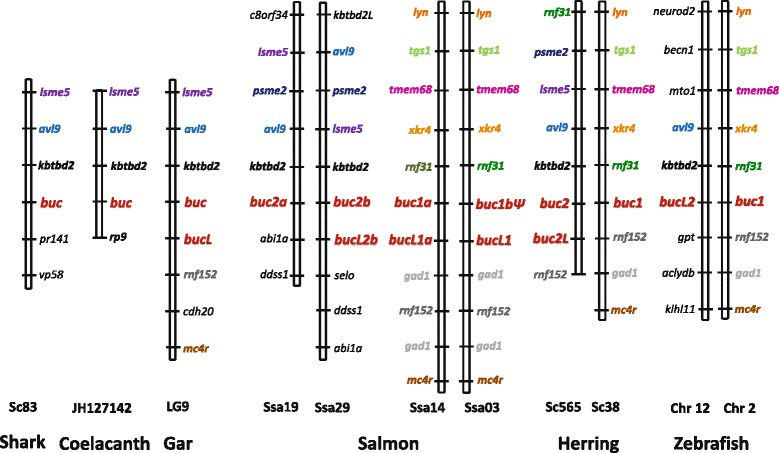
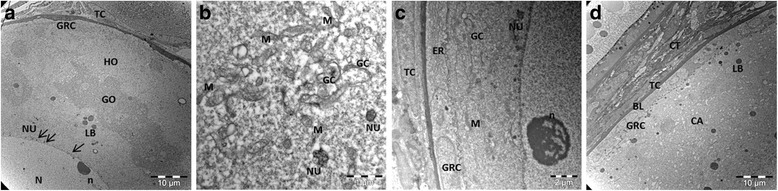
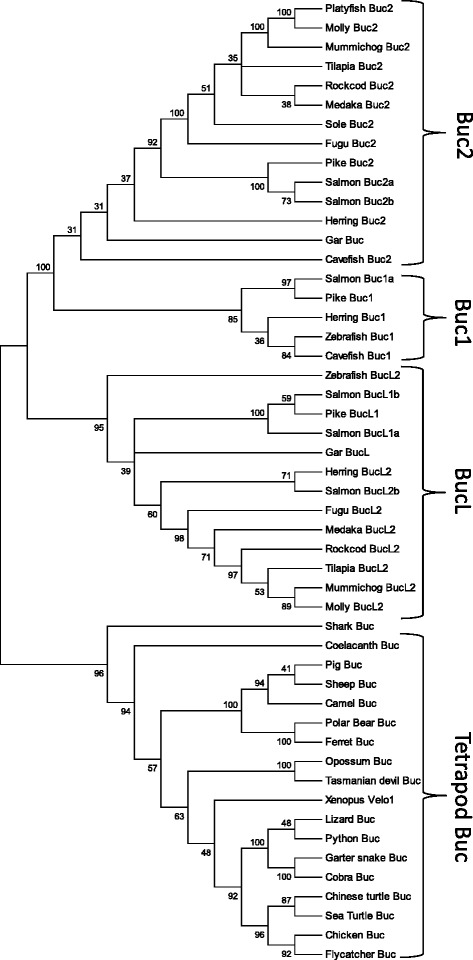
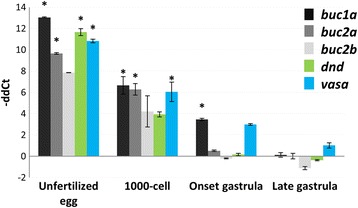
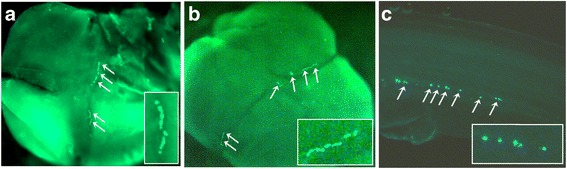
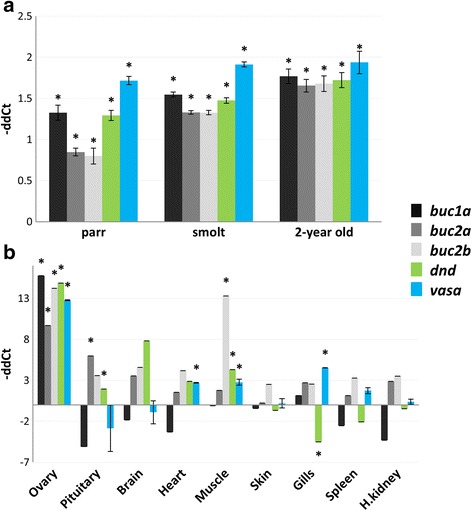
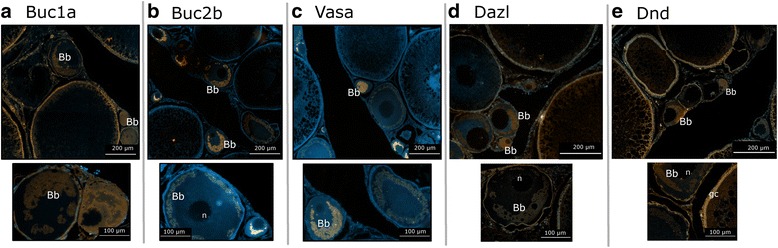
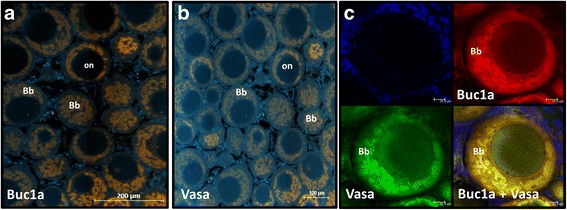
To clarify the evolutionary history of buc we searched for the gene in genomes available from various chordates. No buc sequence was found in lamprey and chordate invertebrates, while the gene was identified in a conserved syntenic region in elephant shark, spotted gar, teleosts, Comoran coelacanth and most tetrapods. Rodents have probably lost the buc gene, while a premature translation stop was found in primates and in Mexican axolotl lacking germ plasm. In contrast, several buc and buc-like (bucL) paralogs were identified in the teleosts examined, including zebrafish, and the tetraploid genome of Atlantic salmon harbors seven buc and bucL genes. Maternal salmon buc1a, buc2a and buc2b mRNAs were abundant in unfertilized eggs together with dnd and vasa mRNAs. Immunostained salmon Buc1a was restricted to cleavage furrows in 4-cell stage embryos similar to a fluorescent zebrafish Buc construct injected in salmon embryos. Salmon Buc1a and Buc2a localized together with DnD, Vasa and Dazl within the Balbiani body of early oocytes.
Buc probably originated more than 400 million years ago and might have played an ancestral role in assembling germ plasm. Functional redundancy or subfunctionalization of salmon Buc paralogs in germline formation is suggested by the maternally inherited mRNAs of three salmon buc genes, the localized Buc1a in the cleavage furrows and the distribution of Buc1a and Buc2a in the Balbiani body during oogenesis. The extra-ovarian expression of salmon buc genes and the presence of a second zebrafish bucL gene suggest additional functions not related to germ cell specification.
脊椎动物中,产生配子的原始生殖细胞(PGCs)由两种不同机制决定。在哺乳动物和蝾螈中,生殖细胞命运由合子信号诱导,而在鸟类、青蛙和硬骨鱼中,母源传递的生殖细胞决定因子指定了PGCs。斑马鱼中由单个Buc(非洲爪蟾中称为Velo1,果蝇中称为Oskar)组织卵母细胞中生殖质的组装。在几个昆虫谱系中,oskar的二次缺失与种系决定策略的变化一致,而哺乳动物中buc的存在表明其功能与种系形成无关。
为了阐明buc的进化历史,我们在各种脊索动物的可用基因组中搜索该基因。在七鳃鳗和脊索动物无脊椎动物中未发现buc序列,而在姥鲨、雀鳝、硬骨鱼、科莫罗腔棘鱼和大多数四足动物的保守同线区域中鉴定到了该基因。啮齿动物可能已丢失buc基因,而在灵长类动物和缺乏生殖质的墨西哥蝾螈中发现了过早的翻译终止。相反,在包括斑马鱼在内的所研究硬骨鱼中鉴定到了几个buc和类buc(bucL)旁系同源基因,大西洋鲑的四倍体基因组中有七个buc和bucL基因。母源的鲑鱼buc1a、buc2a和buc2b mRNA与dnd和vasa mRNA一起在未受精卵中大量存在。免疫染色的鲑鱼Buc1a局限于4细胞期胚胎的卵裂沟,类似于注射到鲑鱼胚胎中的荧光斑马鱼Buc构建体。鲑鱼Buc1a和Buc2a与DnD、Vasa和Dazl一起定位于早期卵母细胞的巴尔比亚尼小体中。
Buc可能起源于4亿多年前,可能在组装生殖质中起了祖先作用。三个鲑鱼buc基因的母源遗传mRNA、卵裂沟中定位的Buc1a以及卵子发生过程中Buc1a和Buc2a在巴尔比亚尼小体中的分布,提示了鲑鱼Buc旁系同源基因在种系形成中的功能冗余或亚功能化。鲑鱼buc基因的卵巢外表达以及第二个斑马鱼bucL基因的存在表明存在与生殖细胞特化无关的其他功能。