Roberts Natalie B, Juntti Scott A, Coyle Kaitlin P, Dumont Bethany L, Stanley M Kaitlyn, Ryan Allyson Q, Fernald Russell D, Roberts Reade B
Department of Biological Sciences and W. M. Keck Center for Behavioral Biology, North Carolina State University, Raleigh, NC, USA.
Department of Biology, Stanford University, Stanford, CA, USA.
BMC Genomics. 2016 Oct 26;17(1):835. doi: 10.1186/s12864-016-3177-1.
The East African riverine cichlid species Astatotilapia burtoni serves as an important laboratory model for sexually dimorphic physiology and behavior, and also serves as an outgroup species for the explosive adaptive radiations of cichlid species in Lake Malawi and Lake Victoria. An astounding diversity of genetic sex determination systems have been revealed within the adaptive radiation of East African cichlids thus far, including polygenic sex determination systems involving the epistatic interaction of multiple, independently segregating sex determination alleles. However, sex determination has remained unmapped in A. burtoni. Here we present mapping results supporting the presence of multiple, novel sex determination alleles, and thus the presence of polygenic sex determination in A. burtoni.
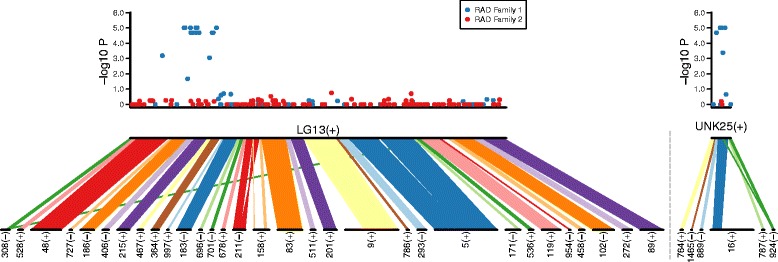
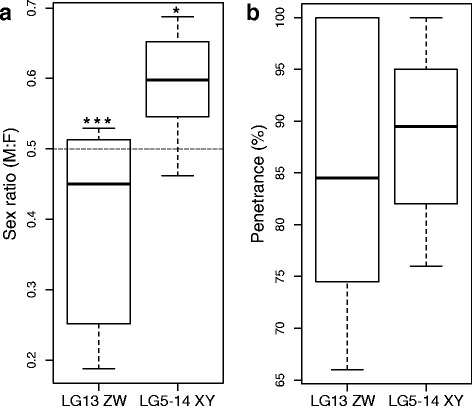
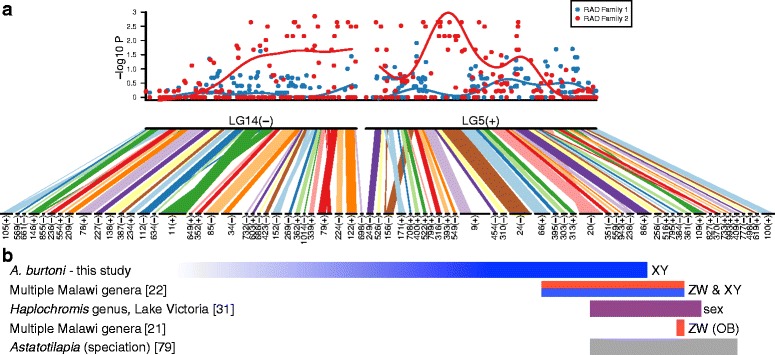
Using mapping in small families in conjunction with restriction-site associated DNA sequencing strategies, we identify associations with sex at loci on linkage group 13 and linkage group 5-14. Inheritance patterns support an XY sex determination system on linkage group 5-14 (a chromosome fusion relative to other cichlids studied), and an XYW system on linkage group 13, and these associations are replicated in multiple families. Additionally, combining our genetic data with comparative genomic analysis identifies another fusion that is unassociated with sex, with linkage group 8-24 and linkage group 16-21 fused in A. burtoni relative to other East African cichlid species.
We identify genetic signals supporting the presence of three previously unidentified sex determination alleles at two loci in the species A. burtoni, strongly supporting the presence of polygenic sex determination system in the species. These results provide a foundation for future mapping of multiple sex determination genes and their interactions. A better understanding of sex determination in A. burtoni provides important context for their use in behavioral studies, as well as studies of the evolution of genetic sex determination and sexual conflicts in East African cichlids.
东非河流丽鱼科物种伯氏非鲫是性二态生理和行为的重要实验室模型,也是马拉维湖和维多利亚湖丽鱼科物种爆发式适应性辐射的外类群物种。迄今为止,在东非丽鱼科的适应性辐射中已揭示出惊人多样的遗传性别决定系统,包括涉及多个独立分离的性别决定等位基因上位相互作用的多基因性别决定系统。然而,伯氏非鲫的性别决定基因尚未定位。在此,我们展示的定位结果支持存在多个新的性别决定等位基因,从而证明伯氏非鲫存在多基因性别决定。
通过在小家系中进行定位并结合限制性位点相关DNA测序策略,我们在连锁群13和连锁群5 - 14上鉴定出与性别相关的位点。遗传模式支持连锁群5 - 14(相对于其他研究过的丽鱼科是染色体融合)上的XY性别决定系统,以及连锁群13上的XYW系统,并且这些关联在多个家系中得到重复。此外,将我们的遗传数据与比较基因组分析相结合,识别出另一个与性别无关的融合,相对于其他东非丽鱼科物种,伯氏非鲫中连锁群8 - 24和连锁群16 - 21发生了融合。
我们鉴定出遗传信号,支持在伯氏非鲫物种的两个位点存在三个先前未鉴定的性别决定等位基因,有力地支持了该物种中多基因性别决定系统的存在。这些结果为未来多个性别决定基因及其相互作用的定位奠定了基础。更好地理解伯氏非鲫的性别决定,为其在行为研究以及东非丽鱼科遗传性别决定和性冲突进化研究中的应用提供了重要背景。