Theelen Willemijn Sme, Mittempergher Lorenza, Willems Stefan M, Bosma Astrid J, Peters Dennis Dgc, van der Noort Vincent, Japenga Eva J, Peeters Ton, Koole Koos, Šuštić Tonći, Blaauwgeers J L, van Noesel Carel J, Bernards René, van den Heuvel Michel M
Department of Thoracic Oncology The Netherlands Cancer Institute Amsterdam The Netherlands.
Division of Molecular Carcinogenesis The Netherlands Cancer Institute Amsterdam The Netherlands.
J Pathol Clin Res. 2016 Aug 13;2(4):223-233. doi: 10.1002/cjp2.51. eCollection 2016 Oct.
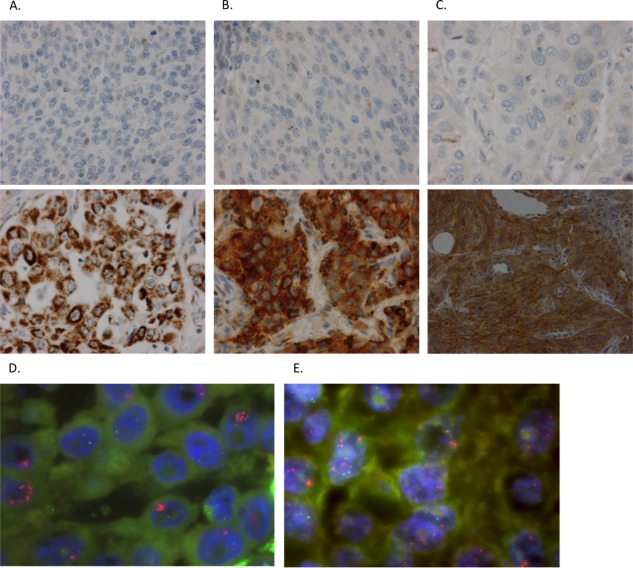
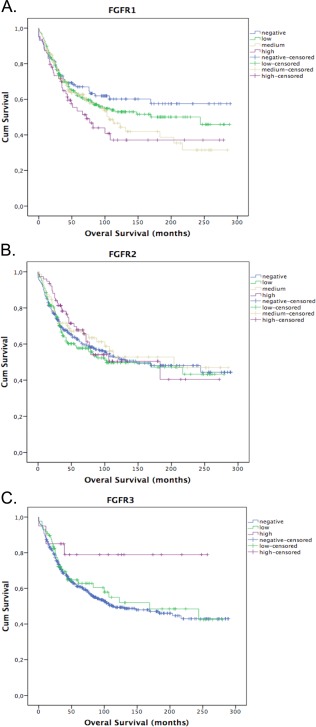
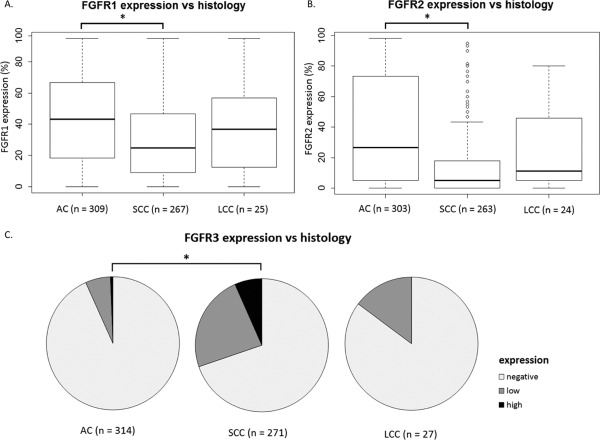
This study aimed to determine protein expression levels of fibroblast growth factor receptors (FGFR) 1, 2 and 3 in early stage non-small cell lung cancer (NSCLC). Additionally, a screen to define the frequency of translocation and amplification was performed. Archived tissues from 653 NSCLC samples (adenocarcinoma (AC), squamous cell carcinoma (SCC) and large cell carcinoma (LCC)) were analysed with immunohistochemistry (IHC) for expression of FGFR1, 2 and 3. Expression levels of FGFR1, 2 and 3 were correlated with clinicopathological features. The presence of translocation was detected by RT-PCR and amplification was detected by fluorescence hybridization. FGFR1, 2 and 3 proteins were highly expressed in 64 (10.6%), 76 (12.9%) and 20 (3.3%) NSCLC tumour samples, respectively. Protein expression of FGFR1 was significantly related to worse overall survival in NSCLC. Furthermore, FGFR1 protein expression was associated with light smoking and histological subtype (AC), FGFR2 protein expression with female gender, younger age, histological subtype (AC) and lower tumour stage, and FGFR3 protein was significantly overexpressed in tumours of older patients and SCC histology. The fusion was detected in 3.0% (6/200) of NSCLC samples and the gene was amplified in 4.7% of IHC positive NSCLC samples (2/43). FGFR1, 2 and 3 proteins are expressed in a high number of early stage NSCLC and FGFR1 protein expression may serve as a prognostic biomarker. Recurrent translocations and amplifications in can be found in NSCLC. This study shows that FGFR family members are frequently aberrant in NSCLC and could be interesting therapeutic targets for the treatment of NSCLC.
本研究旨在确定成纤维细胞生长因子受体(FGFR)1、2和3在早期非小细胞肺癌(NSCLC)中的蛋白表达水平。此外,还进行了一项筛查以确定易位和扩增的频率。对653例NSCLC样本(腺癌(AC)、鳞状细胞癌(SCC)和大细胞癌(LCC))的存档组织进行免疫组织化学(IHC)分析,以检测FGFR1、2和3的表达。FGFR1、2和3的表达水平与临床病理特征相关。通过逆转录聚合酶链反应(RT-PCR)检测易位情况,通过荧光杂交检测扩增情况。FGFR1、2和3蛋白分别在64例(10.6%)、76例(12.9%)和20例(3.3%)NSCLC肿瘤样本中高表达。FGFR1的蛋白表达与NSCLC患者较差的总生存期显著相关。此外,FGFR1蛋白表达与轻度吸烟和组织学亚型(AC)相关,FGFR2蛋白表达与女性、较年轻年龄、组织学亚型(AC)和较低肿瘤分期相关,FGFR3蛋白在老年患者的肿瘤和SCC组织学中显著过表达。在3.0%(6/200)的NSCLC样本中检测到融合,在4.7%的IHC阳性NSCLC样本(2/43)中检测到基因扩增。FGFR1、2和3蛋白在大量早期NSCLC中表达,FGFR1蛋白表达可能作为一种预后生物标志物。在NSCLC中可发现FGFR的反复易位和扩增。本研究表明,FGFR家族成员在NSCLC中经常发生异常,可能是NSCLC治疗中有趣的治疗靶点。