Liu Chang, Eng Cathy, Shen Jianjun, Lu Yue, Takata Yoko, Mehdizadeh Amir, Chang George J, Rodriguez-Bigas Miguel A, Li Yanan, Chang Ping, Mao Yixiang, Hassan Manal M, Wang Fangyu, Li Donghui
Department of Gastrointestinal Medical Oncology, The University of Texas MD Anderson Cancer Center, Houston, Texas, USA.
Department of Gastroenterology and Hepatology, Jinling Hospital, Southern Medical University, Nanjing, China.
Oncotarget. 2016 Nov 15;7(46):76250-76260. doi: 10.18632/oncotarget.12841.
The study was aimed to evaluate the prognostic or predictive value of serum exosomal microRNAs (miRNAs) for tumor recurrence and response to adjuvant therapy in stage II and stage III colon cancer.
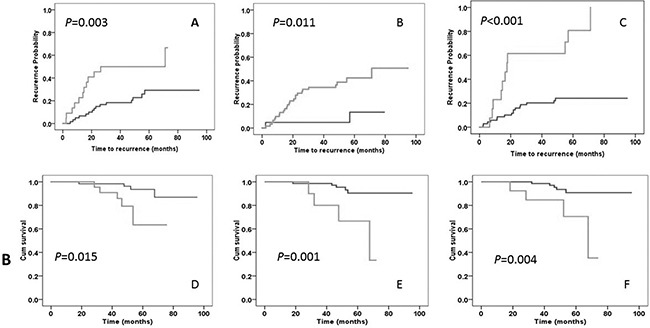
145 differentially expressed mature miRNAs were identified (P<0.05) and 10 top hits were carried forward in validation test. MiR-4772-3p was significantly under-expressed in 27 patients with recurrence compared to in 57 patients without recurrence (P=0.002). The reduced expression was significantly related to increased risk of tumor recurrence and risk of death. As a predictor for tumor recurrence, ROC analysis revealed the AUC (95% CI) was 0.72 (0.59-0.85, P=0.001) for lower level of miR-4772-3p compared to 0.63 (0.51-0.75, P=0.062) for tumor site and 0.65 (0.51-0.78,P=0.034) for lymph node status. Among 66/84 patients who received FOLFOX adjuvant therapy, 9/10 (90%) patients with a lower level and 10/56 (18%) patients with a higher level of miR-4772-3p had tumor recurrence (P<0.001).
Blood samples were prospectively collected from84 patients with stage II/III colon cancer after tumor resection and before adjuvant therapy. Serum exosomal miRNA profiles were determined by RNA sequencing. Differentially expressed mature miRNAs were identified between patients with or without tumor recurrence. The top hits were validated in individual RNA samples using quantitative real-time reverse transcription PCR.
Reduced expression of serum exosomal miR-4772-3p is a prognostic biomarker for tumor recurrence in stage II and stage III colon cancer patients. The predictive value of this marker for response to FOLFOX adjuvant therapy needs further investigation.
本研究旨在评估血清外泌体微小RNA(miRNA)对II期和III期结肠癌患者肿瘤复发及辅助治疗反应的预后或预测价值。
共鉴定出145个差异表达的成熟miRNA(P<0.05),其中10个最显著的miRNA进入验证试验。与57例未复发患者相比,27例复发患者中miR-4772-3p显著低表达(P=0.002)。其表达降低与肿瘤复发风险和死亡风险增加显著相关。作为肿瘤复发的预测指标,ROC分析显示,miR-4772-3p低水平组的AUC(95%CI)为0.72(0.59-0.85,P=0.001),而肿瘤部位组为0.63(0.51-0.75,P=0.062),淋巴结状态组为0.65(0.51-0.78,P=0.034)。在接受FOLFOX辅助治疗的66/84例患者中,miR-4772-3p水平较低的患者中有9/10(90%)发生肿瘤复发,而水平较高的患者中有10/56(18%)复发(P<0.001)。
前瞻性收集84例II/III期结肠癌患者肿瘤切除后及辅助治疗前的血样。通过RNA测序测定血清外泌体miRNA谱。在有或无肿瘤复发的患者之间鉴定差异表达的成熟miRNA。使用定量实时逆转录PCR在个体RNA样本中验证最显著的miRNA。
血清外泌体miR-4772-3p表达降低是II期和III期结肠癌患者肿瘤复发的预后生物标志物。该标志物对FOLFOX辅助治疗反应的预测价值有待进一步研究。