Yao Yu, Liu Jinghao, Li Lei, Yuan Yuan, Nan Kejun, Wu Xin, Zhang Zhenyu, Wu Yi, Li Xin, Zhu Jiaqi, Meng Xuehong, Wei Longgang, Chen Jun, Jiang Zhi
Department of Medical Oncology, The First Affiliated Hospital of Xi'an Jiaotong University, Shanxi, China.
Department of Lung Cancer Surgery, Tianjin Key Laboratory of Lung Cancer Metastasis and Tumor Microenvironment, Tianjin Lung Cancer Institute, Tianjin Medical University General Hospital, Tianjin, China.
Oncotarget. 2017 Jan 10;8(2):2130-2140. doi: 10.18632/oncotarget.12883.
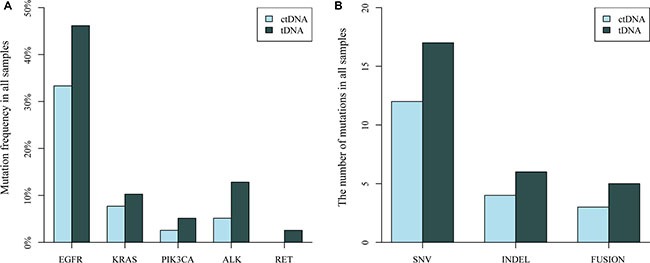
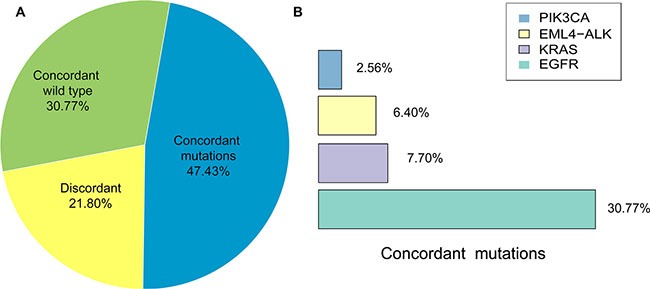
Circulating tumor DNA (ctDNA) isolated from plasma has great potential in identification of gene mutation in non-small cell lung cancers (NSCLC), which is a non-invasive technique and can avoid the inherent shortcomings of tissue biopsy. However the ability of NGS to detect gene mutation in plasma ctDNA has not been broadly explored. To assess the diagnostic ability of ctDNA for the total mutation profile, including single nucleotide variations (SNVs), insertions and deletions (indels) and gene rearrangements, we performed a targeted DNA sequencing approach to screen NSCLC related driver gene mutations in both tissue biopsies and matched blood plasma samples from 39 advanced NSCLC patients from China. The sensitivity of EGFR, KRAS, PIK3CA mutations and gene rearrangements detected in plasma ctDNA was 70.6%, 75%, 50% and 60%, respectively and the overall concordance of gene mutations between tissue DNA and plasma ctDNA was 78.21%. Our data provide evidence that ctDNA in plasma is likely to become an alternative source for cancer-related mutations profiling in advanced NSCLC patients and targeted sequencing of ctDNA offers a promising perspective on precise diagnostics and may serve as a feasible option for clinical monitoring of NSCLC patients.
从血浆中分离出的循环肿瘤DNA(ctDNA)在非小细胞肺癌(NSCLC)基因突变鉴定方面具有巨大潜力,这是一种非侵入性技术,可避免组织活检的固有缺点。然而,二代测序(NGS)检测血浆ctDNA中基因突变的能力尚未得到广泛探索。为了评估ctDNA对包括单核苷酸变异(SNV)、插入和缺失(indel)以及基因重排在内的总突变谱的诊断能力,我们采用靶向DNA测序方法,对来自39名中国晚期NSCLC患者的组织活检样本和配对血浆样本中的NSCLC相关驱动基因突变进行筛查。在血浆ctDNA中检测到的EGFR、KRAS、PIK3CA突变和基因重排的敏感性分别为70.6%、75%、50%和60%,组织DNA与血浆ctDNA之间基因突变的总体一致性为78.21%。我们的数据表明,血浆中的ctDNA可能成为晚期NSCLC患者癌症相关突变分析的替代来源,ctDNA的靶向测序为精确诊断提供了一个有前景的方向,并且可能作为NSCLC患者临床监测的可行选择。