Korenberg J R, Engels W R
Proc Natl Acad Sci U S A. 1978 Jul;75(7):3382-6. doi: 10.1073/pnas.75.7.3382.
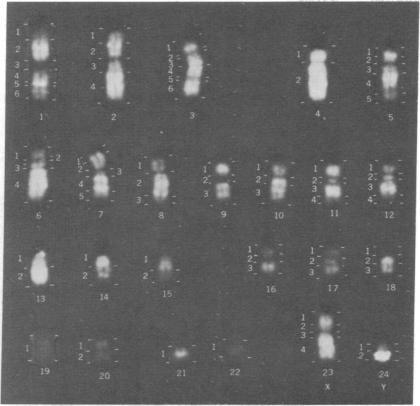
Human chromosomes were labeled with base-specific radioactive DNA precursors and examined autoradiographically to measure their DNA content and base ratio (percentage A-T base pairs). The requirement that incorporation of labeled bases be uniform during DNA synthesis was met by the use of inhibitors of de novo synthesis of DNA precursors. The genome was subdivided into 75 segments based on quinacrine banding, and the base ratio of each was calculated by a method that corrects for bias due to the scatter of grains about their source. Estimates of base ratio are shown to be sufficiently precise to detect variability among chromosomes and among segments within a chromosome. Analysis of these data and of measurements of the quinacrine fluorescence intensity of segments leads to the following conclusions. Base ratio is positively correlated with brightness, as predicted from independent in vitro studies. Larger chromosomes tend to have higher base ratios and to be brighter than smaller ones. The best prediction of the brightness of a segment must take into account not only its base ratio but also its DNA content. To explain these results, we suggest an evolutionary model in which chromosomes containing repeated sequences of A-T-rich DNA tend to grow by means of unequal sister chromatid and meiotic exchanges.
用人染色体特异性放射性DNA前体进行标记,并通过放射自显影检查以测量其DNA含量和碱基比率(A-T碱基对的百分比)。通过使用DNA前体从头合成抑制剂,满足了DNA合成过程中标记碱基掺入均匀的要求。根据喹吖因带型,将基因组细分为75个片段,并通过一种校正由于颗粒围绕其来源的散射而产生偏差的方法计算每个片段的碱基比率。结果表明,碱基比率的估计足够精确,能够检测染色体之间以及染色体内各片段之间的变异性。对这些数据以及片段喹吖因荧光强度测量结果的分析得出以下结论。正如独立的体外研究所预测的那样,碱基比率与亮度呈正相关。较大的染色体往往具有较高的碱基比率,并且比较小的染色体更亮。对一个片段亮度的最佳预测不仅必须考虑其碱基比率,还必须考虑其DNA含量。为了解释这些结果,我们提出了一个进化模型,其中包含富含A-T的DNA重复序列的染色体倾向于通过不等姐妹染色单体和减数分裂交换而生长。