Chau Stephanie Lynn, Alabaster Amy, Luikart Karin, Brenman Leslie Manace, Habel Laurel A
1 Kaiser Permanente Oakland Medical Center, Oakland, CA, USA.
2 Kaiser Permanente Northern California, Oakland, CA, USA.
J Prim Care Community Health. 2017 Apr;8(2):55-62. doi: 10.1177/2150131916674889. Epub 2016 Oct 31.
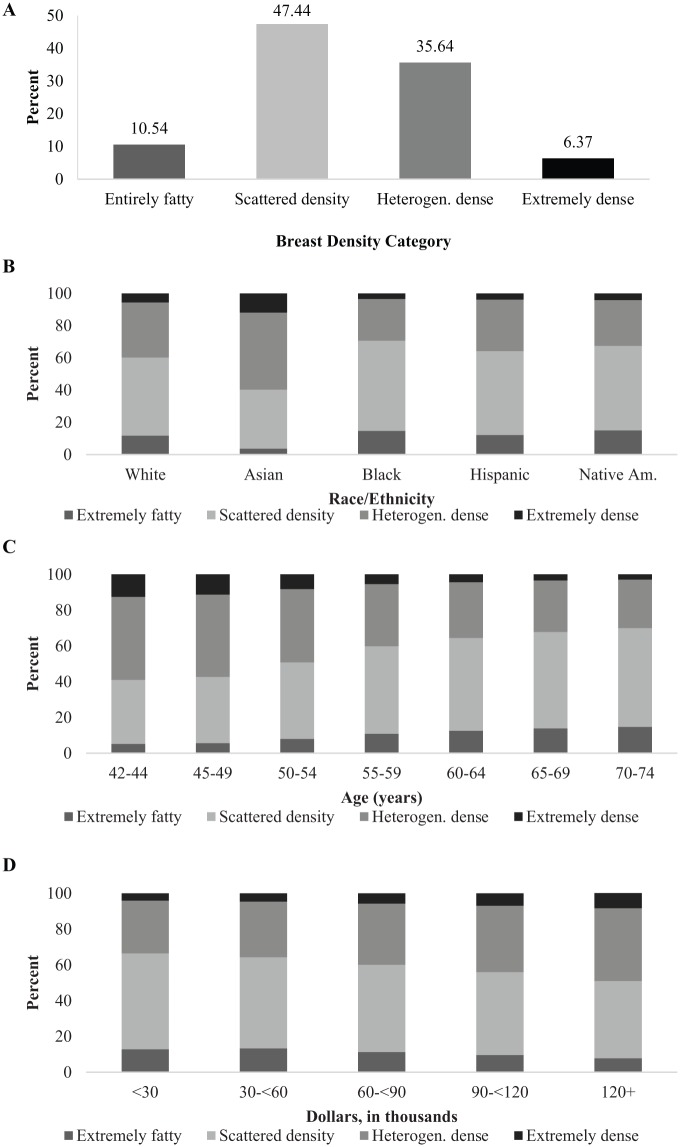
Half of US states mandate women be notified if they have dense breasts on their mammogram, yet guidelines and data on supplemental screening modalities are limited. Breast density (BD) refers to the extent that breast tissue appears radiographically dense on mammograms. High BD reduces the sensitivity of screening mammography and increases breast cancer risk. The aim of this study was to determine the potential impact of California's 2013 BD notification legislation on breast cancer screening patterns.
We conducted a cohort study of women aged 40 to 74 years who were members of a large Northern California integrated health plan (approximately 3.9 million members) in 2011-2015. We calculated pre- and post-legislation rates of screening mammography and magnetic resonance imaging (MRI). We also examined whether women with dense breasts (defined as BI-RADS density c or d) had higher MRI rates than women with nondense breasts (defined as BI-RADS density a or b).
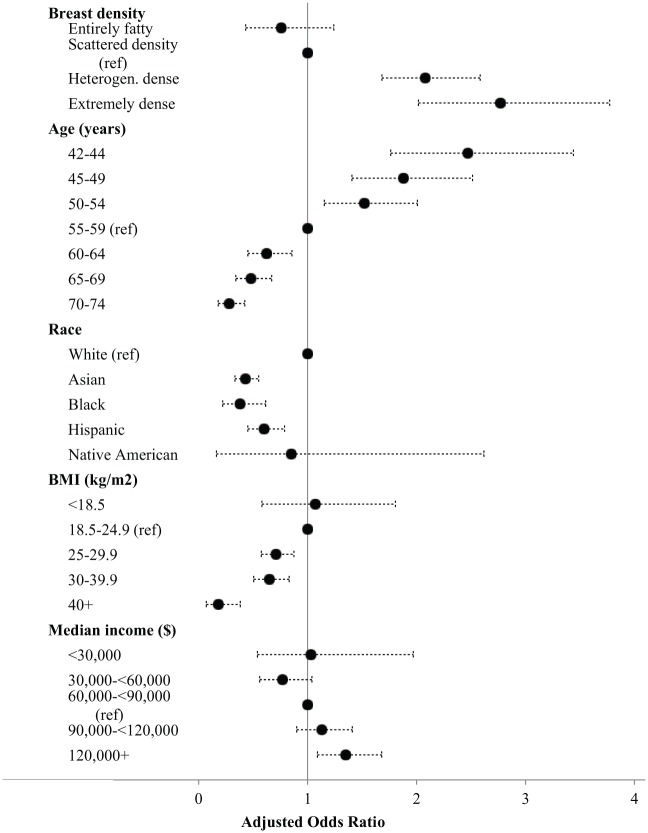
After adjustment for race/ethnicity, age, body mass index, medical facility, neighborhood median income, and cancer history, there was a relative 6.6% decrease (relative risk [RR] 0.934, confidence interval [CI] 0.92-0.95) in the rate of screening mammography, largely driven by a decrease among women <50 years. While infrequent, there was a relative 16% increase (RR 1.16, CI 1.07-1.25) in the rate of screening MRI, with the greatest increase among the youngest women. In the postlegislation period, women with extremely dense breasts (BI-RADS d) had 2.77 times (CI 1.93-3.95) the odds of a MRI within 9 months of a screening mammogram compared with women with nondense breasts (BI-RADS b).
In this setting, MRI rates increased in the postlegislation period. In addition, women with higher BD were more likely to have supplementary MRI. The decrease in mammography rates seen primarily among younger women may have been due to changes in national screening guidelines.
美国半数州规定,若女性乳房X光检查显示乳房致密,需通知她们,但关于补充筛查方式的指南和数据有限。乳房密度(BD)指乳房组织在乳房X光片上呈现的放射学致密程度。高BD会降低筛查性乳房X光检查的敏感性并增加患乳腺癌风险。本研究的目的是确定加利福尼亚州2013年BD通知立法对乳腺癌筛查模式的潜在影响。
我们对2011 - 2015年期间年龄在40至74岁、属于北加利福尼亚一个大型综合健康计划(约390万成员)的女性进行了队列研究。我们计算了立法前后筛查性乳房X光检查和磁共振成像(MRI)的比率。我们还检查了乳房致密(定义为BI - RADS密度c或d)的女性的MRI比率是否高于乳房不致密(定义为BI - RADS密度a或b)的女性。
在对种族/族裔、年龄、体重指数、医疗机构、邻里中位数收入和癌症病史进行调整后,筛查性乳房X光检查比率相对下降了6.6%(相对风险[RR] 0.934,置信区间[CI] 0.92 - 0.95),主要是由50岁以下女性的下降导致的。虽然不常见,但筛查性MRI比率相对增加了16%(RR 1.16,CI 1.07 - 1.25),最年轻的女性增加幅度最大。在立法后时期,乳房极度致密(BI - RADS d)的女性在筛查性乳房X光检查后9个月内进行MRI检查的几率是乳房不致密(BI - RADS b)女性的2.77倍(CI 1.93 - 3.95)。
在这种情况下,立法后时期MRI比率有所增加。此外,BD较高的女性更有可能进行补充MRI检查。主要在年轻女性中出现的乳房X光检查比率下降可能是由于国家筛查指南的变化。