Dalzini Elena, Cosciani-Cunico Elena, Sfameni Chiara, Monastero Paola, Daminelli Paolo, Losio Marina Nadia, Varisco Giorgio
Centro di Referenza Nazionale per i Rischi Emergenti in Sicurezza Alimentare, Istituto Zooprofilattico Sperimentale della Lombardia e dell'Emilia Romagna "B. Ubertini" , Brescia, Brescia, Italy.
Istituto Zooprofilattico Sperimentale della Lombardia e dell'Emilia Romagna "B. Ubertini" , Brescia, Italy.
Ital J Food Saf. 2014 Dec 18;3(4):4586. doi: 10.4081/ijfs.2014.4586. eCollection 2014 Dec 9.
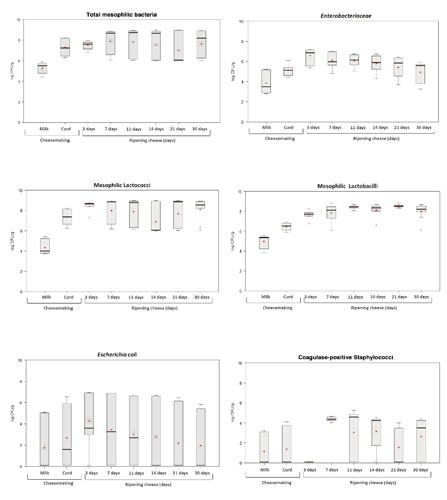
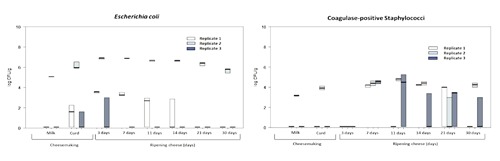
The aim of this work was to study the microbiological and physico-chemical changes throughout three cheesemaking replicates of Italian cheese made from raw goat milk. Therefore, during the process, three samples of milk, curd and cheese at 3, 7, 11, 14, 21 and 30 days of ripening old cheese were taken from three cheesemaking replicates. The average of total mesophilic bacteria and count in raw milk was 5.27±0.57 and 3.8±1.02 Log cfu/mL, respectively. Lactic acid bacteria was the predominant bacterial group during the process, and they developed in different ways in each of the media used (M17 and MRS agar). Variability of microbial concentrations was observed between three cheesemaking replicates. A correlation between the presence of higher levels of in milk and the presence of other contaminants bacteria such as βglucuronidase-positive and coagulase-positive staphylococci was observed. In cheesemaking replicate n. 2, level was 5.07±0.03 Log cfu/mL and increased by about 1 log until the last week of ripening, when the level decreased to 5.69±0.2 Log cfu/mL. The milk used for the cheesemaking replicate n. 2 was found to be contaminated also by coagulase-positive staphylococci (3.18±0.06 Log cfu/mL), but the behaviour of this group appeared to be very variable. In this study a first step of process control and microbial groups study was performed and the cheesemaking process was registered in the website www.ars-alimentaria.it, the Italian site supported by the Italian Board of Health.
这项工作的目的是研究用生山羊奶制作意大利奶酪的三个奶酪制作复制品过程中的微生物和理化变化。因此,在这个过程中,从三个奶酪制作复制品中取出了在成熟老奶酪的第3、7、11、14、21和30天的牛奶、凝乳和奶酪的三个样本。原料奶中嗜温菌总数的平均值分别为5.27±0.57和3.8±1.02 Log cfu/mL。乳酸菌是该过程中的主要细菌菌群,它们在所用的每种培养基(M17和MRS琼脂)中以不同方式生长。在三个奶酪制作复制品之间观察到微生物浓度的变异性。观察到牛奶中较高水平的[此处原文缺失具体物质]与其他污染细菌如β-葡萄糖醛酸酶阳性和凝固酶阳性葡萄球菌的存在之间存在相关性。在奶酪制作复制品2中,[此处原文缺失具体物质]水平为5.07±0.03 Log cfu/mL,在成熟的最后一周之前增加了约1个对数,然后该水平降至5.69±0.2 Log cfu/mL。发现用于奶酪制作复制品2的牛奶也被凝固酶阳性葡萄球菌污染(3.18±0.06 Log cfu/mL),但该菌群的行为似乎非常多变。在本研究中,进行了过程控制和微生物菌群研究的第一步,并且奶酪制作过程已在意大利卫生部支持的意大利网站www.ars-alimentaria.it上进行了记录。