Seo Seyoung, Park Seong Joon, Ryu Min-Hee, Park Sook Ryun, Ryoo Baek-Yeol, Park Young Soo, Na Young-Soon, Lee Chae-Won, Lee Ju-Kyung, Kang Yoon-Koo
Department of Oncology, Asan Medical Center, University of Ulsan College of Medicine, Seoul, Korea.
Department of Pathology, Asan Medical Center, University of Ulsan College of Medicine, Seoul, Korea.
Oncotarget. 2017 May 16;8(20):33844-33854. doi: 10.18632/oncotarget.12953.
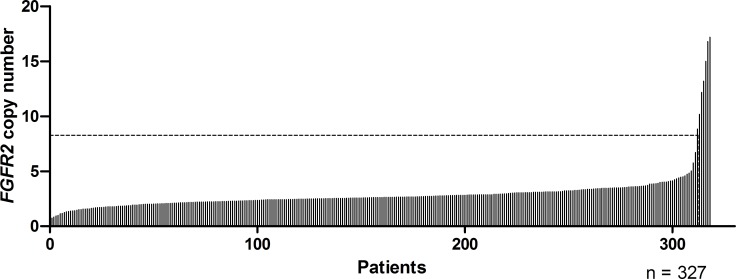
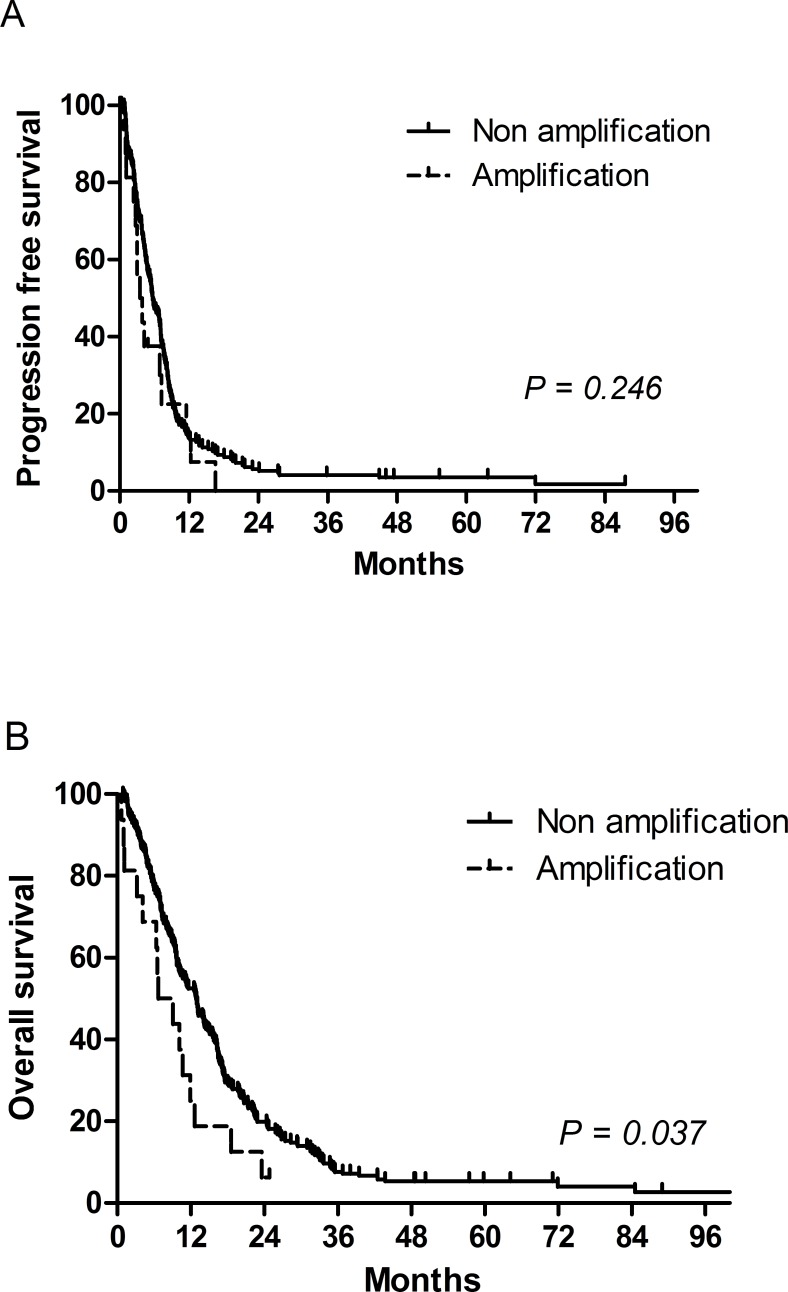
Although Fibroblast growth factor receptor (FGFR) 2 gene amplification and its prognostic significance have been reported in resectable gastric cancers, information on these features remains limited in the metastatic setting. The presence of FGFR2 amplification was assessed in formalin-fixed, paraffin-embedded tissues using a quantitative PCR-based gene copy number assay with advanced gastric cancer cohorts. A total of 327 patients with tumor portion of ≥70% were analyzed for clinical features. Among these patients, 260 who received first-line fluoropyrimidine and platinum chemotherapy were analyzed for survival.Sixteen of 327 patients (4.9%) exhibited FGFR2 amplification. The amplification group showed associations with age <65 years, Borrmann type 4 disease, poor performance status, poorly differentiated histology, extra-abdominal lymph node metastases, and bone metastases. The median overall survival (OS) and progression-free survival (PFS) were found to be 12.7 and 5.8 months, respectively. In univariate analysis, PFS did not differ between amplification and no amplification groups (hazard ratio [HR]=1.34, 95% confidence interval [CI]: 0.78-2.31, p=0.290), although the OS was significantly shorter in the amplification group (HR=1.92, 95% CI: 1.13-3.26, p=0.015). However, multivariate analysis indicated that FGFR2 amplification was not an independent prognostic factor for OS (HR=1.42, 95% CI: 0.77-2.61, p=0.261).Although FGFR2 amplification is associated with poorer OS, it does not appear to be an independent prognostic predictor in patients with advanced gastric cancer treated with palliative fluoropyrimidine and platinum chemotherapy.
尽管在可切除胃癌中已报道了成纤维细胞生长因子受体(FGFR)2基因扩增及其预后意义,但在转移性情况下,关于这些特征的信息仍然有限。使用基于定量PCR的基因拷贝数测定法,在福尔马林固定、石蜡包埋组织中评估晚期胃癌队列中FGFR2扩增的存在情况。对总共327例肿瘤部分≥70%的患者进行临床特征分析。在这些患者中,对260例接受一线氟嘧啶和铂类化疗的患者进行生存分析。327例患者中有16例(4.9%)表现出FGFR2扩增。扩增组与年龄<65岁、Borrmann 4型疾病、较差的体能状态、低分化组织学、腹外淋巴结转移和骨转移相关。发现中位总生存期(OS)和无进展生存期(PFS)分别为12.7个月和5.8个月。在单变量分析中,扩增组和未扩增组的PFS无差异(风险比[HR]=1.34,95%置信区间[CI]:0.78-2.31,p=0.290),尽管扩增组的OS明显较短(HR=1.92,95%CI:1.13-3.26,p=0.015)。然而,多变量分析表明,FGFR2扩增不是OS的独立预后因素(HR=1.42,95%CI:0.77-2.61,p=0.261)。尽管FGFR2扩增与较差的OS相关,但在接受姑息性氟嘧啶和铂类化疗治疗晚期胃癌的患者中,它似乎不是独立的预后预测指标。