Dong Yan, Liu Jindong, Zhang Yan, Geng Hongwei, Rasheed Awais, Xiao Yonggui, Cao Shuanghe, Fu Luping, Yan Jun, Wen Weie, Zhang Yong, Jing Ruilian, Xia Xianchun, He Zhonghu
Institute of Crop Science/National Wheat Improvement Center, Chinese Academy of Agricultural Sciences, Beijing, China.
College of Agronomy, Xinjiang Agricultural University, 311 Nongda East Road, Urumqi, Xinjiang, 830052, China.
PLoS One. 2016 Nov 1;11(11):e0164293. doi: 10.1371/journal.pone.0164293. eCollection 2016.
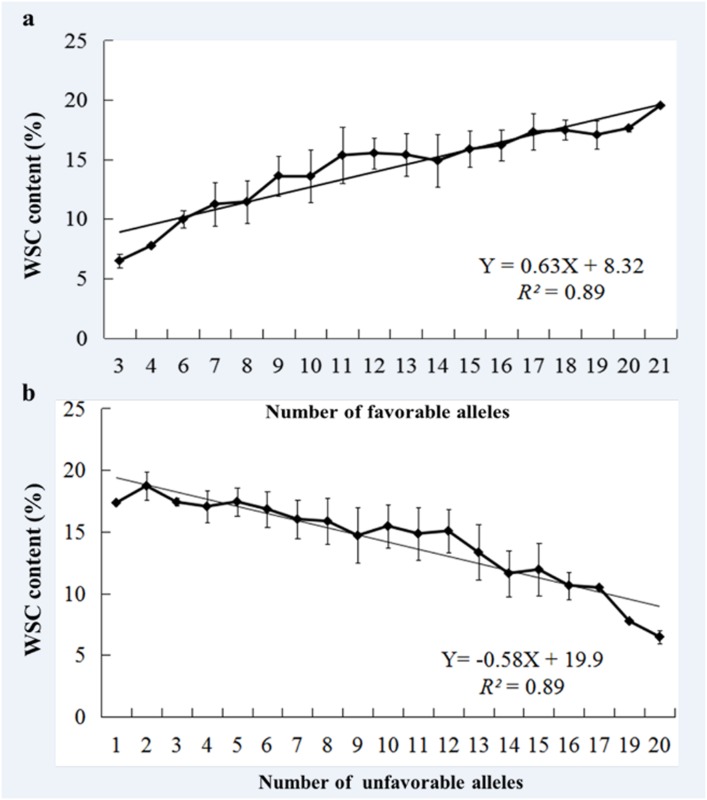
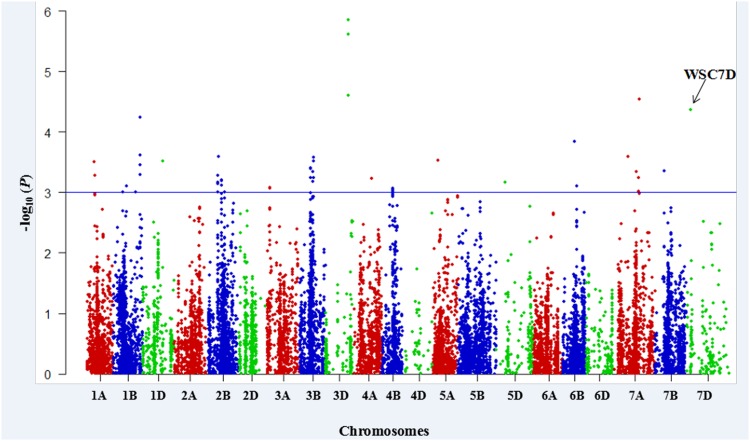
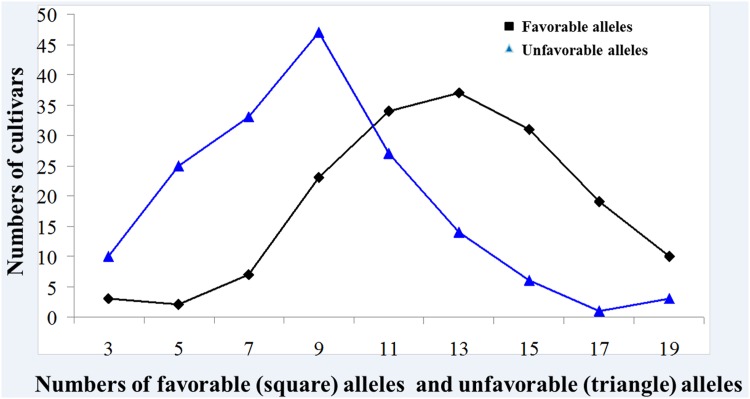
Water soluble carbohydrates (WSC) in stems play an important role in buffering grain yield in wheat against biotic and abiotic stresses; however, knowledge of genes controlling WSC is very limited. We conducted a genome-wide association study (GWAS) using a high-density 90K SNP array to better understand the genetic basis underlying WSC, and to explore marker-based breeding approaches. WSC was evaluated in an association panel comprising 166 Chinese bread wheat cultivars planted in four environments. Fifty two marker-trait associations (MTAs) distributed across 23 loci were identified for phenotypic best linear unbiased estimates (BLUEs), and 11 MTAs were identified in two or more environments. Liner regression showed a clear dependence of WSC BLUE scores on numbers of favorable (increasing WSC content) and unfavorable alleles (decreasing WSC), indicating that genotypes with higher numbers of favorable or lower numbers of unfavorable alleles had higher WSC content. In silico analysis of flanking sequences of trait-associated SNPs revealed eight candidate genes related to WSC content grouped into two categories based on the type of encoding proteins, namely, defense response proteins and proteins triggered by environmental stresses. The identified SNPs and candidate genes related to WSC provide opportunities for breeding higher WSC wheat cultivars.
茎中的水溶性碳水化合物(WSC)在缓冲小麦籽粒产量以抵御生物和非生物胁迫方面发挥着重要作用;然而,关于控制WSC的基因的了解非常有限。我们使用高密度90K SNP阵列进行了全基因组关联研究(GWAS),以更好地理解WSC的遗传基础,并探索基于标记的育种方法。在四个环境中种植的包含166个中国面包小麦品种的关联群体中对WSC进行了评估。针对表型最佳线性无偏估计(BLUEs),鉴定出分布在23个位点的52个标记-性状关联(MTA),并且在两个或更多环境中鉴定出11个MTA。线性回归表明WSC BLUE分数明显依赖于有利(增加WSC含量)和不利等位基因(降低WSC)的数量,这表明具有较高有利等位基因数量或较低不利等位基因数量的基因型具有较高的WSC含量。对性状关联SNP侧翼序列的电子分析揭示了八个与WSC含量相关的候选基因,根据编码蛋白的类型分为两类,即防御反应蛋白和由环境胁迫触发 的蛋白。鉴定出的与WSC相关的SNP和候选基因为培育具有更高WSC含量的小麦品种提供了机会。