Spunt Robert P, Ellsworth Emily, Adolphs Ralph
California Institute of Technology, 1200 E. California Blvd., Pasadena, CA 91125, USA.
Soc Cogn Affect Neurosci. 2017 Jan 1;12(1):95-105. doi: 10.1093/scan/nsw161.
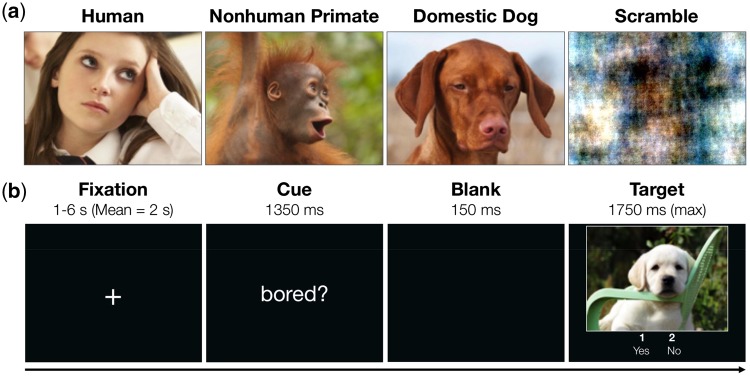
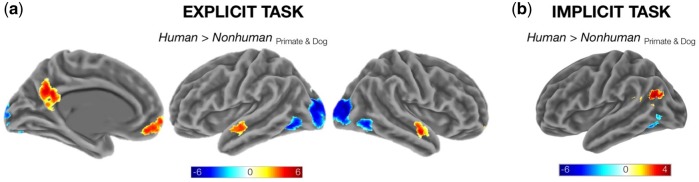
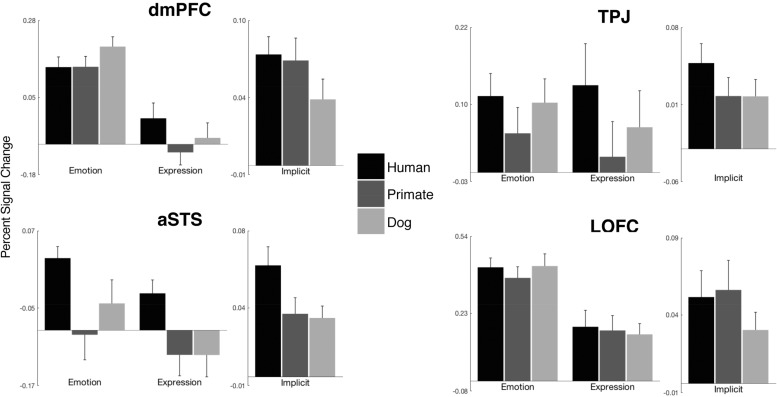
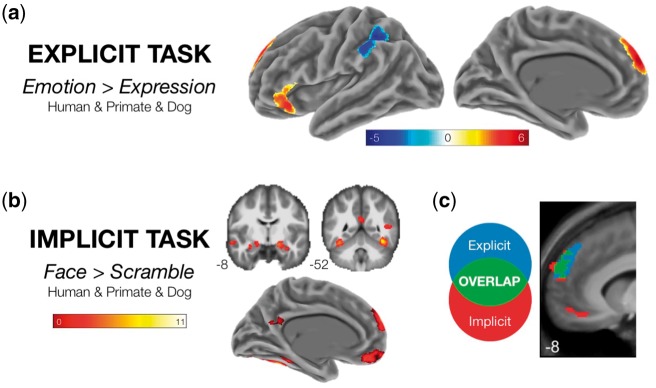
Humans cannot help but attribute human emotions to non-human animals. Although such attributions are often regarded as gratuitous anthropomorphisms and held apart from the attributions humans make about each other's internal states, they may be the product of a general mechanism for flexibly interpreting adaptive behavior. To examine this, we used functional magnetic resonance imaging (fMRI) in humans to compare the neural mechanisms associated with attributing emotions to humans and non-human animal behavior. Although undergoing fMRI, participants first passively observed the facial displays of human, non-human primate and domestic dogs, and subsequently judged the acceptability of emotional (e.g. 'annoyed') and facial descriptions (e.g. 'baring teeth') for the same images. For all targets, emotion attributions selectively activated regions in prefrontal and anterior temporal cortices associated with causal explanation in prior studies. These regions were similarly activated by both human and non-human targets even during the passive observation task; moreover, the degree of neural similarity was dependent on participants' self-reported beliefs in the mental capacities of non-human animals. These results encourage a non-anthropocentric view of emotion understanding, one that treats the idea that animals have emotions as no more gratuitous than the idea that humans other than ourselves do.
人类不可避免地会将人类情感赋予非人类动物。尽管这种赋予常常被视为无端的拟人化,且与人类对彼此内在状态的赋予有所不同,但它们可能是一种灵活解释适应性行为的通用机制的产物。为了对此进行研究,我们对人类使用功能磁共振成像(fMRI),以比较将情感赋予人类和非人类动物行为所涉及的神经机制。在进行fMRI扫描时,参与者首先被动观察人类、非人类灵长类动物和家犬的面部表情,随后判断针对相同图像的情感描述(如“恼怒”)和面部描述(如“呲牙”)的可接受性。对于所有目标,情感赋予选择性地激活了前额叶和颞叶前部皮质中与先前研究中的因果解释相关的区域。即使在被动观察任务期间,这些区域在人类和非人类目标的情况下均有类似激活;此外,神经相似程度取决于参与者自我报告的对非人类动物心理能力的信念。这些结果支持了一种非人类中心主义的情感理解观点,即认为动物具有情感并不比认为除自己之外的人类具有情感更无端。