Rašić Gordana, Filipović Igor, Callahan Ashley G, Stanford Darren, Chan Abigail, Lam-Phua Sai Gek, Tan Cheong Huat, Hoffmann Ary Anthony
Pest and Environmental Adaptation Research Group, Bio21 Institute, School of BioSciences, The University of Melbourne, Parkville, Australia.
Institute of Vector Borne Disease, Monash University, Clayton, Australia.
PLoS Negl Trop Dis. 2016 Nov 2;10(11):e0005096. doi: 10.1371/journal.pntd.0005096. eCollection 2016 Nov.
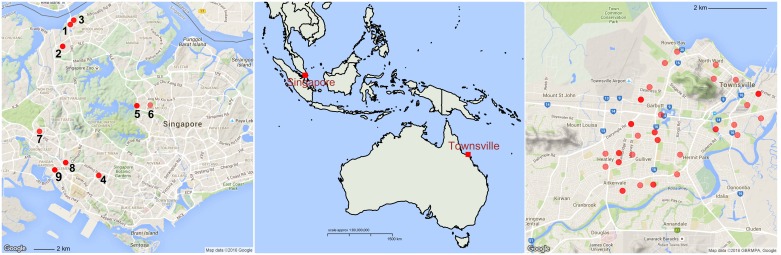
The mosquito Aedes aegypti (L.) is a major vector of viral diseases like dengue fever, Zika and chikungunya. Aedes aegypti exhibits high morphological and behavioral variation, some of which is thought to be of epidemiological significance. Globally distributed domestic Ae. aegypti have often been grouped into (i) the very pale variety queenslandensis and (ii) the type form. Because the two color forms co-occur across most of their range, there is interest in understanding how freely they interbreed. This knowledge is particularly important for control strategies that rely on mating compatibilities between the release and target mosquitoes, such as Wolbachia releases and SIT. To address this question, we analyzed nuclear and mitochondrial genome-wide variation in the co-occurring pale and type Ae. aegypti from northern Queensland (Australia) and Singapore.
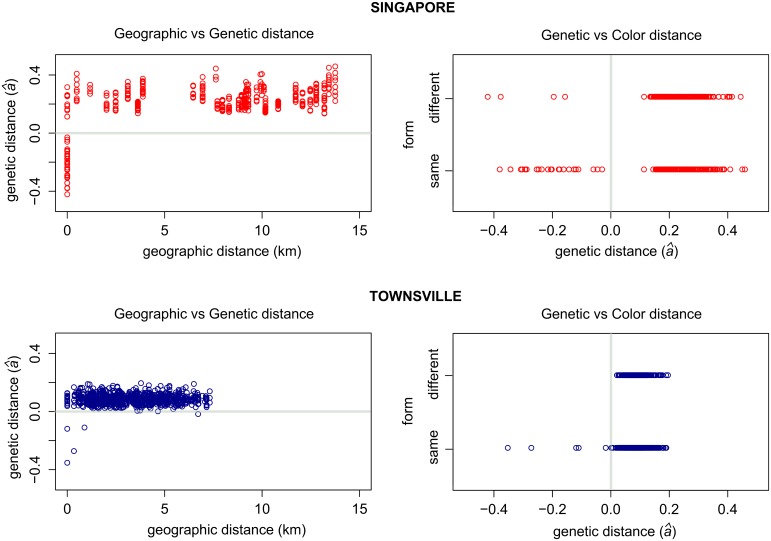
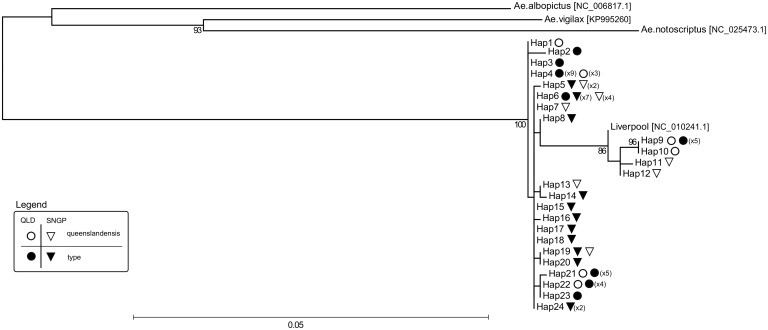
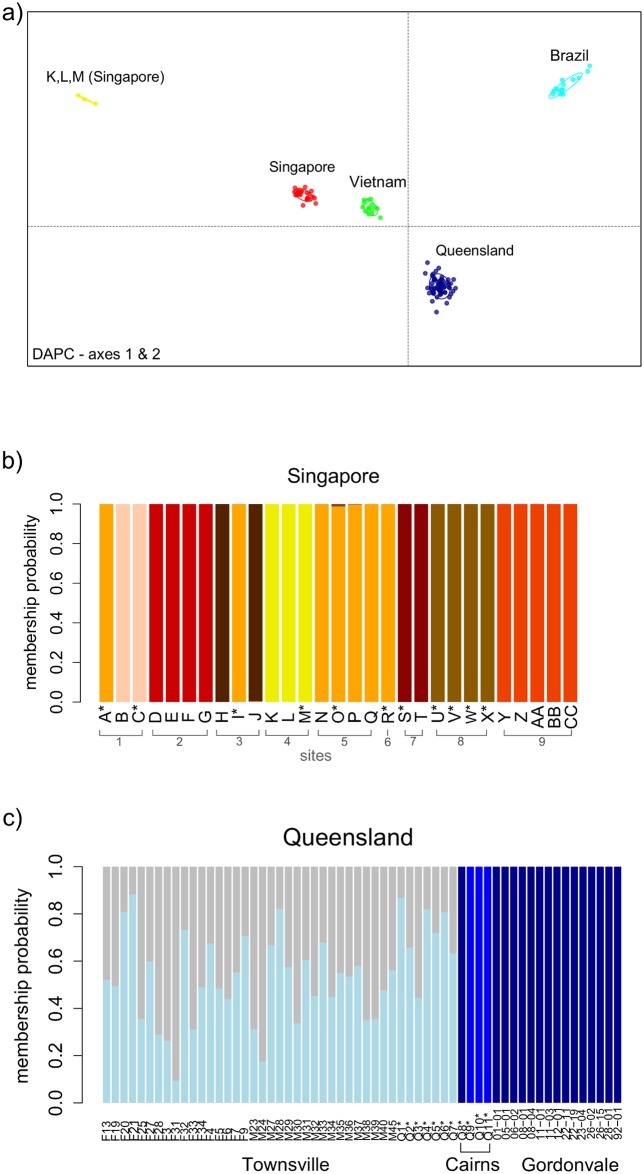
METHODS/FINDINGS: We typed 74 individuals at a 1170 bp-long mitochondrial sequence and at 16,569 nuclear SNPs using a customized double-digest RAD sequencing. 11/29 genotyped individuals from Singapore and 11/45 from Queensland were identified as var. queenslandensis based on the diagnostic scaling patterns. We found 24 different mitochondrial haplotypes, seven of which were shared between the two forms. Multivariate genetic clustering based on nuclear SNPs corresponded to individuals' geographic location, not their color. Several family groups consisted of both forms and three queenslandensis individuals were Wolbachia infected, indicating previous breeding with the type form which has been used to introduce Wolbachia into Ae. aegypti populations.
Aedes aegypti queenslandensis are genomically indistinguishable from the type form, which points to these forms freely interbreeding at least in Australia and Singapore. Based on our findings, it is unlikely that the presence of very pale Ae. aegypti will affect the success of Aedes control programs based on Wolbachia-infected, sterile or RIDL mosquitoes.
埃及伊蚊是登革热、寨卡病毒病和基孔肯雅热等病毒性疾病的主要传播媒介。埃及伊蚊表现出高度的形态和行为变异,其中一些变异被认为具有流行病学意义。全球分布的家栖埃及伊蚊通常被分为:(i)非常浅色的昆士兰型和(ii)典型型。由于这两种颜色形态在其大部分分布范围内共存,因此人们有兴趣了解它们之间杂交的自由程度。这些知识对于依赖释放蚊与目标蚊之间交配兼容性的控制策略尤为重要,例如沃尔巴克氏体释放和昆虫不育技术。为了解决这个问题,我们分析了来自澳大利亚昆士兰北部和新加坡的共存浅色型和典型型埃及伊蚊的核基因组和线粒体基因组变异。
方法/发现:我们使用定制的双酶切RAD测序对74个个体的1170bp长的线粒体序列和16569个核单核苷酸多态性进行分型。根据诊断性鳞片模式,来自新加坡的29个基因分型个体中的11个和来自昆士兰的45个个体中的11个被鉴定为昆士兰型。我们发现了24种不同的线粒体单倍型,其中7种在两种形态之间共享。基于核单核苷酸多态性的多变量遗传聚类与个体的地理位置相对应,而非其颜色。几个家族群体由两种形态组成,并且有3个昆士兰型个体感染了沃尔巴克氏体,这表明之前它们与已被用于将沃尔巴克氏体引入埃及伊蚊种群的典型型进行了杂交。
埃及伊蚊昆士兰型在基因组上与典型型无法区分,这表明这些形态至少在澳大利亚和新加坡能够自由杂交。基于我们的发现,非常浅色的埃及伊蚊的存在不太可能影响基于感染沃尔巴克氏体、不育或释放昆虫显性致死技术的蚊子的埃及伊蚊控制项目的成功实施。