Li Wen-Jun, Sui Xiao-Lin, Kuss Patrick, Liu Yan-Yan, Li Ai-Rong, Guan Kai-Yun
Key Laboratory of Biogeography and Bioresource in Arid Land, Xinjiang Institute of Ecology and Geography, Chinese Academy of Sciences, Urumqi 830011, China.
University of Chinese Academy of Sciences, Beijing 100049, China.
PLoS One. 2016 Nov 2;11(11):e0165700. doi: 10.1371/journal.pone.0165700. eCollection 2016.
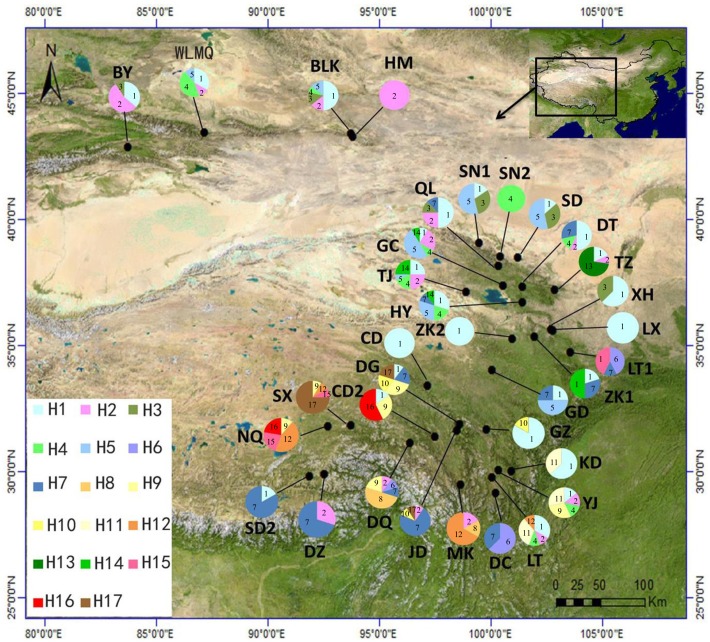
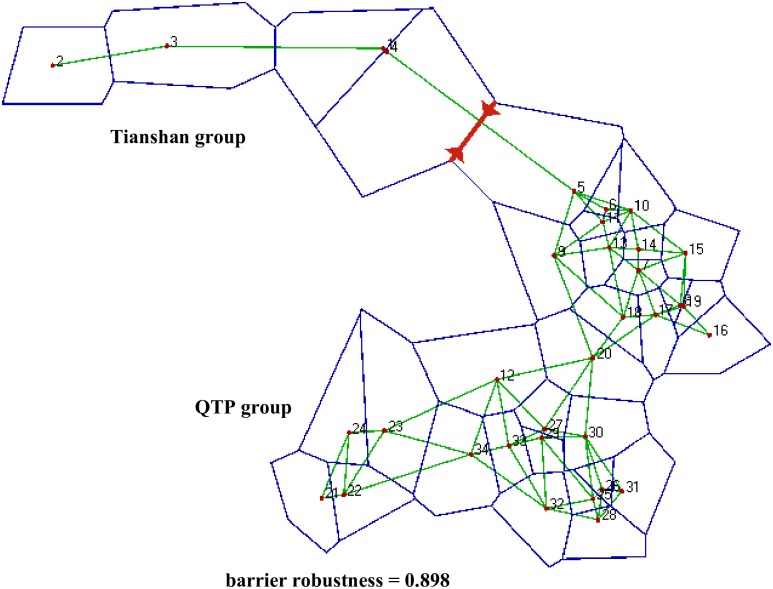
Quaternary climate fluctuations have profoundly affected the current distribution patterns and genetic structures of many plant and animal species in the Qinghai-Tibetan Plateau (QTP) and adjacent mountain ranges, e.g. Tianshan (TSR), Altay, etc. In this greater area disjunct distributions are prominent but have nevertheless received little attention with respect to the historical processes involved. Here, we focus on Pedicularis kansuensis to test whether the current QTP and TSR disjunction is the result of a recent Holocene range expansion involving dispersal across arid land bridge(s) or a Pleistocene range fragmentation involving persistence in refugia. Two chloroplast DNA spacers were sequenced for 319 individuals from 34 populations covering the entire distribution range of this species in China. We found a total of 17 haplotypes of which all occurred in the QTP, and only five in the TSR. Overall genetic diversity was high (HT = 0.882, HS = 0.559) and higher in the QTP than in the TSR. Genetic differentiation among regions and populations was relatively low (GST = 0.366) and little evidence for a phylogeographic pattern emerged. The divergence times for the four main lineages could be dated to the early Pleistocene. Surprisingly, the two ubiquitous haplotypes diverged just before or around the Last Glacial Maximum (LGM) and were found in different phylogenetic lineages. The Species Distribution Model suggested a disappearance of P. kansuensis from the TSR during the LGM in contrast to a relatively constant potential distribution in the QTP. We conclude that P. kansuensis colonized the TSR after the LGM. The improbable long-distance dispersal by wind or water across arid land seed flow may well have had birds or men as vector.
第四纪气候波动对青藏高原(QTP)及相邻山脉(如天山(TSR)、阿尔泰山等)的许多动植物物种当前的分布格局和遗传结构产生了深远影响。在这个更大的区域,间断分布很突出,但涉及的历史过程却很少受到关注。在这里,我们聚焦于甘肃马先蒿,以检验当前QTP和TSR的间断分布是全新世近期范围扩张(涉及跨越干旱陆桥扩散)的结果,还是更新世范围破碎化(涉及在避难所中持续存在)的结果。我们对来自中国该物种整个分布范围的34个种群的319个个体的两个叶绿体DNA间隔区进行了测序。我们共发现了17种单倍型,所有单倍型都出现在QTP,只有5种出现在TSR。总体遗传多样性较高(HT = 0.882,HS = 0.559),且QTP中的遗传多样性高于TSR。区域间和种群间的遗传分化相对较低(GST = 0.366),几乎没有出现系统发育地理格局的证据。四个主要谱系的分歧时间可追溯到早更新世。令人惊讶的是,这两种普遍存在的单倍型在末次盛冰期(LGM)之前或期间分歧,并存在于不同的系统发育谱系中。物种分布模型表明,在LGM期间TSR地区的甘肃马先蒿消失了,而QTP地区的潜在分布相对稳定。我们得出结论,甘肃马先蒿在LGM之后 colonized TSR地区。通过风或水在干旱陆桥种子流上进行远距离扩散不太可能,很可能是以鸟类或人类为媒介。 (注:“colonized”此处可能有误,结合语境推测可能是“colonized”,意为殖民、开拓,但整体语境不太准确,需根据更准确的原文信息判断,暂按此翻译)