Baturova Maria A, Sheldon Seth H, Carlson Jonas, Brady Peter A, Lin Grace, Rabinstein Alejandro A, Friedman Paul A, Platonov Pyotr G
Department of Cardiology, Clinical Science, Lund University, Lund, SE-221 85, Sweden.
University Clinic, St. Petersburg State University, Kadetskaya Line 13-15, St. Petersburg, 199004, Russia.
BMC Cardiovasc Disord. 2016 Nov 3;16(1):209. doi: 10.1186/s12872-016-0384-2.
Detection of atrial fibrillation after ischemic stroke is challenging due to its paroxysmal nature. We aimed to assess predictors of paroxysmal atrial fibrillation using non-invasive surface ECG and transthoracic echocardiography to select candidates for atrial fibrillation screening.
Ischemic stroke patients without documented atrial fibrillation (n = 110, 67 ± 10 years, 40 female) and a control group of age- and gender-matched patients with history of paroxysmal atrial fibrillation prior to stroke (n = 55, 67 ± 10 years, 19 female) comprised the study sample. Using non-invasive ECG monitoring for three weeks, short episodes of paroxysmal atrial fibrillation were detected in 24 of 110 patients (22 %). The standard 12-lead ECG with sinus rhythm at stroke onset was digitally processed and analyzed. Transthoracic echocardiography data were reviewed for these patients.
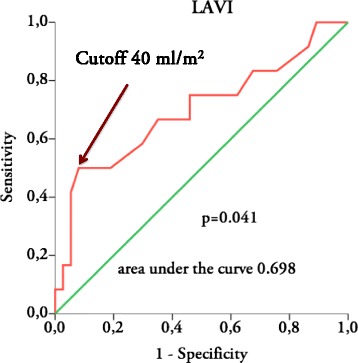
Atrial fibrillation history was independently associated with P terminal force in lead V 1 > 40 mm*ms (OR 4.04 95 % CI 1.34-12.14, p = 0.013) and left atrial volume index (OR 1.08 95 % CI 1.03-1.13, p = 0.002; for LAVI > 40 mL/m OR 6.40 95 % CL 1.47-27.91, p = 0.013). Among patients without atrial fibrillation history, no ECG characteristics were predictive of atrial fibrillation detected after stroke. Left atrial volume index remained an independent predictor of atrial fibrillation detected after stroke (OR 1.09 95 % CI 1.02-1.16, p = 0.017). A cutoff of <40 mL/m had an 84 % negative predictive value for ruling out atrial fibrillation on ambulatory monitoring with a sensitivity of 50 % and a specificity of 86 %.
In a post hoc analysis, left atrial dilatation assessed by left atrial volume index independently predicted atrial fibrillation after stroke in patients without prior atrial fibrillation history, while the other clinical or ECG markers were not predictive of atrial fibrillation detected early after ischemic stroke.
This study is a post hoc analysis from the prospective case-control study registered in December 2011, ClinicalTrials.gov ID: NCT01325545 .
由于阵发性房颤的特性,在缺血性卒中后检测房颤具有挑战性。我们旨在使用无创体表心电图和经胸超声心动图评估阵发性房颤的预测因素,以选择房颤筛查的候选人。
研究样本包括无房颤记录的缺血性卒中患者(n = 110,年龄67±10岁,女性40例)和年龄及性别匹配的卒中前有阵发性房颤病史的对照组患者(n = 55,年龄67±10岁,女性19例)。通过无创心电图监测三周,在110例患者中的24例(22%)检测到阵发性房颤的短暂发作。对卒中发作时窦性心律的标准12导联心电图进行数字处理和分析。对这些患者的经胸超声心动图数据进行回顾。
房颤病史与V1导联P波终末电势>40 mm*ms独立相关(OR 4.04,95%CI 1.34 - 12.14,p = 0.013)以及左房容积指数相关(OR 1.08,95%CI 1.03 - 1.13,p = 0.002;对于左房容积指数>40 mL/m²,OR 6.40,95%CI 1.47 - 27.91,p = 0.013)。在无房颤病史的患者中,没有心电图特征可预测卒中后检测到的房颤。左房容积指数仍然是卒中后检测到的房颤的独立预测因素(OR 1.09,95%CI 1.02 - 1.16,p = 0.017)。<40 mL/m²的截断值对于动态监测排除房颤具有84%的阴性预测价值,敏感性为50%,特异性为86%。
在一项事后分析中,通过左房容积指数评估的左房扩张独立预测了无既往房颤病史患者卒中后的房颤,而其他临床或心电图标志物不能预测缺血性卒中后早期检测到的房颤。
本研究是对2011年12月注册的前瞻性病例对照研究的事后分析,ClinicalTrials.gov标识符:NCT01325545 。