Özcan Cengiz, Juel Knud, Flensted Lassen Jens, von Kappelgaard Lene Mia, Mortensen Poul Erik, Gislason Gunnar
The National Institute of Public Health, University of Southern Denmark, Copenhagen K, Denmark; Department of Cardiology, Copenhagen University Hospital Gentofte, Hellerup, Denmark.
The National Institute of Public Health, University of Southern Denmark, Copenhagen K, Denmark.
Clin Epidemiol. 2016 Oct 25;8:503-508. doi: 10.2147/CLEP.S99475. eCollection 2016.
The Danish Heart Registry (DHR) seeks to monitor nationwide activity and quality of invasive diagnostic and treatment strategies in patients with ischemic heart disease as well as valvular heart disease and to provide data for research.
All adult (≥15 years) patients undergoing coronary angiography (CAG), percutaneous coronary intervention (PCI), coronary artery bypass grafting, and heart valve surgery performed across all Danish hospitals were included.
The DHR contains a subset of the data stored in the Eastern and Western Denmark Heart Registries (EDHR and WDHR). For each type of procedure, up to 70 variables are registered in the DHR. Since 2010, the data quality protocol encompasses fulfillment of web-based validation rules of daily-submitted records and yearly approval of the data by the EDHR and WDHR.
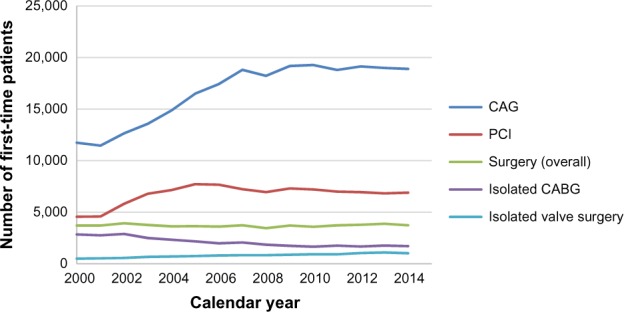
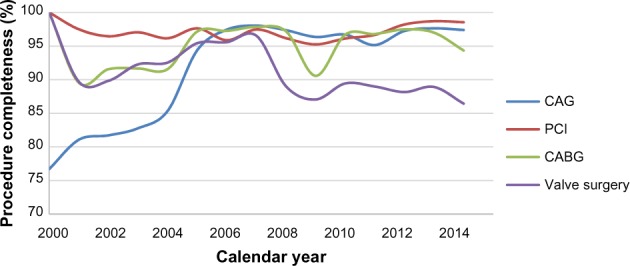
The data collection on procedure has been complete for PCI and surgery since 2000, and for CAG as of 2006. From 2000 to 2014, the number of CAG, PCI, and surgical procedures changed by 231%, 193%, and 99%, respectively. Until the end of 2014, a total of 357,476 CAG, 131,309 PCI, and 60,831 surgical procedures had been performed, corresponding to 249,445, 100,609, and 55,539 first-time patients, respectively. The DHR generally has a high level of completeness (1-missing) of each procedure (>90%) when compared to the National Patient Registry. Variables important for assessing the quality of care have a high level of completeness for surgery since 2000, and for CAG and PCI since 2010.
The DHR contains valuable data on cardiac invasive procedures, which makes it an important national monitoring and quality system and at the same time serves as a platform for research projects in the cardiovascular field.
丹麦心脏注册中心(DHR)旨在监测全国范围内缺血性心脏病以及心脏瓣膜病患者侵入性诊断和治疗策略的开展情况及质量,并为研究提供数据。
纳入了丹麦所有医院中接受冠状动脉造影(CAG)、经皮冠状动脉介入治疗(PCI)、冠状动脉旁路移植术和心脏瓣膜手术的所有成年(≥15岁)患者。
DHR包含存储在丹麦东部和西部心脏注册中心(EDHR和WDHR)的数据子集。对于每种手术类型,DHR中最多登记70个变量。自2010年以来,数据质量协议包括每日提交记录的基于网络的验证规则的执行情况以及EDHR和WDHR对数据的年度批准。
自2000年以来,PCI和手术的手术数据收集已完成,CAG的数据收集截至2006年。2000年至2014年,CAG、PCI和手术的数量分别增长了231%、193%和99%。截至2014年底,共进行了357,476例CAG、131,309例PCI和60,831例手术,分别对应249,445例、100,609例和55,539例初诊患者。与国家患者注册中心相比,DHR中每种手术的完整性(1-缺失率)总体较高(>90%)。自2000年以来,对于手术,以及自2010年以来对于CAG和PCI,评估医疗质量重要的变量具有较高的完整性。
DHR包含有关心脏侵入性手术的宝贵数据,这使其成为一个重要的国家监测和质量系统,同时也是心血管领域研究项目的平台。