Milne Alice E, Mueller Jutta L, Männel Claudia, Attaheri Adam, Friederici Angela D, Petkov Christopher I
Institute of Neuroscience, Henry Wellcome Building, Newcastle University, Framlington Place, Newcastle upon Tyne, NE2 4HH, United Kingdom.
Centre for Behavior and Evolution, Henry Wellcome Building, Newcastle University, Framlington Place, Newcastle upon Tyne, NE2 4HH, United Kingdom.
Sci Rep. 2016 Nov 9;6:36259. doi: 10.1038/srep36259.
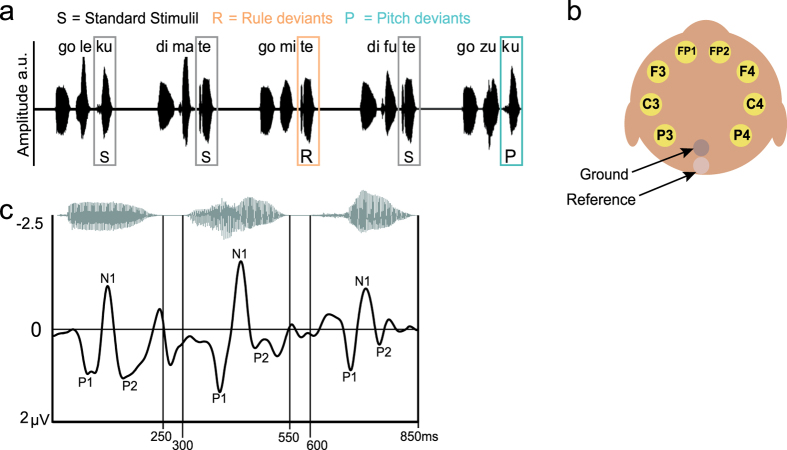
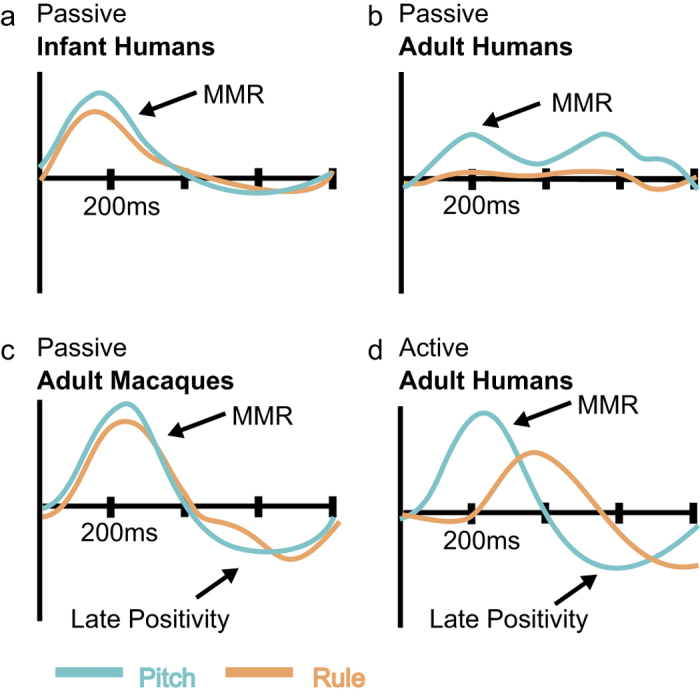
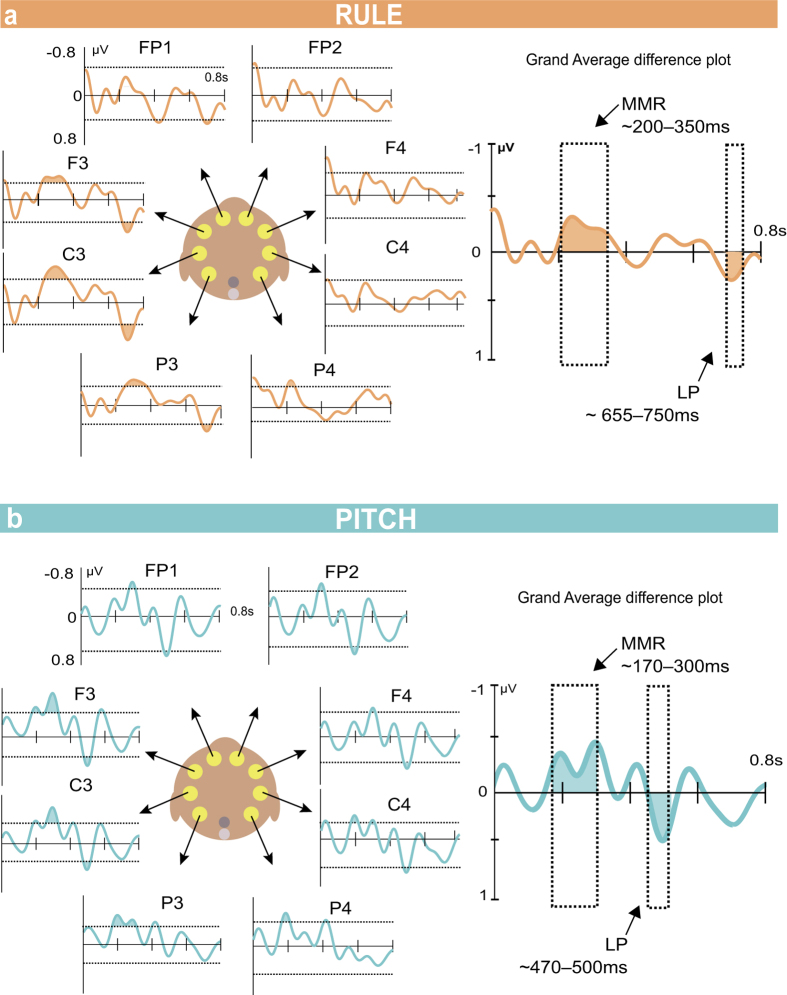
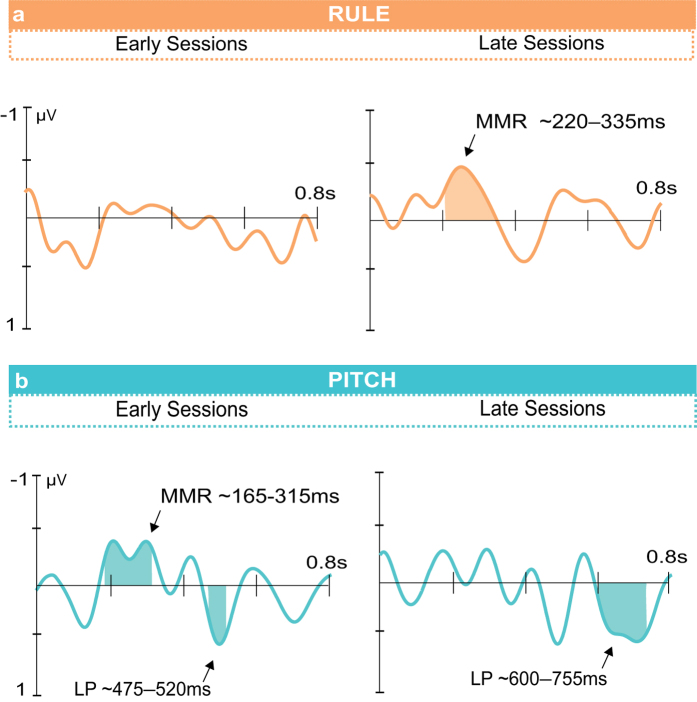
There is considerable interest in understanding the ontogeny and phylogeny of the human language system, yet, neurobiological work at the interface of both fields is absent. Syntactic processes in language build on sensory processing and sequencing capabilities on the side of the receiver. While we better understand language-related ontogenetic changes in the human brain, it remains a mystery how neurobiological processes at specific human development stages compare with those in phylogenetically closely related species. To address this knowledge gap, we measured EEG event-related potentials (ERPs) in two macaque monkeys using a paradigm developed to evaluate human infant and adult brain potentials associated with the processing of non-adjacent ordering relationships in sequences of syllable triplets. Frequent standard triplet sequences were interspersed with infrequent voice pitch or non-adjacent rule deviants. Monkey ERPs show early pitch and rule deviant mismatch responses that are strikingly similar to those previously reported in human infants. This stands in contrast to adults' later ERP responses for rule deviants. The results reveal how non-adjacent sequence ordering relationships are processed in the primate brain and provide evidence for evolutionarily conserved neurophysiological effects, some of which are remarkably like those seen at an early human developmental stage.
人们对理解人类语言系统的个体发生和系统发育有着浓厚的兴趣,然而,在这两个领域的交叉点上的神经生物学研究却付诸阙如。语言中的句法过程建立在接收者一侧的感觉处理和序列能力之上。虽然我们对人类大脑中与语言相关的个体发育变化有了更好的理解,但在特定人类发育阶段的神经生物学过程与系统发育上密切相关的物种相比如何,仍然是一个谜。为了解决这一知识空白,我们使用一种开发用于评估与处理音节三元组序列中不相邻排序关系相关的人类婴儿和成人大脑电位的范式,测量了两只猕猴的脑电图事件相关电位(ERP)。频繁出现的标准三元组序列中穿插着不常出现的音高或不相邻规则偏差。猕猴的ERP显示出早期的音高和规则偏差失配反应,与先前在人类婴儿中报道的反应惊人地相似。这与成年人对规则偏差的后期ERP反应形成对比。结果揭示了灵长类大脑中不相邻序列排序关系是如何被处理的,并为进化上保守的神经生理效应提供了证据,其中一些效应与人类早期发育阶段所见的效应非常相似。