
阻塞性睡眠呼吸暂停发作的非线性动力学预测
Nonlinear Dynamics Forecasting of Obstructive Sleep Apnea Onsets.
作者信息
Le Trung Q, Bukkapatnam Satish T S
机构信息
Department of Biomedical Engineering, International University-Vietnam National University, Ho Chi Minh, Vietnam.
Department of Biomedical Engineering, Texas A&M University, College Station, Texas, United States of America.
出版信息
PLoS One. 2016 Nov 11;11(11):e0164406. doi: 10.1371/journal.pone.0164406. eCollection 2016.
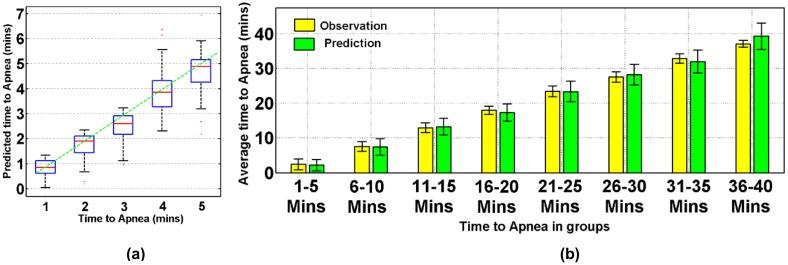
Recent advances in sensor technologies and predictive analytics are fueling the growth in point-of-care (POC) therapies for obstructive sleep apnea (OSA) and other sleep disorders. The effectiveness of POC therapies can be enhanced by providing personalized and real-time prediction of OSA episode onsets. Previous attempts at OSA prediction are limited to capturing the nonlinear, nonstationary dynamics of the underlying physiological processes. This paper reports an investigation into heart rate dynamics aiming to predict in real time the onsets of OSA episode before the clinical symptoms appear. A prognosis method based on a nonparametric statistical Dirichlet-Process Mixture-Gaussian-Process (DPMG) model to estimate the transition from normal states to an anomalous (apnea) state is utilized to estimate the remaining time until the onset of an impending OSA episode. The approach was tested using three datasets including (1) 20 records from 14 OSA subjects in benchmark ECG apnea databases (Physionet.org), (2) records of 10 OSA patients from the University of Dublin OSA database and (3) records of eight subjects from previous work. Validation tests suggest that the model can be used to track the time until the onset of an OSA episode with the likelihood of correctly predicting apnea onset in 1 min to 5 mins ahead is 83.6 ± 9.3%, 80 ± 8.1%, 76.2 ± 13.3%, 66.9 ± 15.4%, and 61.1 ± 16.7%, respectively. The present prognosis approach can be integrated with wearable devices, enhancing proactive treatment of OSA and real-time wearable sensor-based of sleep disorders.
传感器技术和预测分析的最新进展推动了阻塞性睡眠呼吸暂停(OSA)和其他睡眠障碍的即时护理(POC)疗法的发展。通过提供OSA发作的个性化实时预测,可以提高POC疗法的有效性。先前对OSA的预测尝试仅限于捕捉潜在生理过程的非线性、非平稳动态。本文报告了一项针对心率动态的研究,旨在在临床症状出现之前实时预测OSA发作的开始。一种基于非参数统计狄利克雷过程混合高斯过程(DPMG)模型的预后方法被用于估计从正常状态到异常(呼吸暂停)状态的转变,以估计即将发生的OSA发作开始前的剩余时间。该方法使用三个数据集进行了测试,包括(1)来自基准心电图呼吸暂停数据库(Physionet.org)中14名OSA受试者的20条记录,(2)都柏林大学OSA数据库中10名OSA患者的记录,以及(3)先前工作中8名受试者的记录。验证测试表明,该模型可用于跟踪直到OSA发作开始的时间,提前1分钟到5分钟正确预测呼吸暂停发作的可能性分别为83.6±9.3%、80±8.1%、76.2±13.3%、66.9±15.4%和61.1±16.7%。目前的预后方法可以与可穿戴设备集成,加强OSA的主动治疗以及基于可穿戴传感器的睡眠障碍实时监测。



 Zotero 插件