Prazeres Filipe, Santiago Luiz
Faculdade de Ciências da Saúde, Universidade da Beira Interior, Covilhã, 6200-506, Portugal.
Centro de Saúde de Aveiro, Aveiro, 3810-000, Portugal.
Health Qual Life Outcomes. 2016 Nov 11;14(1):156. doi: 10.1186/s12955-016-0559-7.
Multimorbidity has a high prevalence in the primary care context and it is frequently associated with worse health-related quality of life (HRQoL). Few studies evaluated the variables that could have a potential effect on HRQoL of primary care patients with multimorbidity. The purpose of this study, the first of its kind ever undertaken in Portugal, is to analyse the relationship between multimorbidity, health-related quality of life, perceived family support and unmet health needs in adult patients attending primary care.
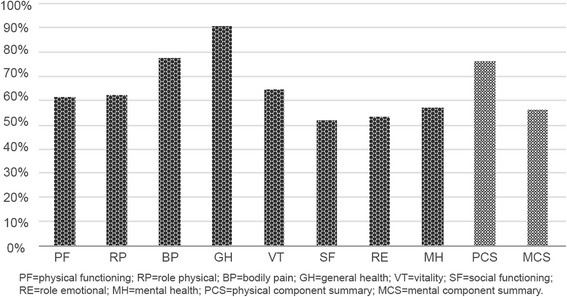
Multicentre, cross-sectional survey conducted among primary care patients with multimorbidity. It included 521 participants (64.1 % females) who met the inclusion criteria. HRQoL was evaluated using the Portuguese Short Form-12 Health Status Questionnaire. The Portuguese Family APGAR was used to measure the perceived family support. A patients' unmet health needs questionnaire was used. The unmet needs for medical, surgical and dental care; prescription medications; mental healthcare or counselling; and eyeglasses or other technical aid was assessed. Descriptive and multivariate analyses were performed.
The sample had an overall average of 4.5 chronic health problems. Increased multimorbidity levels were linked to worse health-related quality of life, particularly the physical health. Some variables were confirmed as playing a role on health-related quality of life. Male patients with high monthly incomes and highly functional families had better physical and mental health. High levels of education and the presence of asthma were also associated with better physical health. Contrariwise, elderly patients with high levels of multimorbidity and with osteoarthritis had lower physical health. The majority of the patients did not have unmet health needs. When health needs were stated they were mostly for generalist medical care, dental care, and eyeglasses/other technical aid. Financial insufficiency was the primary reason for not fulfilling their health needs.
To improve the quality of life of multimorbid patients, within primary care practices and health delivery systems, one should take into special account the sex of the patient, the perceived family support and the self-perceived economic status because of their relationship with both physical and mental health. Limitations and recommendations are discussed.
多重疾病在初级保健环境中具有较高的患病率,并且经常与较差的健康相关生活质量(HRQoL)相关联。很少有研究评估可能对患有多重疾病的初级保健患者的HRQoL产生潜在影响的变量。本研究是葡萄牙首次进行此类研究,其目的是分析多重疾病、健康相关生活质量、感知到的家庭支持与成年初级保健患者未满足的健康需求之间的关系。
对患有多重疾病的初级保健患者进行多中心横断面调查。纳入了521名符合纳入标准的参与者(64.1%为女性)。使用葡萄牙语版简短健康调查问卷12评估HRQoL。使用葡萄牙语家庭APGAR量表来衡量感知到的家庭支持。使用患者未满足的健康需求问卷。评估了医疗、手术和牙科护理、处方药、心理保健或咨询以及眼镜或其他技术辅助设备方面未满足的需求。进行了描述性和多变量分析。
样本中慢性健康问题的总体平均数量为4.5个。多重疾病水平的增加与较差的健康相关生活质量相关,尤其是身体健康方面。一些变量被证实对健康相关生活质量有影响。月收入高且家庭功能良好的男性患者身心健康状况较好。高学历和患有哮喘也与较好的身体健康相关。相反,多重疾病程度高且患有骨关节炎的老年患者身体健康状况较差。大多数患者没有未满足的健康需求。当提及健康需求时,主要是对全科医疗、牙科护理以及眼镜/其他技术辅助设备的需求。经济不足是未满足其健康需求的主要原因。
为了改善患有多重疾病患者的生活质量,在初级保健实践和医疗服务体系中,应特别考虑患者的性别、感知到的家庭支持以及自我感知的经济状况,因为它们与身心健康都有关系。讨论了研究的局限性和建议。