Zhang Ge, Lei Fei, Zhou Qingzhong, Feng Daxiong, Bai Yongheng
Department of Orthopedics, The Luzhou People's Hospital, Luzhou, Sichuan 646000, P.R. China.
Department of Spinal Surgery, The First Affiliated Hospital of Luzhou Medical College, Luzhou, Sichuan 646000, P.R. China.
Mol Med Rep. 2016 Dec;14(6):5180-5188. doi: 10.3892/mmr.2016.5918. Epub 2016 Nov 1.
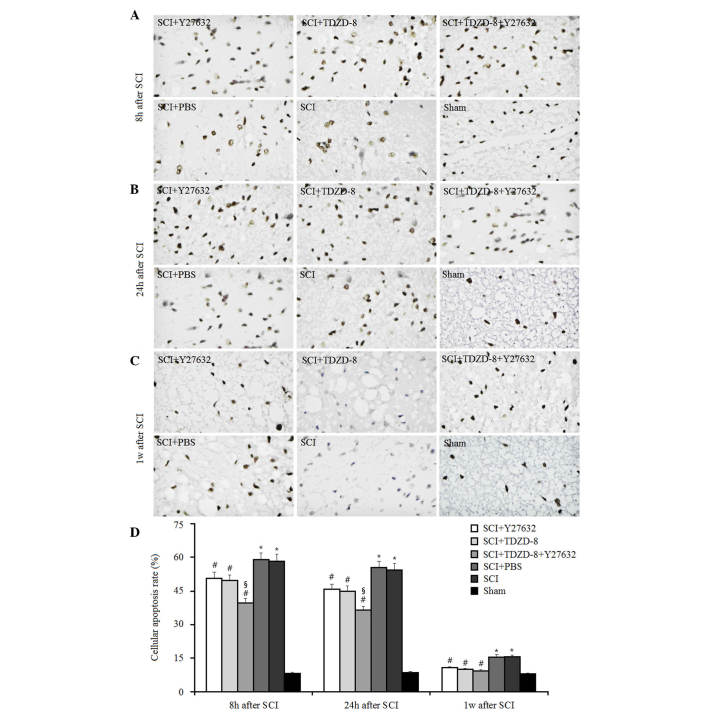
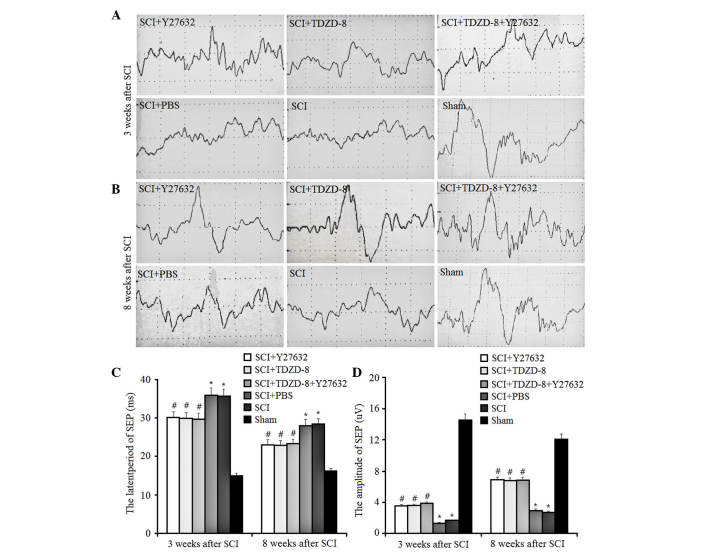
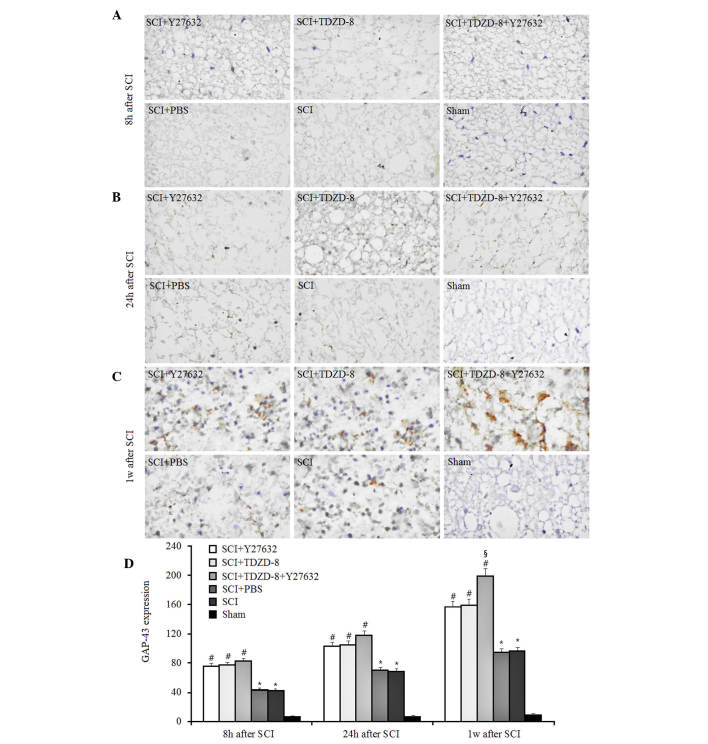
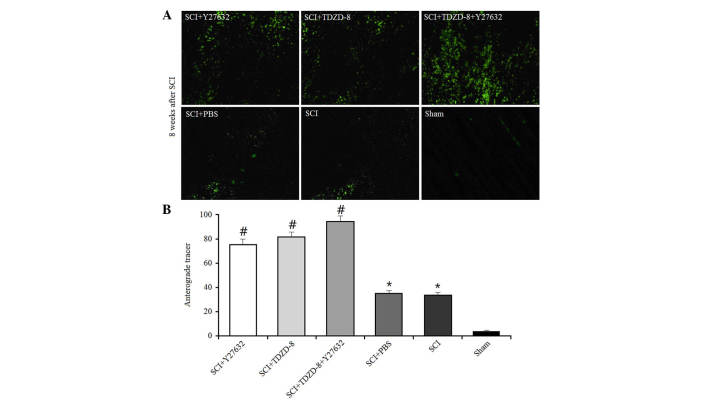
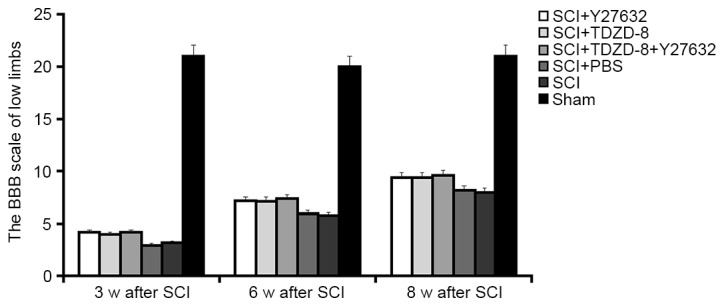
Previous studies have reported that the Rho-associated coiled-coil containing protein kinase 2 (ROCKII) and glycogen synthase kinase‑3β (GSK)‑3β signaling pathways are involved in axonal regeneration. The present study investigated the effects of the combined application of Y27632 (a ROCKII inhibitor) and 4-benzyl-2‑methyl-1,2,4-thiadiazolidine-3,5-dione (TDZD-8; a GSK‑3β inhibitor) on neurite outgrowth and functional recovery in rats with spinal cord injury (SCI). A total of 90 female Sprague‑Dawley rats were randomly allocated into six groups, and the SCI rats received daily administration of 1.6 mg/kg Y27632 for 2 weeks and/or 1 mg/kg TDZD‑8 for 3 weeks via a catheter. Cellular apoptosis in the injured spinal cords was measured at each time point using a terminal deoxynucleotidyl transferase‑mediated dUTP nick end labeling assay. The expression levels of growth‑associated protein‑43 (GAP‑43) were determined by immunohistochemical staining. In addition, an anterograde tracer was used to analyze axonal regeneration, the Basso Beattie Bresnahan locomotor rating scale (BBB) was analyzed, and the somatosensory evoked potential (SEP) test was conducted. The results demonstrated that SCI upregulated the number of apoptotic cells, increased GAP‑43 expression and enhanced the latent periods of SEP, as compared with in mice that underwent a sham operation. Furthermore, SCI decreased the BBB scores and the SEP amplitudes. These injuries in the spinal cord were reduced following treatment with Y27632, TDZD‑8, or their combined application, as detected by decreased apoptosis, the induction of axonal regeneration, and the promotion of functional recovery of the lower limbs. Although the BBB scores, and SEP amplitudes and latent periods were not significantly different among the three drug treatment groups, the combined application of Y27632 and TDZD‑8 resulted in stronger axonal regenerative potency and a greater protective effect on secondary SCI. These results indicated that the combined application of Y27632 and TDZD‑8 may more effectively protect against secondary SCI by inhibiting cellular apoptosis, enhancing GAP-43 expression and promoting neurite outgrowth in SCI rats, compared with Y27632 or TDZD-8 alone.
以往研究报道,含Rho相关卷曲螺旋蛋白激酶2(ROCKII)和糖原合酶激酶-3β(GSK)-3β信号通路参与轴突再生。本研究调查了Y27632(一种ROCKII抑制剂)和4-苄基-2-甲基-1,2,4-噻二唑烷-3,5-二酮(TDZD-8;一种GSK-3β抑制剂)联合应用对脊髓损伤(SCI)大鼠神经突生长和功能恢复的影响。将90只雌性Sprague-Dawley大鼠随机分为6组,SCI大鼠通过导管每日给予1.6mg/kg Y27632,持续2周和/或1mg/kg TDZD-8,持续3周。在每个时间点,使用末端脱氧核苷酸转移酶介导的dUTP缺口末端标记法测量损伤脊髓中的细胞凋亡。通过免疫组织化学染色测定生长相关蛋白-43(GAP-43)的表达水平。此外,使用顺行示踪剂分析轴突再生,分析Basso Beattie Bresnahan运动评分量表(BBB),并进行体感诱发电位(SEP)测试。结果表明,与假手术小鼠相比,SCI上调了凋亡细胞数量,增加了GAP-43表达,并延长了SEP潜伏期。此外,SCI降低了BBB评分和SEP振幅。用Y27632、TDZD-8或它们的联合应用治疗后,脊髓中的这些损伤减少,表现为凋亡减少、轴突再生诱导和下肢功能恢复促进。虽然三个药物治疗组之间的BBB评分、SEP振幅和潜伏期没有显著差异,但Y27632和TDZD-8的联合应用导致更强的轴突再生能力和对继发性SCI的更大保护作用。这些结果表明,与单独使用Y27632或TDZD-8相比,Y27632和TDZD-8联合应用可能通过抑制细胞凋亡、增强GAP-43表达和促进SCI大鼠神经突生长,更有效地预防继发性SCI。