Lima Luiz H, Morales Yael, Cabral Thiago
Doheny Eye Institute, University of California Los Angeles (UCLA), Los Angeles, CA USA ; Federal University of Sao Paulo (UNIFESP), Rua Botucatu, 821, Vila Clementino, Sao Paulo, São Paulo 04023-062 Brazil.
Doheny Eye Institute, University of California Los Angeles (UCLA), Los Angeles, CA USA.
Int J Retina Vitreous. 2016 Oct 3;2:23. doi: 10.1186/s40942-016-0048-5. eCollection 2016.
To determine the safety and efficacy of poly--isopropylacrylamide, a thermoresponsive adhesive, for sutureless sclerotomy closure in rabbits.
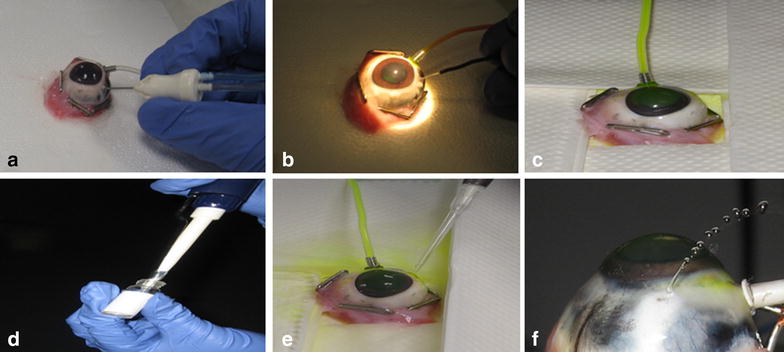
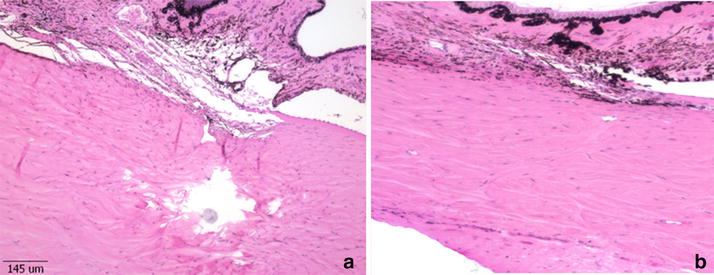
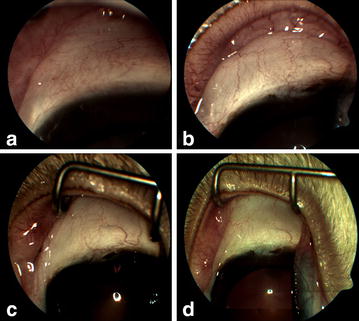
Eight rabbits were randomized into three groups: short-term acute, mid-term chronic, and long-term chronic studies. A corresponding control group in which the scleral wounds were sutured by 6-0 vicryl sutures was assigned for each study group. A 20-gauge sclerotomy was performed following a core vitrectomy and 0.1 mL of 50 % liquid poly--isopropylacrylamide was applied to the scleral wounds. Before the polymer application, the scleral surface was raised above 32 °C using a halogen bulb lamp. Follow-up exams included color external and fundus photography, fundus fluorescein angiography, optical coherence tomography, and electroretinography. After the last follow-up assessment, the rabbits were sacrificed and histopathological studies on the scleral incision sites were performed.
Scleral wound healing was observed in the long-term chronic study rabbits. Histological studies were able to identify poly--isopropylacrylamide polymer at the sclerotomy site in the mid-term chronic study rabbits. Besides iatrogenic cataracts due to mechanical instrument touch in 2 rabbits, no other ocular abnormalities were identified in any of the eyes in the perioperative setting or during the follow-up period. Cornea, retina, and vitreous remained unaffected, and no abnormal inflammatory reaction or endophthalmitis was noticed in the 3 study groups. Filtering blebs indicative of leakage through the sclerotomies were not observed during the follow-up period.
Poly--isopropylacrylamide may provide effective in vitro scleral adhesion above 32 °C. Clinical studies are required to evaluate its utility in patients undergoing pars plana vitrectomy.
确定热响应性粘合剂聚异丙基丙烯酰胺用于兔无缝线巩膜切开术闭合的安全性和有效性。
将8只兔子随机分为三组:短期急性、中期慢性和长期慢性研究。为每个研究组分配一个相应的对照组,其中巩膜伤口用6-0可吸收缝线缝合。在进行核心玻璃体切除术后进行20号巩膜切开术,并将0.1 mL 50%的液体聚异丙基丙烯酰胺应用于巩膜伤口。在应用聚合物之前,使用卤素灯泡灯将巩膜表面温度升高到32°C以上。随访检查包括彩色外部和眼底摄影、眼底荧光血管造影、光学相干断层扫描和视网膜电图。在最后一次随访评估后,处死兔子并对巩膜切口部位进行组织病理学研究。
在长期慢性研究的兔子中观察到巩膜伤口愈合。组织学研究能够在中期慢性研究的兔子的巩膜切开部位识别出聚异丙基丙烯酰胺聚合物。除了2只兔子因机械器械触碰导致医源性白内障外,在围手术期或随访期间,任何一只眼睛均未发现其他眼部异常。角膜、视网膜和玻璃体未受影响,3个研究组均未观察到异常炎症反应或眼内炎。在随访期间未观察到提示巩膜切开处渗漏的滤过泡。
聚异丙基丙烯酰胺在32°C以上可能提供有效的体外巩膜粘连。需要进行临床研究以评估其在接受玻璃体切除术的患者中的效用。