Trnková Petra, Baltas Dimos, Karabis Andreas, Stock Markus, Dimopoulos Johannes, Georg Dietmar, Pötter Richard, Kirisits Christian
Department of Radiotherapy, Medical University of Vienna, Austria.
Department of Medical Physics & Engineering, Strahlenklinik, Klinikum Offenbach GmbH, Germany; Nuclear and Particle Physics Section, Physics Department, University of Athens, Athens, Greece.
J Contemp Brachytherapy. 2010 Dec;2(4):163-170. doi: 10.5114/jcb.2010.19497. Epub 2011 Jan 14.
The purpose of this study was to compare two inverse planning algorithms for cervical cancer brachytherapy and a conventional manual treatment planning according to the MUW (Medical University of Vienna) protocol.
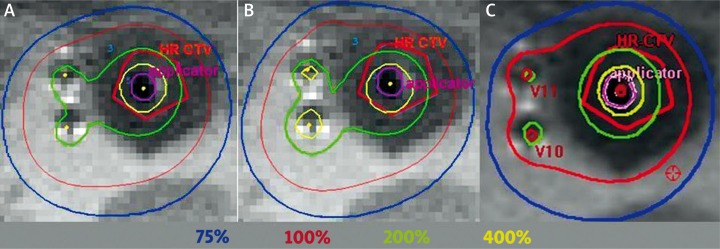
For 20 patients, manually optimized, and, inversely optimized treatment plans with Hybrid Inverse treatment Planning and Optimization (HIPO) and with Inverse Planning Simulated Annealing (IPSA) were created. Dosimetric parameters, absolute volumes of normal tissue receiving reference doses, absolute loading times of tandem, ring and interstitial needles, Paddick and COIN conformity indices were evaluated.
HIPO was able to achieve a similar dose distribution to manual planning with the restriction of high dose regions. It reduced the loading time of needles and the overall treatment time. The values of both conformity indices were the lowest. IPSA was able to achieve acceptable dosimetric results. However, it overloaded the needles. This resulted in high dose regions located in the normal tissue. The Paddick index for the volume of two times prescribed dose was outstandingly low.
HIPO can produce clinically acceptable treatment plans with the elimination of high dose regions in normal tissue. Compared to IPSA, it is an inverse optimization method which takes into account current clinical experience gained from manual treatment planning.
本研究的目的是根据维也纳医科大学(MUW)方案,比较宫颈癌近距离治疗的两种逆向计划算法以及传统的手动治疗计划。
为20例患者创建了手动优化的、使用混合逆向治疗计划与优化(HIPO)以及逆向计划模拟退火(IPSA)进行逆向优化的治疗计划。评估了剂量学参数、接受参考剂量的正常组织的绝对体积、串联针、环形针和间质针的绝对加载时间、帕迪克(Paddick)和COIN适形指数。
HIPO能够在限制高剂量区域的情况下实现与手动计划相似的剂量分布。它减少了针的加载时间和总体治疗时间。两个适形指数的值都是最低的。IPSA能够获得可接受的剂量学结果。然而,它使针过载。这导致高剂量区域位于正常组织中。两倍处方剂量体积的帕迪克指数极低。
HIPO可以产生临床可接受的治疗计划,同时消除正常组织中的高剂量区域。与IPSA相比,它是一种考虑了从手动治疗计划中获得的当前临床经验的逆向优化方法。