Zhang Weifang, Chen Dingwan, Zhou Huan, Xu Yanhua, Xu Zhuopu, Ying Ying, Zhao Zhengyan
Department of Administration, Children's Hospital, Zhejiang University School of Medicine, Hangzhou, 310003, China.
Department of Public Health, Zhejiang Medical College, Hangzhou, China.
Int J Equity Health. 2016 Nov 17;15(1):188. doi: 10.1186/s12939-016-0470-1.
China is now under a period of social transition, and inequity is evident in the field of health care. We aimed to investigate regional health-care inequalities in children's survival in Zhejiang Province, China.
In our study, monitoring data of Zhejiang Province from 2005 to 2014 was collected. The flow of data collection of community-district-city for urban areas or village-township-county rural areas was followed. The factors affecting equity was analyzed including regional economical level and household registry. We adopted standard measures of concentration curve and concentration index to evaluate degree of income-related inequity and the trend of mortality changes.
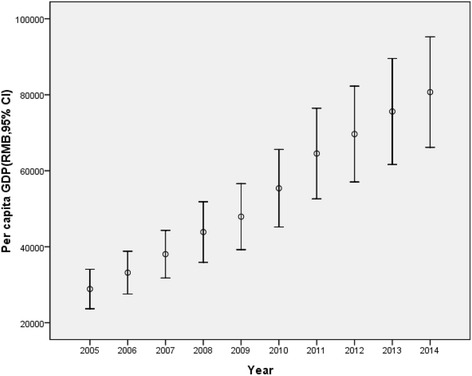
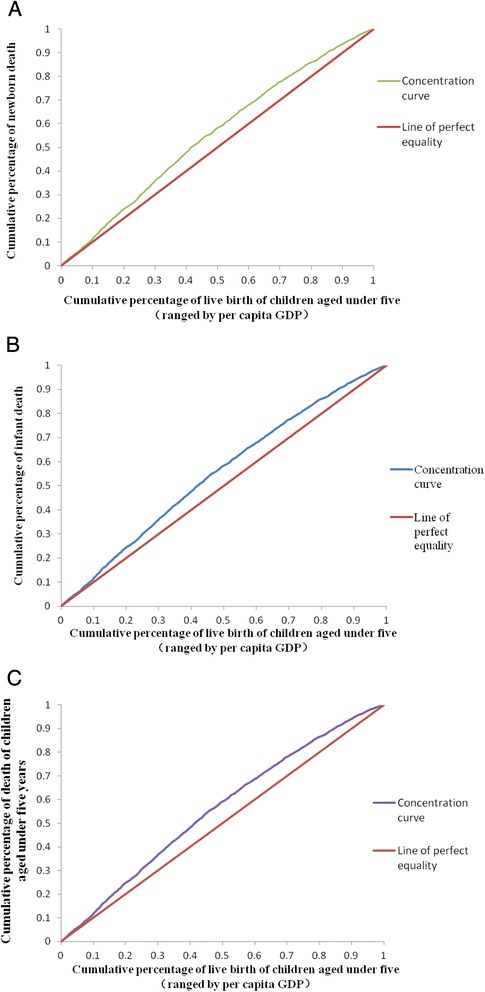
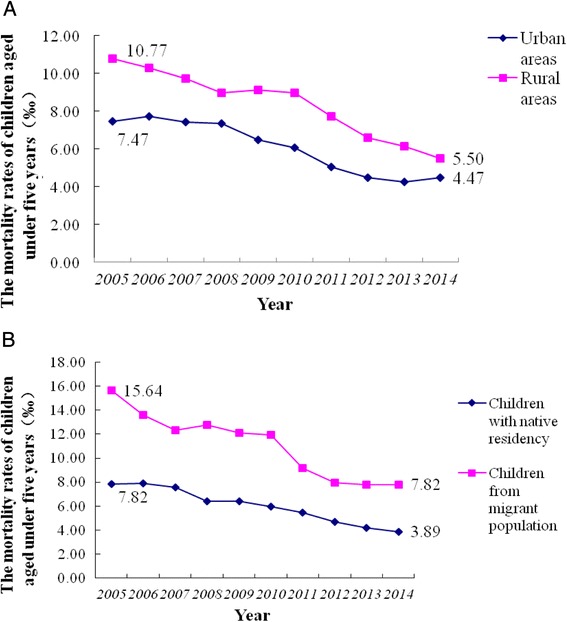
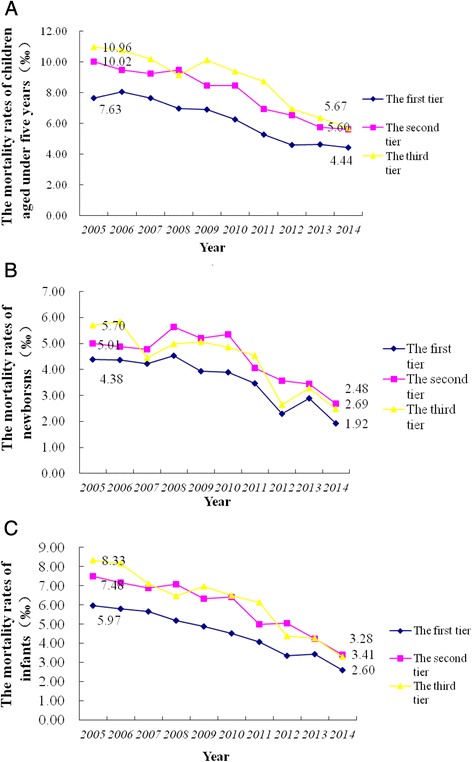
From 2005 to 2014, overall mortality rate in children under five decreased, and regional disparity reduced markedly, and with a reduced disparity of mortality rate among children from urban and rural areas. In 2014, the mortality rate in children from urban and rural areas was similar. In contrast, the mortality rate in the children from migrant population was more than two folds of that in the children from native residency (7.82 ‰ vs. 3.89 ‰). The mortality rates of newborns (rs = -0.396, P < 0.001), infants (rs = -0.553, P < 0.001) and children under five (rs = -0.568, P < 0.001) were all negatively correlated with per capita GDP in different regions. CI in the newborns, infants and children under 5 years was -0.105, -0.107 and -0.118, respectively. The concentration curve was near to equity curve. The concentration curve was near to equity curve. The mortality rate of children was negatively related with economical level in this study.
The survival status was near to equity. Regional economical development can improve children's survival but it was not the only social determinant. Migrant population will be the future monitor focus for reducing disparity on healthcare and increase equity in children's survival.
中国正处于社会转型期,医疗保健领域的不公平现象明显。我们旨在调查中国浙江省儿童生存方面的地区医疗保健不平等情况。
在我们的研究中,收集了浙江省2005年至2014年的监测数据。遵循城市地区社区-区-市或农村地区村-乡-县的数据收集流程。分析了影响公平性的因素,包括地区经济水平和户籍。我们采用集中曲线和集中指数的标准测量方法来评估与收入相关的不公平程度以及死亡率变化趋势。
2005年至2014年,五岁以下儿童的总体死亡率下降,地区差距显著缩小,城乡儿童死亡率差距也有所缩小。2014年,城乡儿童死亡率相近。相比之下,流动人口儿童的死亡率是本地户籍儿童的两倍多(7.82‰对3.89‰)。不同地区新生儿(rs = -0.396,P < 0.001)、婴儿(rs = -0.553,P < 0.001)和五岁以下儿童(rs = -0.568,P < 0.001)的死亡率均与人均GDP呈负相关。新生儿、婴儿和五岁以下儿童的集中指数分别为-0.105、-0.107和-0.118。集中曲线接近公平曲线。本研究中儿童死亡率与经济水平呈负相关。
生存状况接近公平。地区经济发展可以改善儿童生存状况,但它不是唯一的社会决定因素。流动人口将是未来减少医疗保健差距和提高儿童生存公平性的监测重点。