Cremolini Chiara, Antoniotti Carlotta, Pietrantonio Filippo, Berenato Rosa, Tampellini Marco, Baratelli Chiara, Salvatore Lisa, Marmorino Federica, Borelli Beatrice, Nichetti Federico, Bironzo Paolo, Sonetto Cristina, Bartolomeo Maria Di, Braud Filippo de, Loupakis Fotios, Falcone Alfredo, Di Maio M
Unit of Medical Oncology, Azienda Ospedaliero-Universitaria Pisana, Department of Translational Research and New Technologies in Medicine, University of Pisa, Pisa, Italy.
Medical Oncology Department, Fondazione IRCCS Istituto Nazionale dei Tumori, Milan, Italy.
Cancer Res Treat. 2017 Jul;49(3):834-845. doi: 10.4143/crt.2016.249. Epub 2016 Nov 15.
The purpose of this study was to evaluate progression-free survival (PFS) and objective response rate (ORR) as surrogate endpoints of overall survival (OS) in modern clinical trials investigating the efficacy of targeted agents in the second-line treatment of metastatic colorectal cancer (mCRC).
A systematic search of literature pertaining to randomized phase II and III trials evaluating targeted agents as second-line treatments for mCRC was performed. The strength of the correlation between both PFS and ORR and OS was assessed based on the Pearson's correlation coefficient (R) and the coefficient of determination (R).
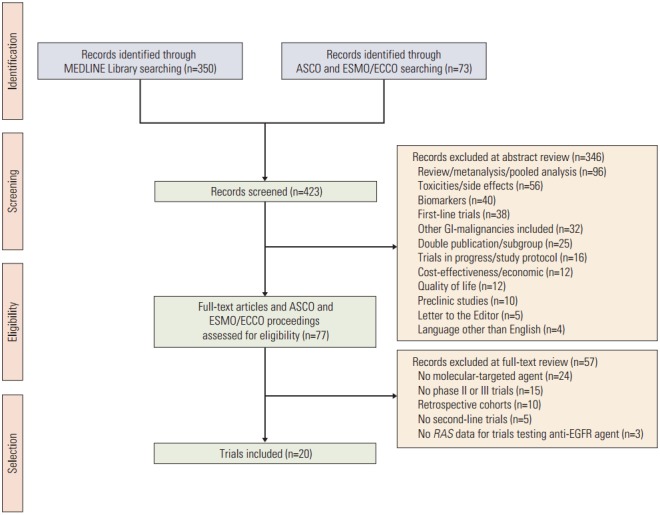
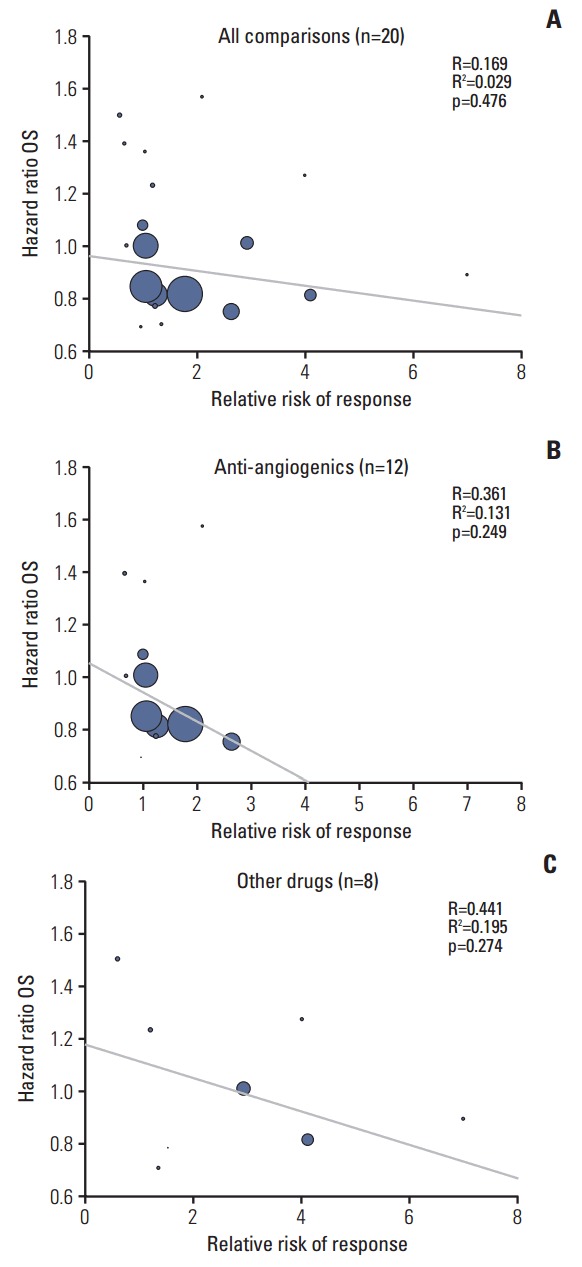
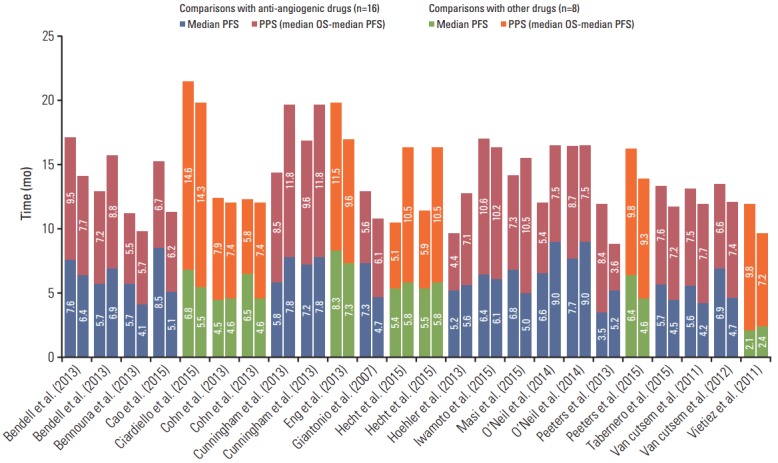
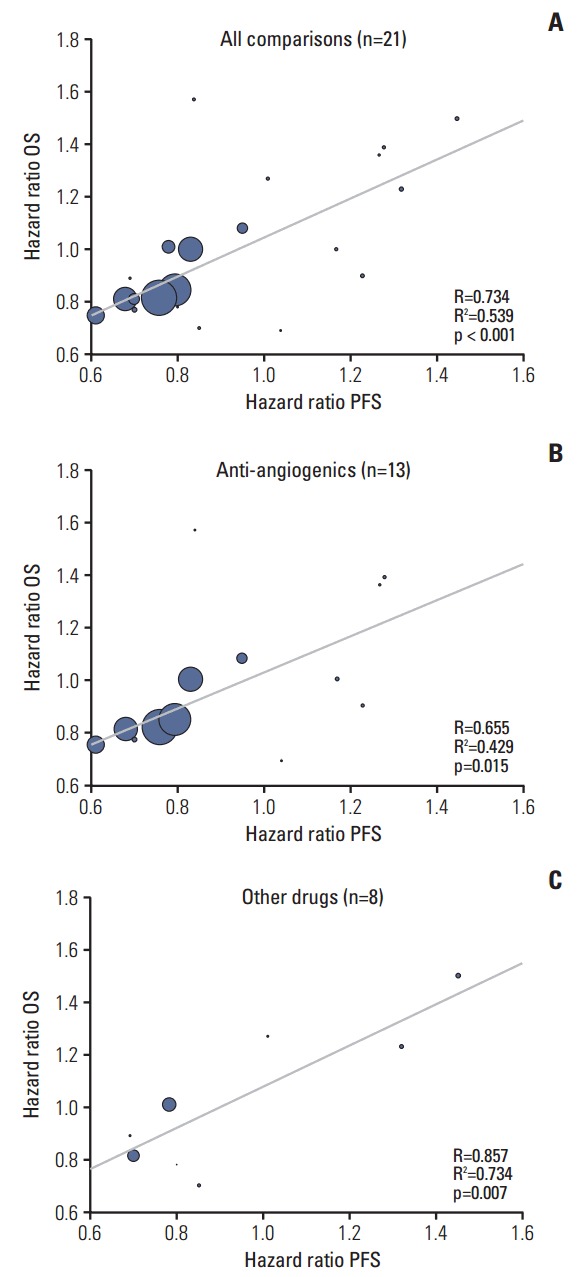
Twenty trials, including a total of 7,571 patients, met the search criteria. The median duration of post-progression survival (PPS) was 7.6 months. The median differences between experimental and control arms were 0.65 months (range, -2.4 to 3.4) for the median PFS and 0.7 months (range, -5.8 to 3.9) for the median OS. PFS and ORR showed moderate (R=0.734, R=0.539, p < 0.001) and poor correlation (R=0.169, R=0.029, p=0.476) with OS, respectively. No differences between anti-angiogenic agents and other drugs were evident.
Targeted agents investigated in the second-line treatment of mCRC provided minimal PFS gains translating into modest OS improvements. Considering both the moderate correlation between PFS and OS and the short duration of PPS, the OS should remain the preferred primary endpoint for randomized clinical trials in the second-line treatment of mCRC.
本研究旨在评估无进展生存期(PFS)和客观缓解率(ORR),作为现代临床试验中转移性结直肠癌(mCRC)二线治疗中靶向药物疗效的总生存期(OS)替代终点。
对评估靶向药物作为mCRC二线治疗的随机II期和III期试验相关文献进行系统检索。基于Pearson相关系数(R)和决定系数(R)评估PFS、ORR与OS之间的相关性强度。
20项试验,共纳入7571例患者,符合检索标准。进展后生存期(PPS)的中位数为7.6个月。试验组与对照组之间的中位数差异,PFS为0.65个月(范围为-2.4至3.4),OS为0.7个月(范围为-5.8至3.9)。PFS和ORR与OS的相关性分别为中等(R = 0.734,R = 0.539,p < 0.001)和较差(R = 0.169,R = 0.029,p = 0.476)。抗血管生成药物与其他药物之间无明显差异。
mCRC二线治疗中研究的靶向药物使PFS获得的改善极小,转化为OS的适度改善。考虑到PFS与OS之间的中等相关性以及PPS的持续时间较短,OS应仍然是mCRC二线治疗随机临床试验的首选主要终点。