
红桑(叶和嫩枝)非极性组分的植物化学研究、细胞毒性及自由基清除活性
Phytochemical investigation, cytotoxicity and free radical scavenging activities of non-polar fractions of Acalypha hispida (leaves and twigs).
作者信息
Onocha Patricia A, Oloyede G K, Afolabi Q O
机构信息
Natural products/Organic Chemistry Unit, Department of Chemistry, University of Ibadan, Nigeria.
出版信息
EXCLI J. 2011 Jan 24;10:1-8. eCollection 2011.
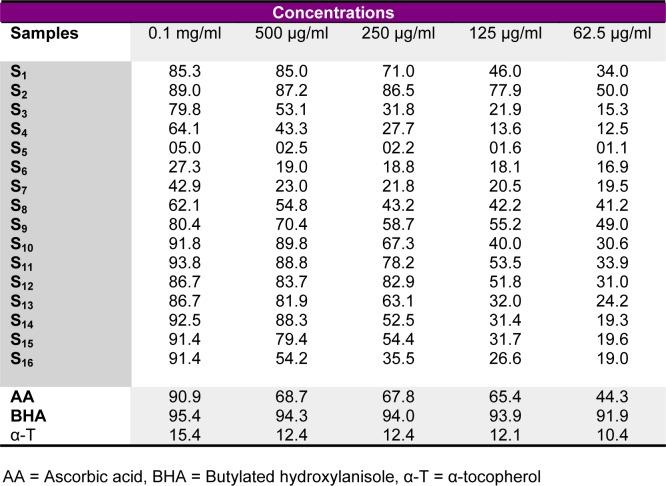
Free radicals are involved in the process of lipid peroxidation and play a cardinal role in numerous chronic diseases like cancer, coronary heart disease and ageing. Thus the ability to scavenge free radicals in order to minimize oxidative damage to living cells is very important. The hexane extract of (Burn F.) was screened for phytochemical constituents and was found to contain flavonoids, carbohydrates, phenols and alkaloids. Fractions obtained from chromatographic separation were screened for free radical scavenging activities using 2,2-diphenyl-1-picrylhydrazyl radical (DPPH) and hydrogen peroxide. Out of the sixteen pooled fractions (S-S) screened, compounds S (91.8 %), S (93.8 %), S (92.5 %) and S (91.4 %) at a concentration of 0.1 mg/ml had significant antioxidant activities when compared to the known antioxidant ascorbic acid (90.9 %). However, in the analysis using hydrogen peroxide, S (99.5 %), S (99.2 %), S (95.4 %),S (95.8 %) and S (95.6 %) gave better activity than ascorbic acid (94.8 %), while only S and S were more effective than butylated hydroxylanisole (98.9 %) and α-Tocopherol (99.1 %) at the same concentration. The cytotoxicity analysis using the Brine Shrimp lethality test gave LC values greater than 1000 μg/ml for some of the fractions indicating very low level of toxicity. The better scavenging activity of could be linked to the presence of secondary plant products like flavonoids and phenols, which have the ability to scavenge hydroxyl radicals, superoxide anions and lipid peroxy radicals.
自由基参与脂质过氧化过程,并在许多慢性疾病如癌症、冠心病和衰老中起主要作用。因此,清除自由基以尽量减少对活细胞的氧化损伤的能力非常重要。对(Burn F.)的己烷提取物进行了植物化学成分筛选,发现其含有黄酮类化合物、碳水化合物、酚类和生物碱。使用2,2-二苯基-1-苦基肼自由基(DPPH)和过氧化氢对色谱分离得到的馏分进行自由基清除活性筛选。在所筛选的16个合并馏分(S - S)中,浓度为0.1 mg/ml时,化合物S(91.8%)、S(93.8%)、S(92.5%)和S(91.4%)与已知抗氧化剂抗坏血酸(90.9%)相比具有显著的抗氧化活性。然而,在使用过氧化氢的分析中,S(99.5%)、S(99.2%)、S(95.4%)、S(95.8%)和S(95.6%)的活性比抗坏血酸(94.8%)更好,而在相同浓度下只有S和S比丁基羟基茴香醚(98.9%)和α-生育酚(99.1%)更有效。使用卤虫致死试验进行的细胞毒性分析表明,一些馏分的LC值大于1000 μg/ml,表明毒性水平非常低。(该提取物)更好的清除活性可能与黄酮类化合物和酚类等次生植物产物的存在有关,这些物质具有清除羟基自由基、超氧阴离子和脂质过氧自由基的能力。

 Zotero 插件