
乳腺癌细胞中HSP90调控的ERBB2降解多步骤过程的鉴定
Identification of an HSP90 modulated multi-step process for ERBB2 degradation in breast cancer cells.
作者信息
Castagnola Patrizio, Bellese Grazia, Birocchi Filippo, Gagliani Maria Cristina, Tacchetti Carlo, Cortese Katia
机构信息
Dipartimento di Terapie Oncologiche Integrate, IRCCS AOU San Martino - IST, Genova, Italy.
Dipartimento di Medicina Sperimentale, Anatomia Umana, Università di Genova, Italy.
出版信息
Oncotarget. 2016 Dec 20;7(51):85411-85429. doi: 10.18632/oncotarget.13392.
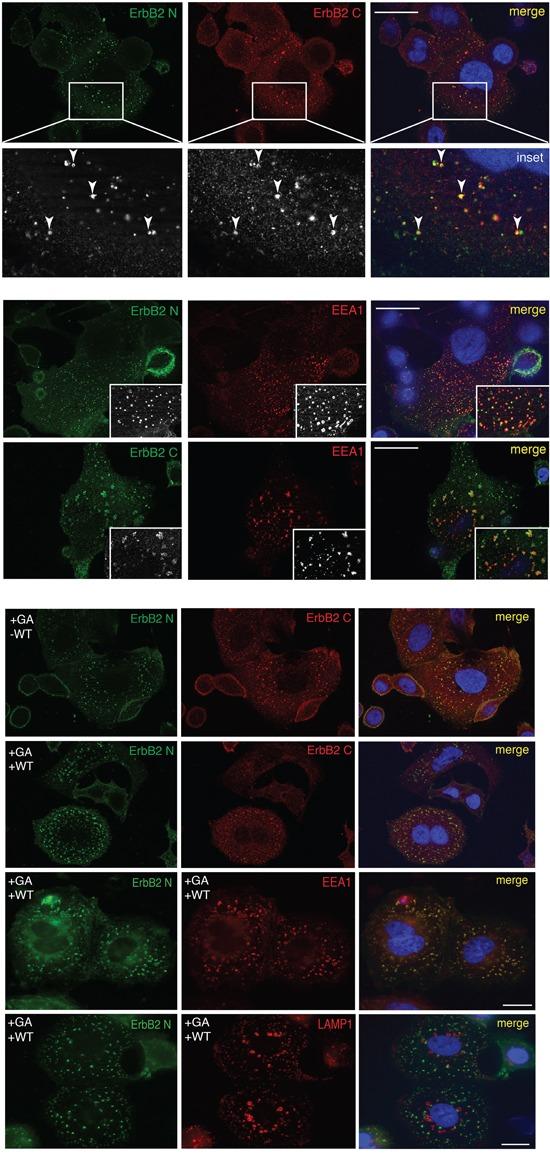
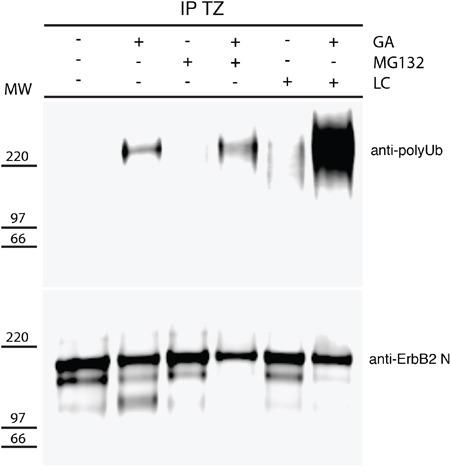
The receptor tyrosine kinase ERBB2 interacts with HSP90 and is overexpressed in aggressive breast cancers. Therapeutic HSP90 inhibitors, i.e. Geldanamycin (GA), target ERBB2 to degradation. We have previously shown that HSP90 is responsible for the missorting of recycling ERBB2 to degradation compartments. In this study, we used biochemical, immunofluorescence and electron microscopy techniques to demonstrate that in SKBR3 human breast cancer cells, GA strongly induces polyubiquitination and internalization of the full-length p185-ERBB2, and promotes its cleavage, with the formation of a p116-ERBB2 form in EEA1-positive endosomes (EE). p116-ERBB2 corresponds to a non-ubiquitinated, signaling-impaired, membrane-bound fragment, which is readily sorted to lysosomes and degraded. To define the sequence of events leading to p116-ERBB2 degradation, we first blocked the EE maturation/trafficking to late endosomes/lysosomes with wortmannin, and found an increase in GA-dependent formation of p116-ERBB2; we then inhibited the proteasome activity with MG-132 or lactacystin, and observed an efficient block of p185-ERBB2 cleavage, and its accumulation in EE, suggesting that p185-ERBB2 polyubiquitination is necessary for proteasome-dependent p116-ERBB2 generation occurring in EE. As polyubiquitination has also been implicated in autophagy-mediated degradation of ERBB2 under different experimental conditions, we exploited this possibility and demonstrate that GA strongly inhibits early autophagy, and reduces the levels of the autophagy markers atg5-12 and LC3-II, irrespective of GA-induced ERBB2 polyubiquitination, ruling out a GA-dependent autophagic degradation of ERBB2. In conclusion, we propose that HSP90 inhibition fosters ERBB2 polyubiquitination and proteasome-dependent generation of a non-ubiquitinated and inactive p116-ERBB2 form in EE, which is trafficked from altered EE to lysosomes.
受体酪氨酸激酶ERBB2与热休克蛋白90(HSP90)相互作用,在侵袭性乳腺癌中过表达。治疗性HSP90抑制剂,即格尔德霉素(GA),可靶向ERBB2使其降解。我们之前已经表明,HSP90负责将循环中的ERBB2错误分选至降解区室。在本研究中,我们使用生物化学、免疫荧光和电子显微镜技术来证明,在SKBR3人乳腺癌细胞中,GA强烈诱导全长p185-ERBB2的多聚泛素化和内化,并促进其裂解,在早期内体抗原1(EEA1)阳性内体(EE)中形成p116-ERBB2形式。p116-ERBB2对应于一种非泛素化、信号受损的膜结合片段,它很容易被分选至溶酶体并降解。为了确定导致p116-ERBB2降解的事件顺序,我们首先用渥曼青霉素阻断EE成熟/向晚期内体/溶酶体的转运,发现GA依赖性p116-ERBB2的形成增加;然后我们用MG-132或乳胞素抑制蛋白酶体活性,并观察到p185-ERBB2裂解的有效阻断及其在EE中的积累,这表明p185-ERBB2多聚泛素化对于EE中发生的蛋白酶体依赖性p116-ERBB2生成是必要的。由于在不同实验条件下,多聚泛素化也与自噬介导的ERBB2降解有关,我们利用了这种可能性并证明,GA强烈抑制早期自噬,并降低自噬标志物自噬相关蛋白5-12(atg5-12)和微管相关蛋白1轻链3-II(LC3-II)的水平,而与GA诱导的ERBB2多聚泛素化无关,排除了GA依赖性ERBB2的自噬降解。总之,我们提出HSP90抑制促进ERBB2多聚泛素化以及在EE中蛋白酶体依赖性生成一种非泛素化且无活性的p116-ERBB2形式,该形式从改变的EE转运至溶酶体。






 Zotero 插件