Tanabe Lauren M, List Karin
Department of Pharmacology, Barbara Ann Karmanos Cancer Institute, Wayne State University School of Medicine, Detroit, MI, USA.
Department of Oncology, Barbara Ann Karmanos Cancer Institute, Wayne State University School of Medicine, Detroit, MI, USA.
FEBS J. 2017 May;284(10):1421-1436. doi: 10.1111/febs.13971. Epub 2016 Dec 24.
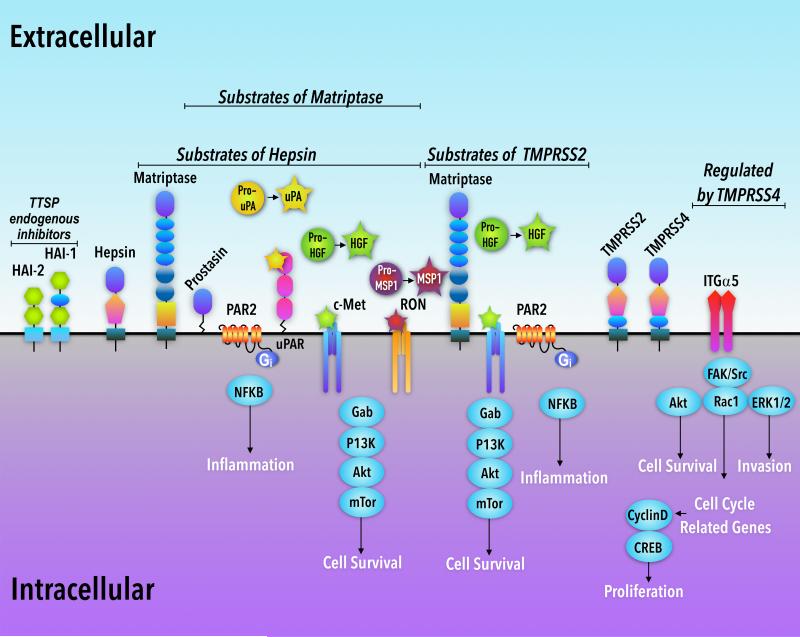
Pericellular proteases have long been implicated in carcinogenesis. Previous research focused on these proteins, primarily as extracellular matrix (ECM) protein-degrading enzymes which allowed cancer cells to breach the basement membrane and invade surrounding tissue. However, recently, there has been a shift in the view of cell surface proteases, including serine proteases, as proteolytic modifiers of particular targets, including growth factors and protease-activated receptors, which are critical for the activation of oncogenic signaling pathways. Of the 176 human serine proteases currently identified, a subset of 17, known as type II transmembrane serine proteases (TTSPs). Many have been shown to be relevant to cancer progression since they were first identified as a family around the turn of the century. To this end, altered expression of TTSPs appeared as a trademark of several tumor types. However, the substrates and underlying signaling pathways remained unclear. Localization of these proteins to the cell surface places them in the unique position to mediate signal transduction between the cell and its surrounding environment. Many of the TTSPs have already been shown to play key roles in processes such as postnatal development, tissue homeostasis, and tumor progression, which share overlapping molecular mechanisms. In this review, we summarize the current knowledge regarding the role of the TTSP family in pro-oncogenic signaling.
细胞周围蛋白酶长期以来一直被认为与癌症发生有关。以往的研究主要聚焦于这些蛋白质,将其视为细胞外基质(ECM)蛋白降解酶,这类酶可使癌细胞突破基底膜并侵入周围组织。然而,最近对于包括丝氨酸蛋白酶在内的细胞表面蛋白酶的看法有所转变,认为它们是特定靶点(包括生长因子和蛋白酶激活受体)的蛋白水解修饰剂,而这些靶点对于致癌信号通路的激活至关重要。在目前已鉴定出的176种人类丝氨酸蛋白酶中,有17种属于一个亚类,称为II型跨膜丝氨酸蛋白酶(TTSPs)。自本世纪初首次被确定为一个家族以来,许多TTSPs已被证明与癌症进展相关。为此,TTSPs的表达改变已成为几种肿瘤类型的一个特征。然而,其底物和潜在的信号通路仍不清楚。这些蛋白质定位于细胞表面,使其处于介导细胞与其周围环境之间信号转导的独特位置。许多TTSPs已被证明在出生后发育、组织稳态和肿瘤进展等过程中发挥关键作用,这些过程具有重叠的分子机制。在本综述中,我们总结了目前关于TTSP家族在促癌信号传导中作用的知识。