Erwin-Cohen Rebecca A, Porter Aimee I, Pittman Phillip R, Rossi Cynthia A, DaSilva Luis
a Virology Division, United States Army Military Research Institute of Infectious Diseases (USAMRIID) , Frederick , MD , USA.
b Division of Medicine, United States Army Military Research Institute of Infectious Diseases (USAMRIID) , Frederick , MD , USA.
Hum Vaccin Immunother. 2017 Jan 2;13(1):169-179. doi: 10.1080/21645515.2016.1227900. Epub 2016 Nov 21.
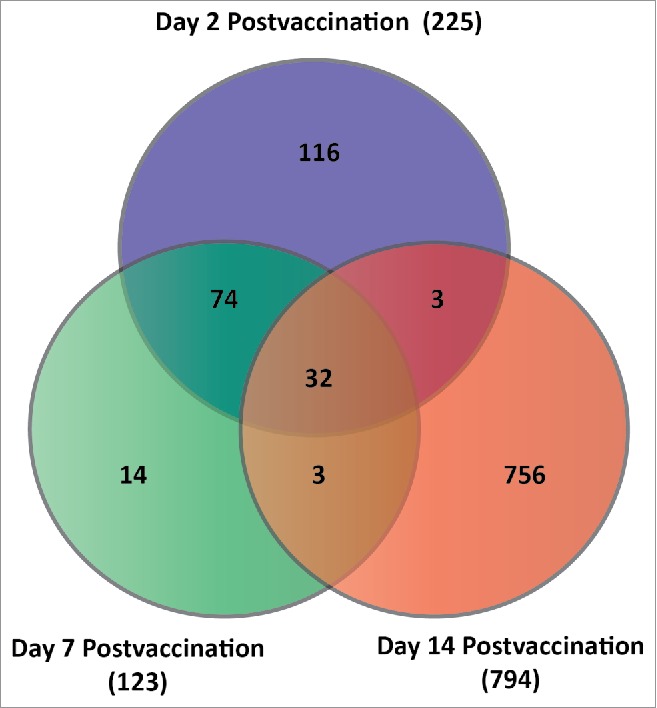
Venezuelan equine encephalitis virus (VEEV) is an important human and animal alphavirus pathogen transmitted by mosquitoes. The virus is endemic in Central and South America, but has also caused equine outbreaks in southwestern areas of the United States. In an effort to better understand the molecular mechanisms of the development of immunity to this important pathogen, we performed transcriptional analysis from whole, unfractionated human blood of patients who had been immunized with the live-attenuated vaccine strain of VEEV, TC-83. We compared changes in the transcriptome between naïve individuals who were mock vaccinated with saline to responses of individuals who received TC-83. Significant transcriptional changes were noted at days 2, 7, and 14 following vaccination. The top canonical pathways revealed at early and intermediate time points (days 2 and 7) included the involvement of the classic interferon response, interferon-response factors, activation of pattern recognition receptors, and engagement of the inflammasome. By day 14, the top canonical pathways included oxidative phosphorylation, the protein ubiquitination pathway, natural killer cell signaling, and B-cell development. Biomarkers were identified that differentiate between vaccinees and control subjects, at early, intermediate, and late stages of the development of immunity as well as markers which were common to all 3 stages following vaccination but distinct from the sham-vaccinated control subjects. The study represents a novel examination of molecular processes that lead to the development of immunity against VEEV in humans and which may be of value as diagnostic targets, to enhance modern vaccine design, or molecular correlates of protection.
委内瑞拉马脑炎病毒(VEEV)是一种由蚊子传播的重要的人和动物甲病毒病原体。该病毒在中美洲和南美洲流行,但也曾在美国西南部地区引发马疫情。为了更好地了解对这种重要病原体产生免疫的分子机制,我们对用VEEV减毒活疫苗株TC - 83免疫的患者的全血(未分级)进行了转录分析。我们比较了用生理盐水进行假接种的未免疫个体与接受TC - 83个体的转录组变化。在接种后的第2天、第7天和第14天观察到显著的转录变化。在早期和中期时间点(第2天和第7天)显示的顶级经典通路包括经典干扰素反应、干扰素反应因子的参与、模式识别受体的激活以及炎性小体的参与。到第14天,顶级经典通路包括氧化磷酸化、蛋白质泛素化途径、自然杀伤细胞信号传导和B细胞发育。确定了在免疫发育的早期、中期和晚期区分接种疫苗者和对照受试者的生物标志物,以及接种后所有三个阶段共有的但与假接种对照受试者不同的标志物。这项研究代表了对导致人类对VEEV产生免疫的分子过程的新研究,这些过程可能作为诊断靶点具有价值,以加强现代疫苗设计或保护的分子关联。