Das Supratik, Boliar Saikat, Mitra Nivedita, Samal Sweety, Bansal Manish, Koff Wayne C, Chakrabarti Bimal K
THSTI-IAVI HIV Vaccine Design Program, Translational Health Science and Technology Institute, NCR Biotech Science Cluster, 3rd Milestone, Faridabad-Gurgaon Expressway, PO box #04, Faridabad, Haryana, 121001, India.
International AIDS Vaccine Initiative, New York, NY, USA.
Retrovirology. 2016 Nov 21;13(1):81. doi: 10.1186/s12977-016-0312-7.
Antigenicity of HIV-1 envelope proteins (Envs) of both lab-adapted and primary isolates expressed on the cell surface rarely match with in vitro neutralization of viruses, pseudo-typed with corresponding Envs. Often, both neutralizing and non-neutralizing antibodies bind to Envs expressed on the cell membrane. This could be due to the lack of efficient cleavage of Env expressed on the cell surface. Naturally occurring, efficiently cleaved Envs with appropriate antigenic properties are relatively rare. Given viral diversity it is essential to increase the pool of candidate Envs suitable for immunogen design. Previously, it has been reported that JRFL Env is the only clade B Env, which is efficiently cleaved on the cell surface and retains desirable antigenic properties. JRCSF is a clade B Env isolated from the same patient as JRFL. JRCSF Env has not been explored aggressively for designing immunogen as the binding characteristics of JRCSF Env to broadly neutralizing antibodies on the cell surface and its cleavage status are unknown.
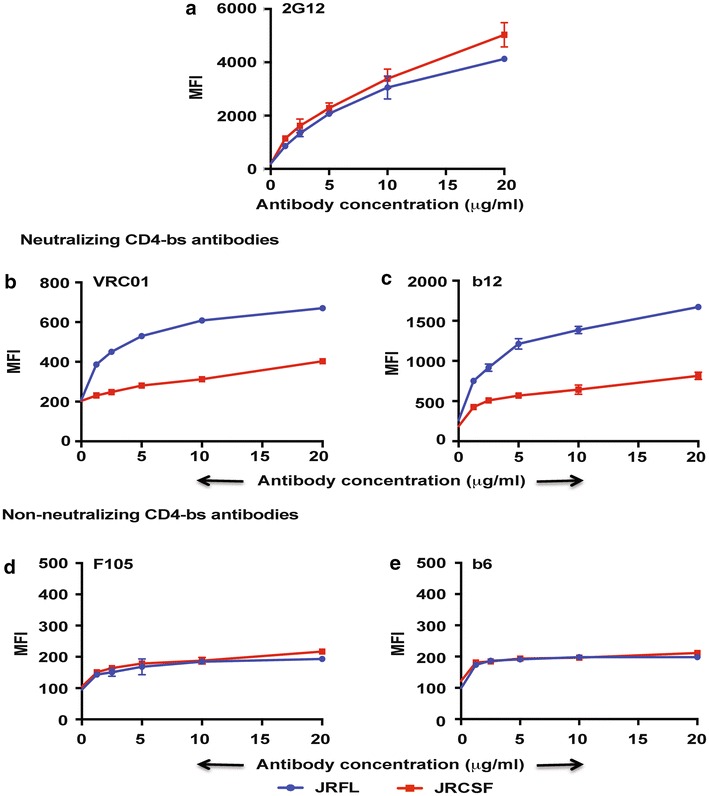
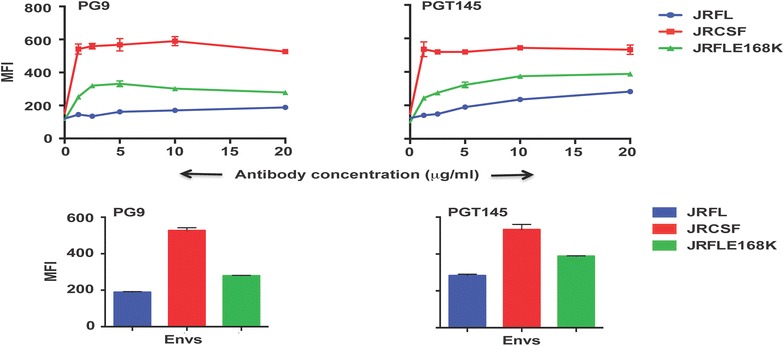
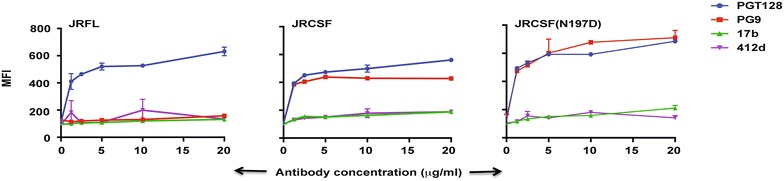
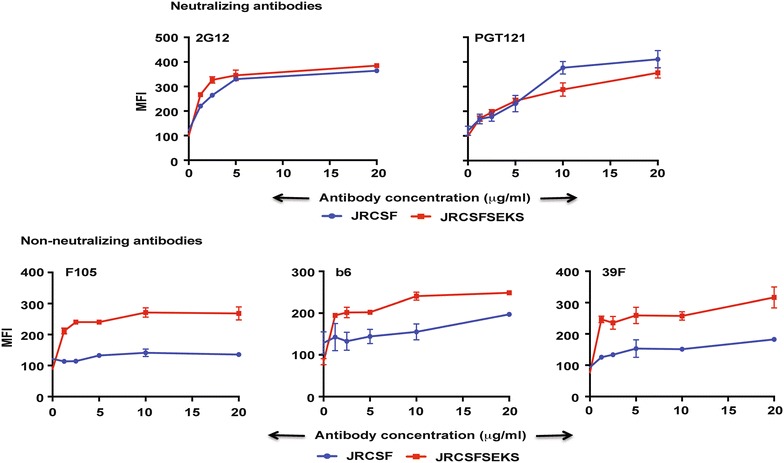
Although JRCSF preferentially binds to most of the other gp120-directed neutralizing antibodies and cleavage dependent antibody, PGT151 efficiently, it binds poorly to CD4-binding-site-directed (CD4-bs-directed) neutralizing antibodies on cell surface. Membrane bound form of modified JRCSF Env containing the N197D mutation binds to CD4-bs-directed neutralizing antibodies better than JRFL, without debilitating its ability to bind quaternary epitope-directed neutralizing antibodies or exposing the CD4i antibody epitopes. In comparison to JRFL (E168K), JRCSF Env binds more efficiently to PG9/PGT145 class of V1/V2-directed conformational antibodies. Biochemical, cell surface staining and gp120 shedding experiments suggest that JRCSF is efficiently cleaved on the cell surface.
Binding of JRCSF Env expressed on cell surface to the various HIV-1 Env-directed antibodies has not been reported earlier. Here, for the first time, we report that compared to JRFL, JRCSF displays epitopes for a larger number of broadly neutralizing antibodies and is also efficiently cleaved when expressed on the cell surface. Thus, considering the diversity of viral Envs and the discovery of conformation dependent glycan-directed antibodies in HIV-1 infected individuals, an innately cleaved JRCSF Env as present on the viral membrane and displaying those distinct epitopes may be an important candidate for immunogen design.
在细胞表面表达的实验室适应性和原代分离株的HIV-1包膜蛋白(Env)的抗原性很少与用相应Env假型化的病毒的体外中和作用相匹配。通常,中和抗体和非中和抗体都会与细胞膜上表达的Env结合。这可能是由于细胞表面表达的Env缺乏有效的切割。具有适当抗原特性的天然存在的、有效切割的Env相对较少。鉴于病毒的多样性,增加适合免疫原设计的候选Env库至关重要。此前有报道称,JRFL Env是唯一一种在细胞表面能有效切割并保留理想抗原特性的B亚型Env。JRCSF是从与JRFL相同患者体内分离出的一种B亚型Env。由于JRCSF Env在细胞表面与广泛中和抗体的结合特性及其切割状态尚不清楚,因此尚未对其进行积极的免疫原设计探索。
尽管JRCSF能优先高效地结合大多数其他针对gp120的中和抗体和切割依赖性抗体PGT151,但它与细胞表面针对CD4结合位点(CD4-bs)的中和抗体结合较差。含有N197D突变的修饰JRCSF Env的膜结合形式与针对CD4-bs的中和抗体的结合能力比JRFL更好,同时又不削弱其结合四级表位导向中和抗体的能力或暴露CD4i抗体表位。与JRFL(E168K)相比,JRCSF Env与PG9/PGT145这类针对V1/V2的构象抗体结合更有效。生化、细胞表面染色和gp120脱落实验表明,JRCSF在细胞表面能有效切割。
此前尚未报道过细胞表面表达的JRCSF Env与各种HIV-1 Env导向抗体的结合情况。在此,我们首次报道,与JRFL相比,JRCSF能与更多广泛中和抗体形成表位,并且在细胞表面表达时也能有效切割。因此,考虑到病毒Env的多样性以及在HIV-1感染个体中发现的构象依赖性聚糖导向抗体,病毒膜上天然存在的、能有效切割并展示这些独特表位的JRCSF Env可能是免疫原设计的重要候选物。