Sarbishegi Maryam, Khajavi Ozra, Arab Mohammad Reza
Cellular and Molecular Research Center, Zahedan University of Medical Sciences, Zahedan, IR Iran; Department of Anatomy, School of Medicine, Zahedan University of Medical Sciences, Zahedan, IR Iran.
Department of Anatomy, School of Medicine, Zahedan University of Medical Sciences, Zahedan, IR Iran.
Nephrourol Mon. 2016 Aug 24;8(5):e39284. doi: 10.5812/numonthly.39284. eCollection 2016 Sep.
Phytotherapy is a popular treatment option in cases of benign prostatic hyperplasia (BPH), with many different herbal products being used for the treatment of this condition. (WC) is an herbal medicine that has shown anti-tumoral, anti-inflammatory, and antioxidant effects.
This study examined the effect of extract (WCE) on prostatic cell apoptosis and cyclooxygenase-2 (COX-2) expression in cases of benign prostatic hyperplasia (BPH) in rats.
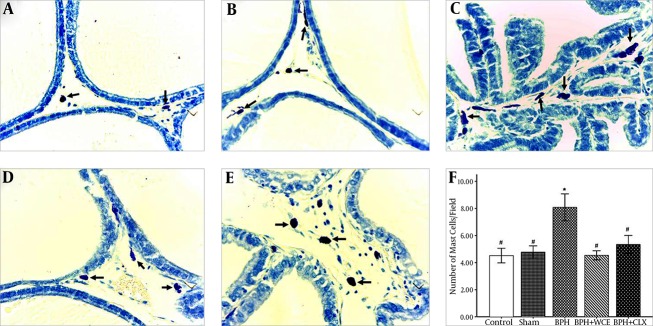
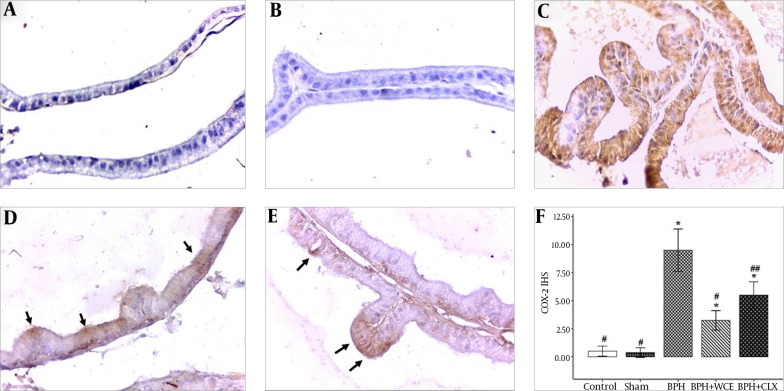
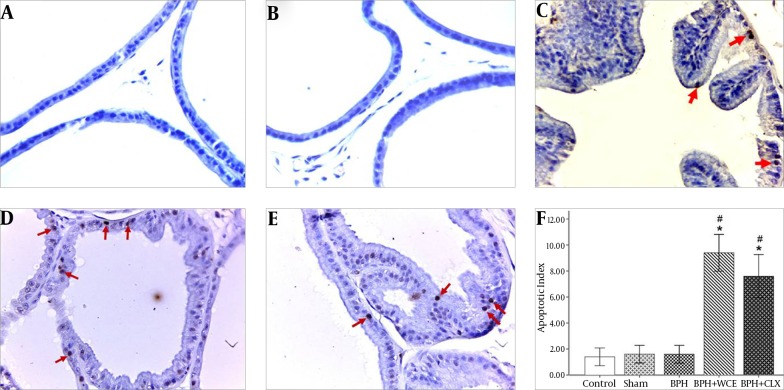
Forty Wistar rats were equally divided into five groups: control, sham, BPH, BPH + WCE, and BPH + CLX (celecoxib) as a positive control group. The induction of BPH was achieved via the subcutaneous injection of 3 mg/kg of testosterone propionate (TP) daily for 28 days. The animals received WCE, celecoxib, or distilled water by oral gavage accompanied by the TP injection. After four weeks, the prostate glands of the rats were weighed to measure the prostatic index (PI). The ventral lobes of the prostates were dissected and processed with paraffin blocks in order to study the number of mast cells. A TUNEL analysis was performed to evaluate the cell apoptosis, while the expression of COX-2 was examined using immunohistochemistry.
BPH was obvious in the ventral lobe of the prostate, and the administration of WCE markedly decreased the PI and the number of mast cells (P < 0.001) in the BPH rats. Additionally, the WCE treatment induced prostatic cell apoptosis when compared to the BPH group. Furthermore, following the WCE treatment, the expression of COX-2 in the prostatic tissues was significantly decreased when compared to the BPH groups.
According to the results of this study, WCE was effective in the treatment of BPH in rats. It may therefore have beneficial effects in the treatment of patients with BPH.
植物疗法是良性前列腺增生(BPH)病例中一种流行的治疗选择,许多不同的草药产品被用于治疗这种疾病。(WC)是一种具有抗肿瘤、抗炎和抗氧化作用的草药。
本研究检测了提取物(WCE)对大鼠良性前列腺增生(BPH)病例中前列腺细胞凋亡和环氧化酶-2(COX-2)表达的影响。
40只Wistar大鼠平均分为五组:对照组、假手术组、BPH组、BPH + WCE组和BPH + CLX(塞来昔布)作为阳性对照组。通过每天皮下注射3 mg/kg丙酸睾酮(TP),持续28天来诱导BPH。在注射TP的同时,动物通过口服灌胃接受WCE、塞来昔布或蒸馏水。四周后,称重大鼠的前列腺以测量前列腺指数(PI)。解剖前列腺的腹叶并用石蜡块处理,以研究肥大细胞的数量。进行TUNEL分析以评估细胞凋亡,同时使用免疫组织化学检测COX-2的表达。
前列腺腹叶中BPH明显,WCE给药显著降低了BPH大鼠的PI和肥大细胞数量(P < 0.001)。此外,与BPH组相比,WCE治疗诱导了前列腺细胞凋亡。此外,与BPH组相比,WCE治疗后前列腺组织中COX-2的表达显著降低。
根据本研究结果,WCE对大鼠BPH治疗有效。因此,它可能对BPH患者的治疗有有益作用。