Department of Urology, Tongji Hospital, Tongji Medical College, Huazhong University of Science and Technology, Wuhan, P.R. China.
Hubei Institute of Urology, Wuhan, P.R. China.
Clin Cancer Res. 2017 Jul 1;23(13):3428-3441. doi: 10.1158/1078-0432.CCR-16-2020. Epub 2016 Nov 22.
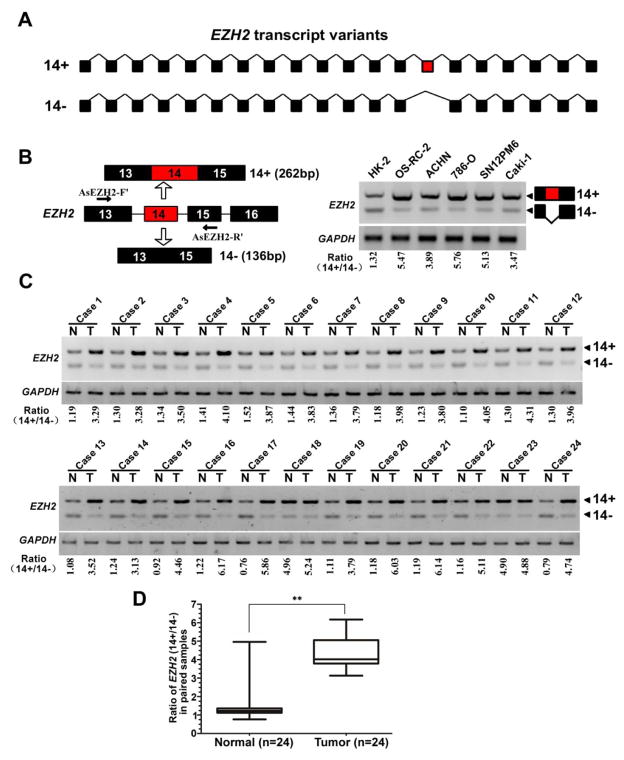
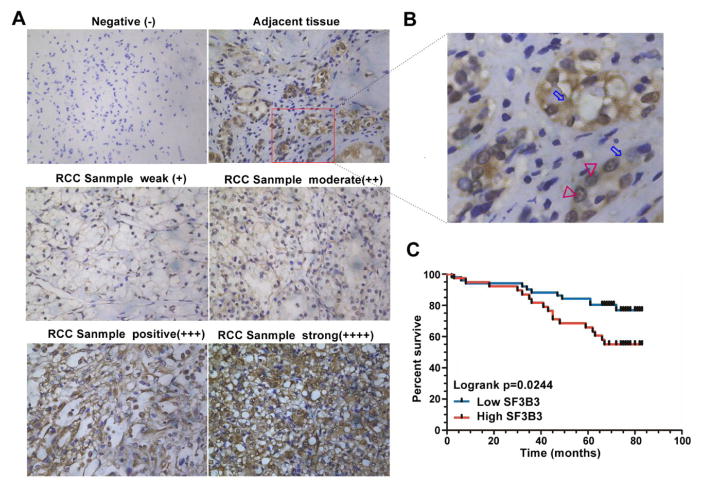
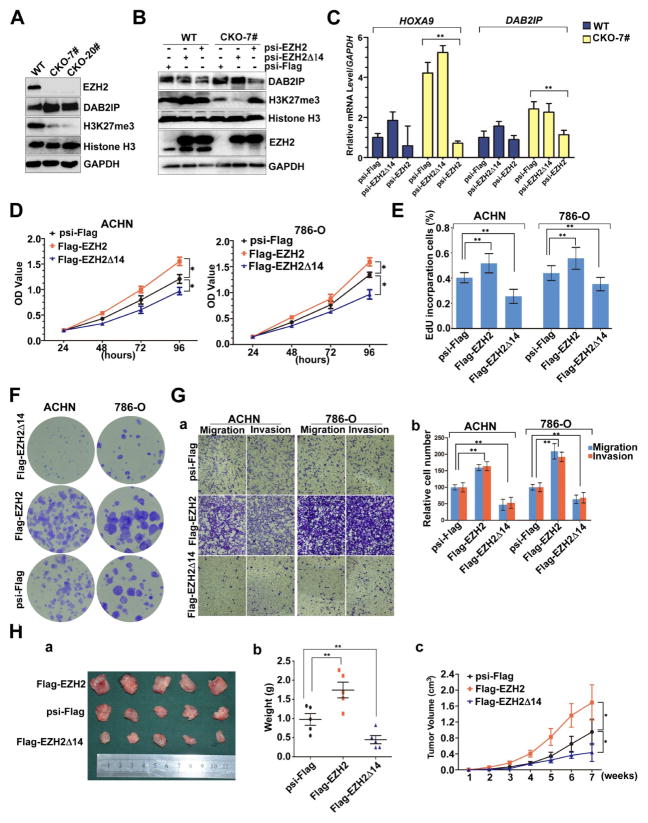
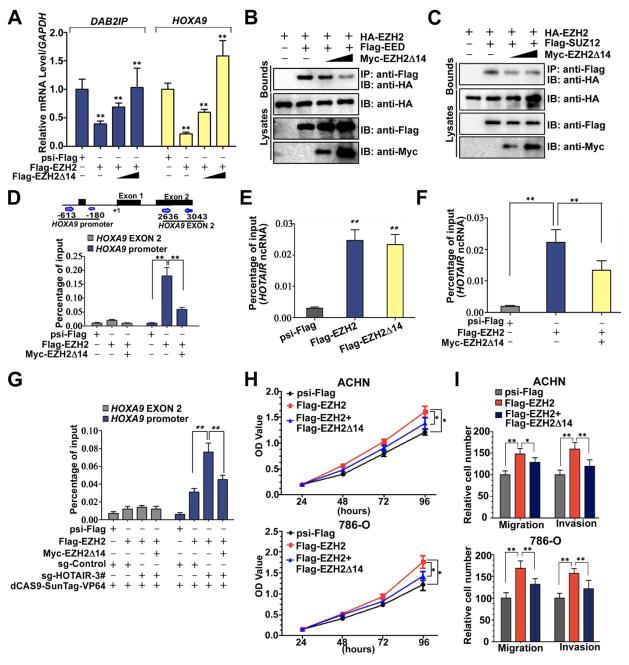
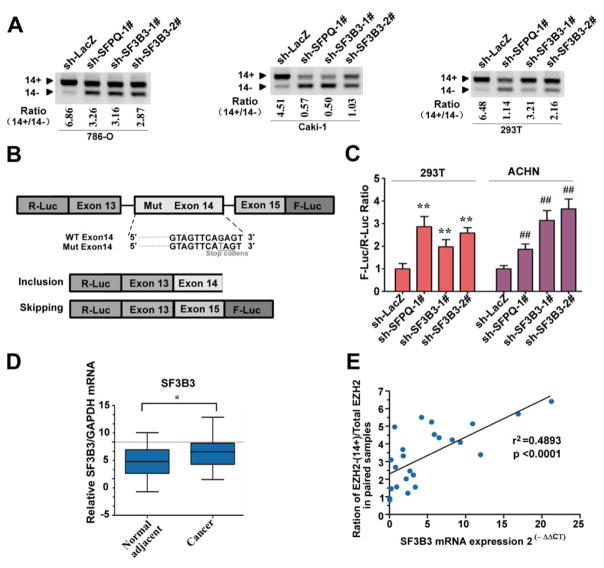
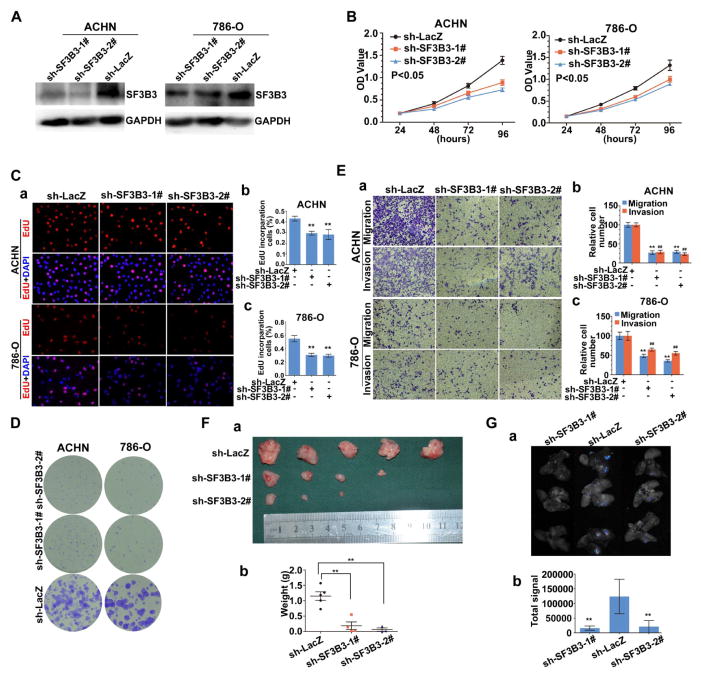
Deregulation or mutation of the gene causes various tumors, including clear cell renal cell carcinoma (ccRCC). Although several splice variants of EZH2 have been identified, little is known about how EZH2 splicing is regulated or the contribution of alternative splicing to its protumorigenic functions. We conducted RT-PCR, Western blot analysis, and IHC techniques to examine EZH2 and its alternative splicing transcript expression in renal cancer tissue and renal cancer cell lines. Proliferation, migration, clonogenicity, and tumorigenicity of renal cancer cells either exhibiting knockdown of EZH2 or its splicing factor SF3B3 were assessed by CCK8, Transwell assay, and murine xenograft experiments. We found that the inclusion of alternative EZH2 exon 14 was significantly increased in ccRCC samples and renal cancer cell lines. In ccRCC lines, enforced expression of EZH2Δ14 inhibited, and EZH2 promoted, cell growth, migration, proliferation, and tumorigenicity in a xenograft model. Mechanistic studies demonstrated that EZH2Δ14 isoform functions as a dominant-negative inhibitor of full-length EZH2. Coexpression of EZH2Δ14 variant with full-length EZH2 not only abrogated DAB2IP and HOXA9 suppression but also inhibited EZH2-driven tumorigenesis. Strikingly, the splicing factor SF3B3 stimulates inclusion of exon14 and has pro-proliferative activity. Importantly, the upregulation of SF3B3 expression observed in clinical ccRCC samples parallels the increased inclusion of EZH2 exon14, and the SF3B3 level is associated with higher tumor stage and poor overall survival. These results suggest SF3B3 as a key regulator of EZH2 pre-mRNA splicing and SF3B3 may represent a novel prognostic factor and potential therapeutic target in ccRCC. .
基因的失调或突变导致各种肿瘤,包括透明细胞肾细胞癌(ccRCC)。尽管已经鉴定出 EZH2 的几种剪接变体,但对于 EZH2 剪接如何受到调节或其剪接变体对其促肿瘤功能的贡献知之甚少。我们通过 RT-PCR、Western blot 分析和 IHC 技术检测了肾癌组织和肾癌细胞系中 EZH2 及其剪接变体转录本的表达。通过 CCK8、Transwell 测定和小鼠异种移植实验评估了 EZH2 表达降低或其剪接因子 SF3B3 降低的肾癌细胞的增殖、迁移、集落形成和致瘤性。我们发现,ccRCC 样本和肾癌细胞系中 EZH2 外显子 14 的剪接明显增加。在 ccRCC 系中,EZH2Δ14 的强制表达抑制了细胞生长、迁移、增殖和异种移植模型中的致瘤性,而 EZH2 则促进了细胞生长、迁移、增殖和异种移植模型中的致瘤性。机制研究表明,EZH2Δ14 同工型作为全长 EZH2 的显性负抑制剂发挥作用。全长 EZH2 与 EZH2Δ14 变体的共表达不仅消除了 DAB2IP 和 HOXA9 的抑制作用,而且抑制了 EZH2 驱动的肿瘤发生。引人注目的是,剪接因子 SF3B3 刺激外显子 14 的包含,并具有促增殖活性。重要的是,临床 ccRCC 样本中观察到的 SF3B3 表达上调与 EZH2 外显子 14 的包含增加相平行,SF3B3 水平与更高的肿瘤分期和不良的总生存期相关。这些结果表明 SF3B3 是 EZH2 前体 mRNA 剪接的关键调节剂,SF3B3 可能代表 ccRCC 的一个新的预后因素和潜在的治疗靶点。