Yuan Qiang, Bu Xing-Yao, Yan Zhao-Yue, Liu Xian-Zhi, Wei Zhen-Yu, Ma Chun-Xiao, Qu Ming-Qi
Department of Neurosurgery, People's Hospital of Zhengzhou University, Zhengzhou, Henan 450003, P.R. China.
Department of Neurosurgery, The First Affiliated Hospital of Zhengzhou University, Zhengzhou, Henan 450003, P.R. China.
Exp Ther Med. 2016 Nov;12(5):3275-3281. doi: 10.3892/etm.2016.3778. Epub 2016 Oct 4.
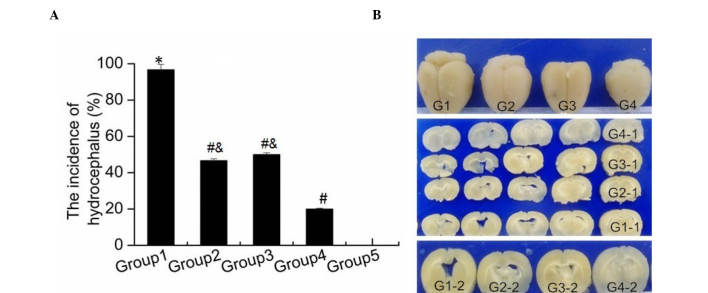
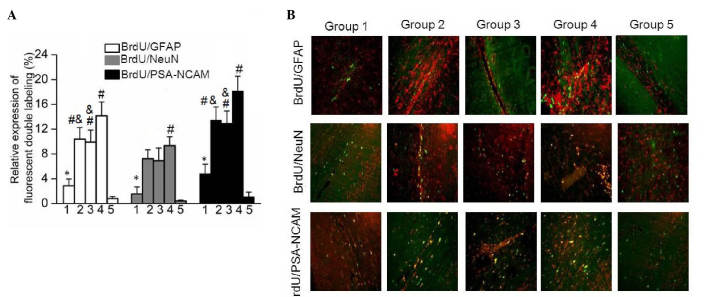
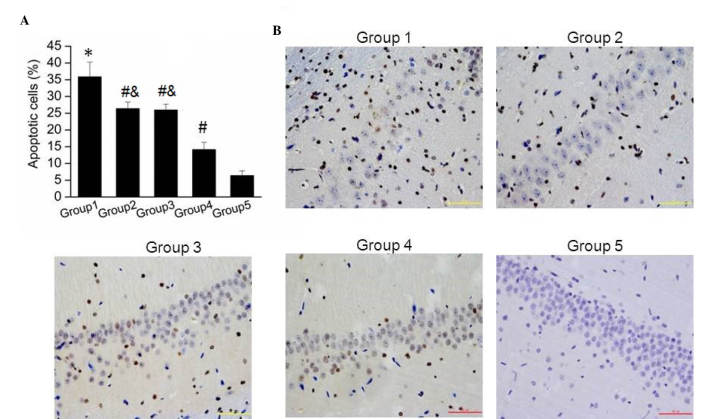
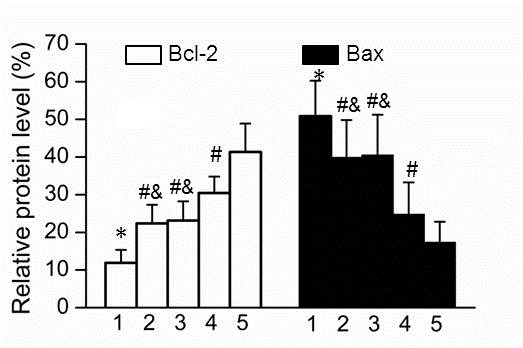
As there are multiple factors causing hydrocephalus subsequent to intraventricular hemorrhage (IVH), it is difficult to achieve the best treatment effect using a single drug alone. In the present study, the protective effect of combination treatment with granulocyte-colony stimulating factor (G-CSF) and lithium chloride against hydrocephalus after IVH was investigated. A total of 130 adult male Sprague-Dawley rats were divided into five groups, including the IVH control, G-CSF treatment, lithium chloride treatment, combination treatment and sham surgery groups. An IVH rat model was established in order to examine the effect of combination treatment on hydrocephalus incidence. A TUNEL assay was performed to detect neuronal apoptosis in the five groups. In addition, the protein expression levels of B-cell lymphoma 2 (Bcl-2) and Bcl-2-associated X protein (Bax) were detected by western blot analysis. The differentiation of nerve cells in the brain tissue obtained from the five rat groups was also determined with double immunofluorescence staining. The results demonstrated that administration of G-CSF or lithium chloride alone was able to only partly relieve the incidence of hydrocephalus after IVH. By contrast, combination treatment with G-CSF and lithium chloride significantly attenuated the development of hydrocephalus following IVH. TUNEL assay showed that neuronal apoptosis was significantly reduced by the combination treatment with G-CSF and lithium chloride. Furthermore, the expression of Bcl-2 was upregulated, whereas Bax expression was downregulated in the combination treatment group. The results also detected the highest expression of BrdU/GFAP, BrdU/NeuN and BrdU/PSA-NCAM in the combination treatment group. In conclusion, the combination of endogenous neural stem cell mobilization (using G-CSF) and lithium chloride treatment resulted in highly reduced incidence of hydrocephalus after IVH by inhibiting neuronal apoptosis.
由于存在多种因素导致脑室内出血(IVH)后发生脑积水,仅使用单一药物难以达到最佳治疗效果。在本研究中,研究了粒细胞集落刺激因子(G-CSF)和氯化锂联合治疗对IVH后脑积水的保护作用。总共130只成年雄性Sprague-Dawley大鼠被分为五组,包括IVH对照组、G-CSF治疗组、氯化锂治疗组、联合治疗组和假手术组。建立IVH大鼠模型以检查联合治疗对脑积水发生率的影响。进行TUNEL检测以检测五组中的神经元凋亡。此外,通过蛋白质印迹分析检测B细胞淋巴瘤2(Bcl-2)和Bcl-2相关X蛋白(Bax)的蛋白表达水平。还用双重免疫荧光染色确定了从五组大鼠获得的脑组织中神经细胞的分化情况。结果表明,单独给予G-CSF或氯化锂只能部分缓解IVH后脑积水的发生率。相比之下,G-CSF和氯化锂联合治疗显著减轻了IVH后脑积水的发展。TUNEL检测表明,G-CSF和氯化锂联合治疗显著减少了神经元凋亡。此外,联合治疗组中Bcl-2的表达上调,而Bax表达下调。结果还检测到联合治疗组中BrdU/GFAP、BrdU/NeuN和BrdU/PSA-NCAM的表达最高。总之,内源性神经干细胞动员(使用G-CSF)和氯化锂治疗的联合通过抑制神经元凋亡导致IVH后脑积水的发生率大幅降低。