Klein H, Sterk C E, Elifson K W
Department of Behavioral Sciences and Health Education, Rollins School of Public Health, Emory University Atlanta, Georgia.
J AIDS Clin Res. 2016 Oct;7(10). doi: 10.4172/2155-6113.1000622. Epub 2016 Oct 8.
Race and HIV are intertwined in complex ways. African Americans, particularly those residing in the southern United States, are at great risk for contracting and subsequently transmitting HIV. Research on the extent to which members of this population understand the risks associated with engaging in specific behaviors is limited. This paper examines HIV knowledge among at-risk adult African American men and women and the factors associated with levels of HIV knowledge.
Based on a conceptual model derived from Social Disorganization Theory and Syndemics Theory, interviews were conducted between 2009 and 2011. Questionnaire-based interviews were conducted with 1,864 respondents from 80 strategically-chosen census block groups in Atlanta, Georgia. An innovative approach to assessing amount of HIV knowledge was implemented, to derive better estimates of the extent of knowledge.
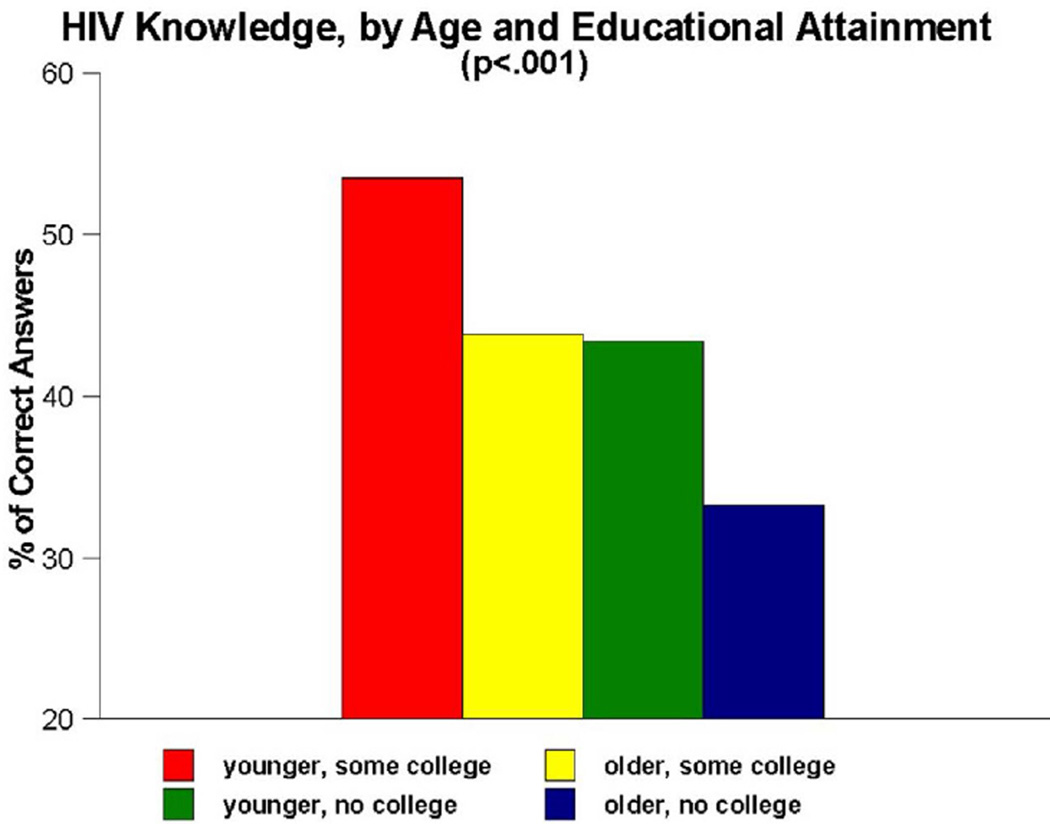
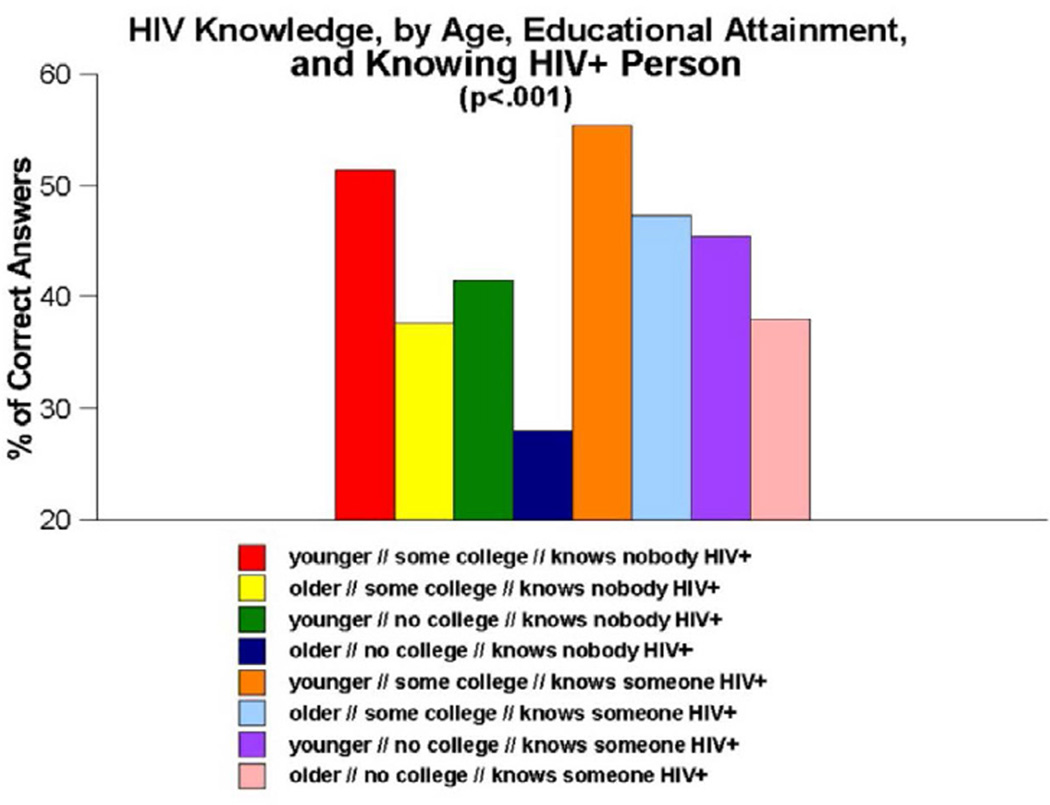
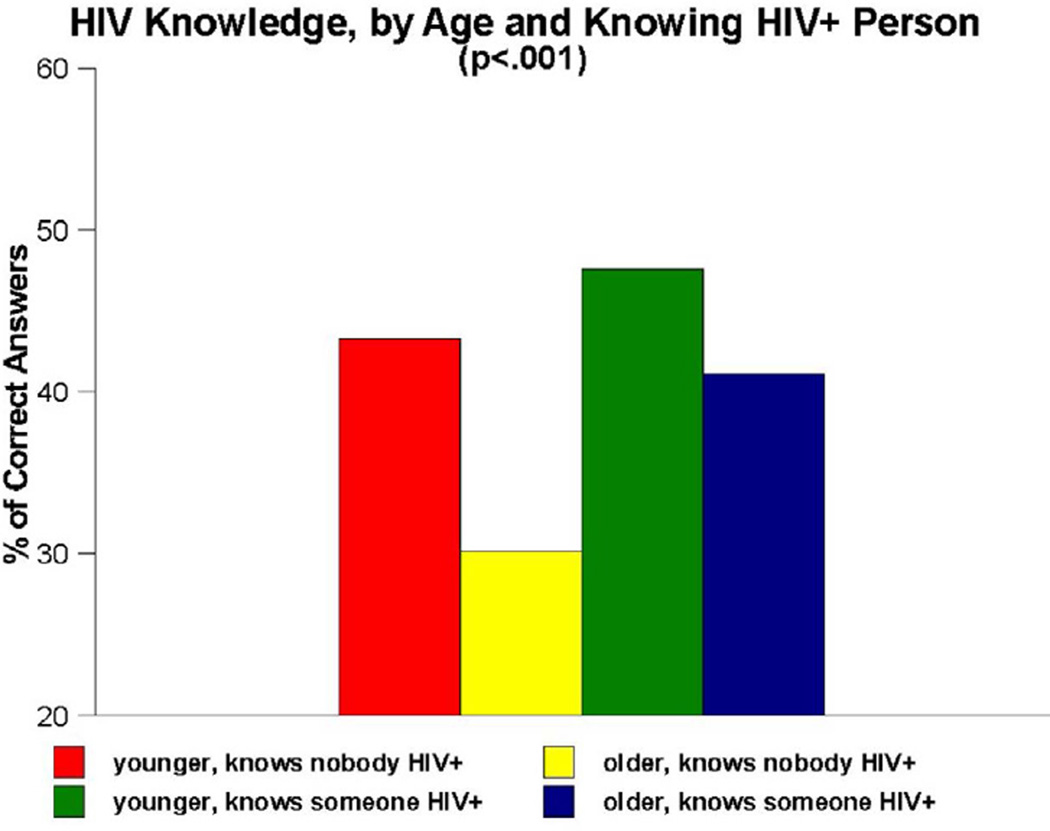
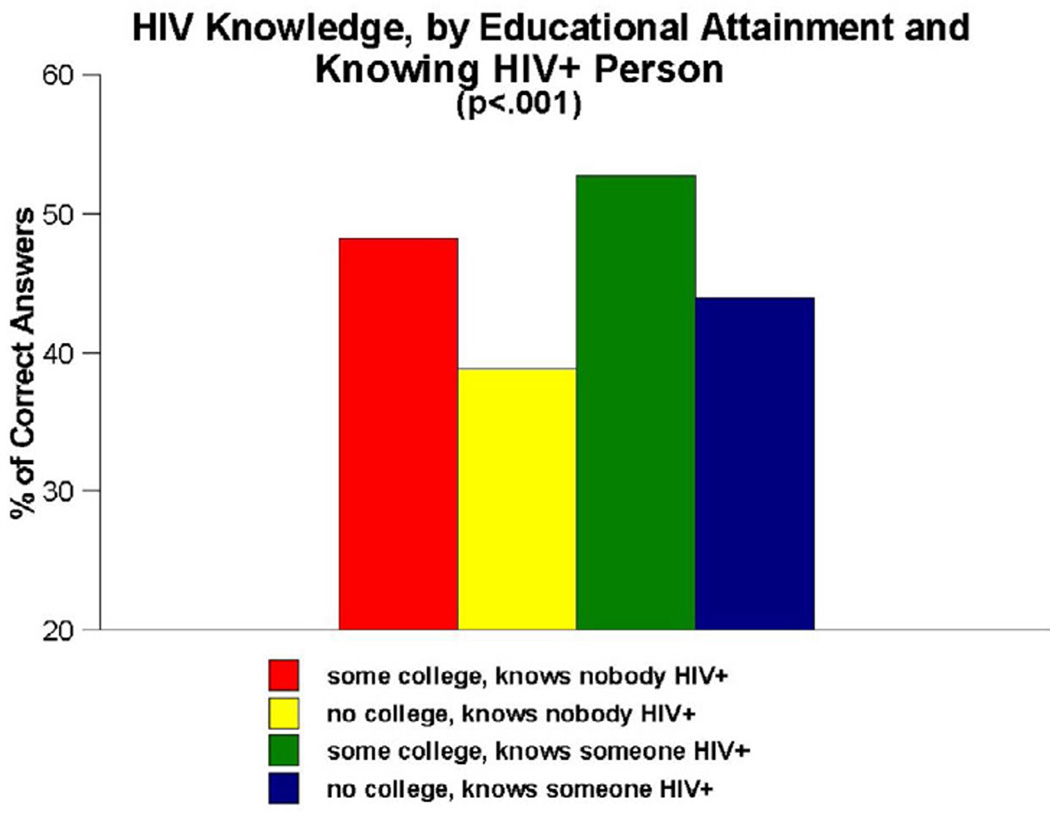
Overall, HIV knowledge was low (average=43.5% correct answers). Seven factors were identified as contributing uniquely to having higher levels of knowledge about HIV transmission: (1) younger age, (2) being educated beyond the high school level, (3) being gay, lesbian or bisexual, (4) experiencing sexual abuse during childhood and/or adolescence, (5) drinking alcohol less frequently, (6) knowing a larger number of HIV-infected persons and (7) knowing anyone currently living with "full blown" AIDS.
HIV educational and intervention programs targeting at-risk African American adults need to develop effective ways of bolstering a solid understanding of how HIV is/not transmitted. In particular, efforts need to be targeted toward older adults, those with lower levels of educational attainment and persons who are not acquainted with anyone who is HIV-infected.
种族与艾滋病病毒以复杂的方式相互交织。非裔美国人,尤其是居住在美国南部的那些人,感染并随后传播艾滋病病毒的风险极大。关于这一人群对特定行为相关风险的理解程度的研究有限。本文考察了有风险的成年非裔美国男性和女性的艾滋病病毒知识以及与艾滋病病毒知识水平相关的因素。
基于从社会失序理论和综合征理论推导出来的概念模型,在2009年至2011年期间进行了访谈。对来自佐治亚州亚特兰大市80个经过战略选择的人口普查街区组的1864名受访者进行了问卷调查。实施了一种评估艾滋病病毒知识量的创新方法,以更好地估计知识程度。
总体而言,艾滋病病毒知识水平较低(平均正确答案率为43.5%)。确定了七个因素对拥有更高水平的艾滋病病毒传播知识有独特贡献:(1)年龄较小,(2)受过高中以上教育,(3)男同性恋、女同性恋或双性恋,(4)在童年和/或青少年时期遭受性虐待,(5)饮酒频率较低,(6)认识较多艾滋病病毒感染者,(7)认识任何目前患有“全面发作”艾滋病的人。
针对有风险的非裔美国成年人的艾滋病病毒教育和干预项目需要制定有效的方法,以增强对艾滋病病毒如何传播/不传播的扎实理解。特别是,需要针对老年人、教育程度较低的人以及不认识任何艾滋病病毒感染者的人开展工作。