Boer Judith M, Steeghs Elisabeth M P, Marchante João R M, Boeree Aurélie, Beaudoin James J, Beverloo H Berna, Kuiper Roland P, Escherich Gabriele, van der Velden Vincent H J, van der Schoot C Ellen, de Groot-Kruseman Hester A, Pieters Rob, den Boer Monique L
Department of Pediatric Oncology/Hematology, Erasmus Medical Center, Sophia Children's Hospital, Rotterdam, The Netherlands.
Department of Clinical Genetics, Erasmus Medical Center, Rotterdam, The Netherlands.
Oncotarget. 2017 Jan 17;8(3):4618-4628. doi: 10.18632/oncotarget.13492.
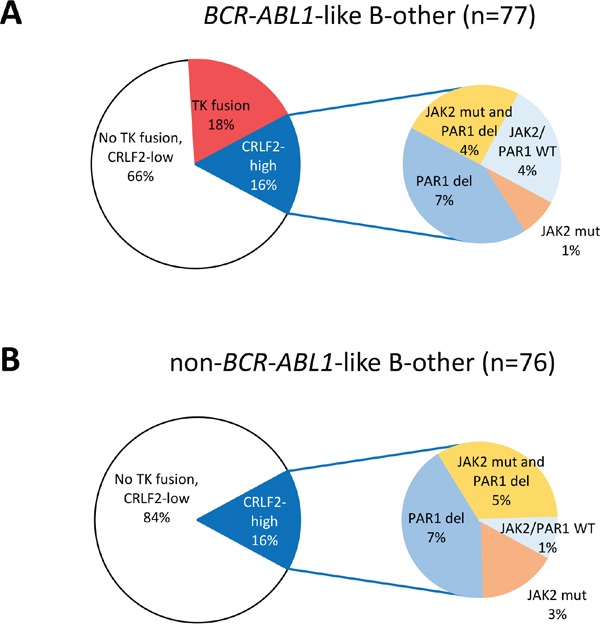
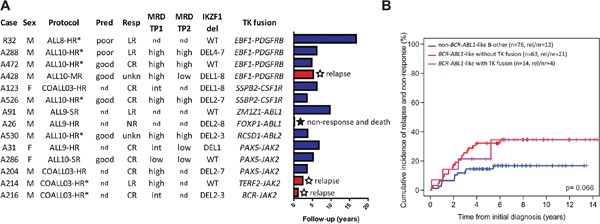
Approximately 15% of pediatric B cell precursor acute lymphoblastic leukemia (BCP-ALL) is characterized by gene expression similar to that of BCR-ABL1-positive disease and unfavorable prognosis. This BCR-ABL1-like subtype shows a high frequency of B-cell development gene aberrations and tyrosine kinase-activating lesions. To evaluate the clinical significance of tyrosine kinase gene fusions in children with BCP-ALL, we studied the frequency of recently identified tyrosine kinase fusions, associated genetic features, and prognosis in a representative Dutch/German cohort. We identified 14 tyrosine kinase fusions among 77 BCR-ABL1-like cases (18%) and none among 76 non-BCR-ABL1-like B-other cases. Novel exon fusions were identified for RCSD1-ABL2 and TERF2-JAK2. JAK2 mutation was mutually exclusive with tyrosine kinase fusions and only occurred in cases with high CRLF2 expression. The non/late response rate and levels of minimal residual disease in the fusion-positive BCR-ABL1-like group were higher than in the non-BCR-ABL1-like B-others (p<0.01), and also higher, albeit not statistically significant, compared with the fusion-negative BCR-ABL1-like group. The 8-year cumulative incidence of relapse in the fusion-positive BCR-ABL1-like group (35%) was comparable with that in the fusion-negative BCR-ABL1-like group (35%), and worse than in the non-BCR-ABL1-like B-other group (17%, p=0.07). IKZF1 deletions, predominantly other than the dominant-negative isoform and full deletion, co-occurred with tyrosine kinase fusions. This study shows that tyrosine kinase fusion-positive cases are a high-risk subtype of BCP-ALL, which warrants further studies with specific kinase inhibitors to improve outcome.
约15%的儿童B细胞前体急性淋巴细胞白血病(BCP-ALL)的特征是基因表达与BCR-ABL1阳性疾病相似且预后不良。这种BCR-ABL1样亚型显示出B细胞发育基因畸变和酪氨酸激酶激活病变的高频率。为了评估酪氨酸激酶基因融合在BCP-ALL儿童中的临床意义,我们在一个具有代表性的荷兰/德国队列中研究了最近鉴定的酪氨酸激酶融合的频率、相关遗传特征和预后。我们在77例BCR-ABL1样病例中鉴定出14例酪氨酸激酶融合(18%),而在76例非BCR-ABL1样B-其他病例中未发现。鉴定出了RCSD1-ABL2和TERF2-JAK2的新型外显子融合。JAK2突变与酪氨酸激酶融合相互排斥,仅发生在CRLF2高表达的病例中。融合阳性的BCR-ABL1样组的非/晚期缓解率和微小残留病水平高于非BCR-ABL1样B-其他组(p<0.01),与融合阴性的BCR-ABL1样组相比也更高,尽管无统计学意义。融合阳性的BCR-ABL1样组8年累积复发率(35%)与融合阴性的BCR-ABL1样组(35%)相当,且比非BCR-ABL1样B-其他组(17%,p=0.07)更差。IKZF1缺失主要发生在非显性负性异构体和完全缺失之外,与酪氨酸激酶融合同时出现。这项研究表明,酪氨酸激酶融合阳性病例是BCP-ALL的高危亚型,值得进一步研究使用特定激酶抑制剂来改善预后。