Pievsky Daniel, Pyrsopoulos Nikolaos
Department of Internal Medicine.
Division of Gastroenterology and Hepatology, Rutgers New Jersey Medical School, University Hospital, Newark, NJ, USA.
J Hepatocell Carcinoma. 2016 Nov 15;3:69-76. doi: 10.2147/JHC.S106072. eCollection 2016.
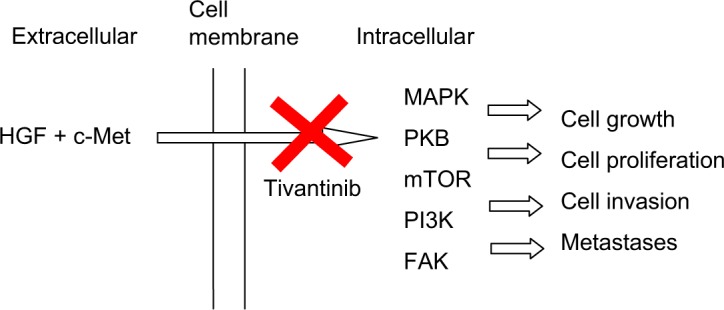
Hepatocellular carcinoma (HCC) is the fastest rising cause of cancer-related death in the United States and carries a very poor prognosis, with a median survival time of <50% at 1 year for advanced disease. To date, sorafenib is the only therapy approved by the Food and Drug Administration for the treatment of advanced HCC. Tivantinib (ARQ-197), a non-ATP competitive inhibitor of cellular mesenchymal-epithelial transcription factor (c-MET), has shown a survival benefit in patients with advanced HCC who have failed or are intolerant to sorafenib in Phase I and II trials. Those patients who have tumors with high concentrations of MET (MET-high) appear to derive the greatest benefit from tivantinib therapy. Currently, two large randomized double-blind placebo-controlled Phase III trials (METIV-HCC [NCT01755767] and JET-HCC [NCT02029157]) are evaluating tivantinib in patients with MET-high advanced HCC, with the primary end points of overall survival and progression-free survival, respectively. This study reviews the evidence for the use of tivantinib in advanced HCC. Specific topics addressed include the pharmacology, dosing, toxicity, and biomarkers associated with tivantinib use.
肝细胞癌(HCC)是美国癌症相关死亡人数增长最快的原因,预后很差,晚期疾病患者1年的中位生存时间<50%。迄今为止,索拉非尼是美国食品药品监督管理局批准用于治疗晚期HCC的唯一疗法。替凡替尼(ARQ-197)是一种细胞间充质-上皮转化因子(c-MET)的非ATP竞争性抑制剂,在I期和II期试验中,它已显示出对索拉非尼治疗失败或不耐受的晚期HCC患者有生存益处。那些肿瘤中MET浓度高(MET高)的患者似乎从替凡替尼治疗中获益最大。目前,两项大型随机双盲安慰剂对照III期试验(METIV-HCC [NCT01755767]和JET-HCC [NCT02029157])正在评估替凡替尼用于MET高的晚期HCC患者,主要终点分别为总生存期和无进展生存期。本研究回顾了替凡替尼用于晚期HCC的证据。涉及的具体主题包括替凡替尼使用的药理学、给药剂量、毒性和生物标志物。