Zirlik Andreas, Bode Christoph
Department of Cardiology and Angiology I, University Heart Centre Freiburg, Hugstetter Strasse 55, 79106, Freiburg, Germany.
J Thromb Thrombolysis. 2017 Apr;43(3):365-379. doi: 10.1007/s11239-016-1446-0.
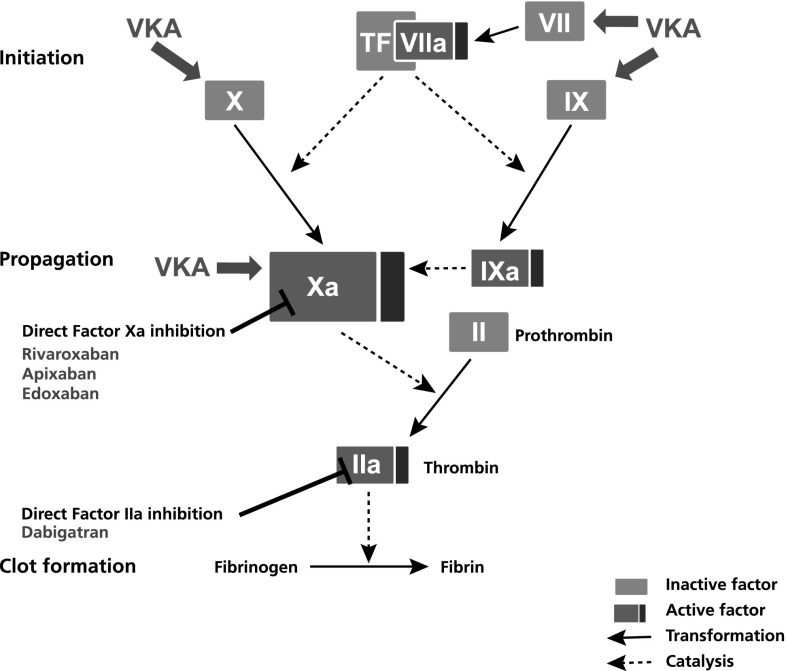
Vitamin K antagonists (VKAs) have been the mainstay of anticoagulation therapy for more than 50 years. VKAs are mainly used for the prevention of stroke in patients with atrial fibrillation (AF) and the treatment and secondary prevention of venous thromboembolism. In the past 5 years, four new agents-the direct factor Xa inhibitors apixaban, edoxaban and rivaroxaban and the direct thrombin inhibitor dabigatran [collectively known as direct oral anticoagulants (DOACs) or non-VKA oral anticoagulants]-have been approved for these and other indications. Despite these new treatment options, the VKA warfarin currently remains the most frequently prescribed oral anticoagulant. The availability of DOACs provides an alternative management option for patients with AF, especially when the treating physician is hesitant to prescribe a VKA owing to associated limitations, such as food and drug interactions, and concerns about bleeding complications. Currently available real-world evidence shows that DOACs have similar or improved effectiveness and safety outcomes compared with warfarin. Treatment decisions on which DOAC is best suited for which patient to maximize safety and effectiveness should take into account not only clinically relevant patient characteristics but also patient preference. This article reviews and highlights real and perceived implications of VKAs for the prevention of stroke in patients with non-valvular AF, with specific reference to their strengths and weaknesses compared with DOACs.
五十多年来,维生素K拮抗剂(VKAs)一直是抗凝治疗的中流砥柱。VKAs主要用于预防心房颤动(AF)患者的中风以及静脉血栓栓塞的治疗和二级预防。在过去五年中,四种新药——直接Xa因子抑制剂阿哌沙班、依度沙班和利伐沙班以及直接凝血酶抑制剂达比加群(统称为直接口服抗凝剂(DOACs)或非VKA口服抗凝剂)——已被批准用于这些及其他适应症。尽管有这些新的治疗选择,但VKA华法林目前仍是最常处方的口服抗凝剂。DOACs的出现为AF患者提供了另一种管理选择,尤其是当治疗医生因食物和药物相互作用等相关限制以及对出血并发症的担忧而不愿开具VKA时。目前可得的真实世界证据表明,与华法林相比,DOACs具有相似或更好的有效性和安全性结果。关于哪种DOAC最适合哪类患者以实现安全性和有效性最大化的治疗决策,不仅应考虑临床相关的患者特征,还应考虑患者的偏好。本文回顾并强调了VKAs在预防非瓣膜性AF患者中风方面的实际和感知影响,并特别提及了与DOACs相比它们各自的优缺点。