Kadohara Kimiko, Sato Izumi, Doi Yuko, Arai Masaru, Fujii Yosuke, Matsunaga Toshiyuki, Kawakami Koji
Department of Pharmacoepidemiology, Graduate School of Medicine and Public Health, Kyoto University, Yoshidakonoecho, Sakyoku, Kyoto City, Kyoto, Japan.
The Keihanshin Consortium for Fostering the Next Generation of Global Leaders in Research (K-CONNEX), Kyoto, Japan.
Neurol Ther. 2017 Jun;6(1):25-37. doi: 10.1007/s40120-016-0057-1. Epub 2016 Nov 28.
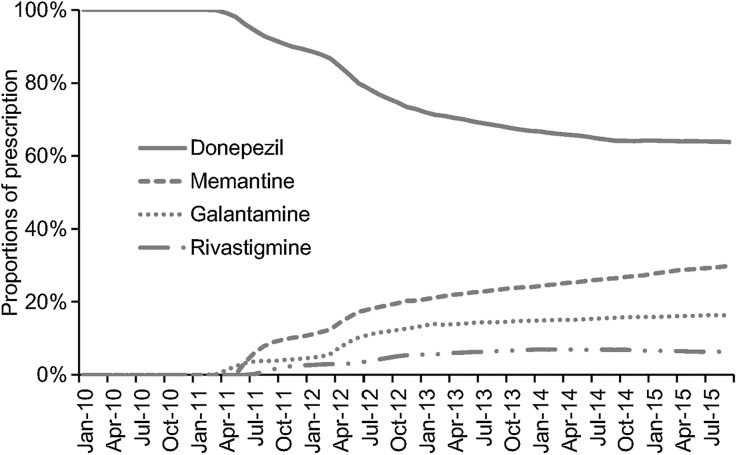
Although four kinds of Alzheimer's disease (AD) drugs are available at present there was only one drug until 2011 in Japan. This study aimed to elucidate prescription trends of these medications for AD in Japanese outpatients before and after the new drug releases in 2011.
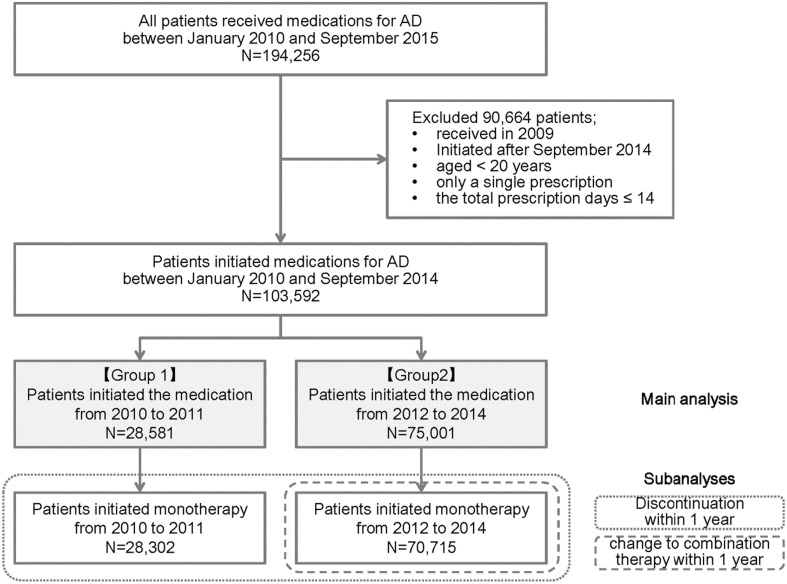
This descriptive study of pharmacy claims databases analyzed outpatient prescription data from community pharmacies across Japan. The study patients were 20 years or older and first administered medications for AD (donepezil, memantine, rivastigmine, or galantamine) between January 2010 and September 2014. They were grouped on the basis of the year of their initial medications for AD administration into the 2010-2011 and 2012-2014 groups (1 and 2, respectively) and their characteristics and AD treatments were summarized by group. The subanalyses used a multivariable logistic regression model to examine the relationship between patient characteristics and discontinuation or change to combination therapy within a year.
A total of 103,592 patients (group 1 and 2, 28,581 and 75,011, respectively) were prescribed medications for AD during the study period. The group 1 and 2 mean ± standard deviation (SD) ages were 79.6 ± 7.4 and 80.9 ± 7.3 years while female patients constituted 64.0% and 64.5%, respectively. Furthermore, in groups 1 and 2 patients, 99.0% and 94.3% received a medication for AD monotherapy, 92.3% and 59.6% were prescribed donepezil, and 40.5% and 41.5% discontinued treatment within a year, respectively. The subanalyses suggest that being at least 85 years old strongly correlated with treatment discontinuation and change to combination therapy within a year.
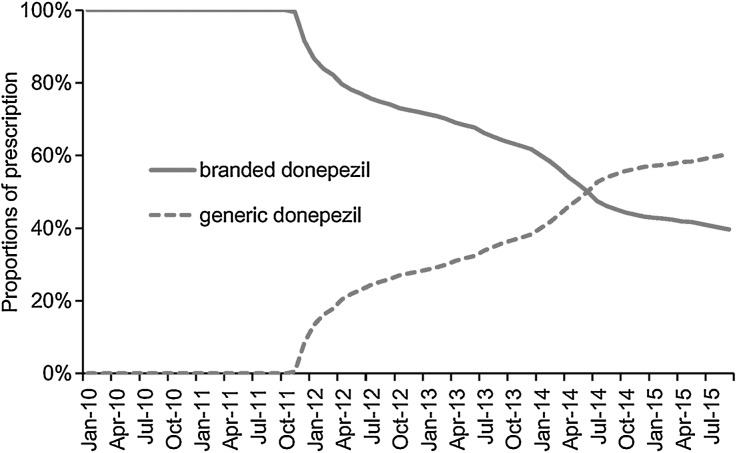
Although the prescription proportions of the various medications for AD have changed since 2011, no apparent changes occurred in the patient characteristics of those who initiated AD treatment between 2010-2011 and 2012-2014.
尽管目前有四种治疗阿尔茨海默病(AD)的药物,但在日本,直到2011年仅有一种此类药物。本研究旨在阐明2011年新药发布前后,日本门诊患者中这些AD药物的处方趋势。
这项对药房索赔数据库的描述性研究分析了来自日本各地社区药房的门诊处方数据。研究患者年龄在20岁及以上,于2010年1月至2014年9月首次接受AD药物治疗(多奈哌齐、美金刚、卡巴拉汀或加兰他敏)。根据首次接受AD药物治疗的年份,将他们分为2010 - 2011组和2012 - 2014组(分别为组1和组2),并按组总结他们的特征和AD治疗情况。亚分析使用多变量逻辑回归模型来研究患者特征与一年内停药或改用联合治疗之间的关系。
在研究期间,共有103,592名患者(组1和组2分别为28,581名和75,011名)接受了AD药物治疗。组1和组2的平均年龄±标准差分别为79.6±7.4岁和80.9±7.3岁,女性患者分别占64.0%和64.5%。此外,在组1和组2的患者中,分别有99.0%和94.3%接受AD单药治疗,92.3%和59.6%被处方多奈哌齐,且分别有40.5%和41.5%在一年内停药。亚分析表明,年龄至少85岁与一年内停药和改用联合治疗密切相关。
尽管自2011年以来,各种AD药物的处方比例有所变化,但在2010 - 至2011年和2012 - 2014年开始接受AD治疗患者的特征方面,未出现明显变化。