McGrath Timothy M, Waddington Gordon, Scarvell Jennie M, Ball Nick, Creer Rob, Woods Kevin, Smith Damian, Adams Roger
Research Institute for Sport and Exercise, University of Canberra, Bruce, Australia.
Private practice, Deakin, Australia.
Orthop J Sports Med. 2016 Nov 22;4(11):2325967116672208. doi: 10.1177/2325967116672208. eCollection 2016 Nov.
Additional high-quality prospective studies are needed to better define the objective criteria used in relation to return-to-sport decisions after synthetic (ligament advanced reinforcement system [LARS]) and autograft (hamstring tendon [2ST/2GR]) anterior cruciate ligament (ACL) reconstruction in active populations.
To prospectively investigate and describe the recovery of objective clinical outcomes after autograft (2ST/2GR) and synthetic (LARS) ACL reconstructions, as well as to investigate the relationship between these clinimetric test outcomes and return-to-sport activity (Tegner activity scale [TAS] score) at 12 and 24 months postoperatively.
Case series; Level of evidence, 4.
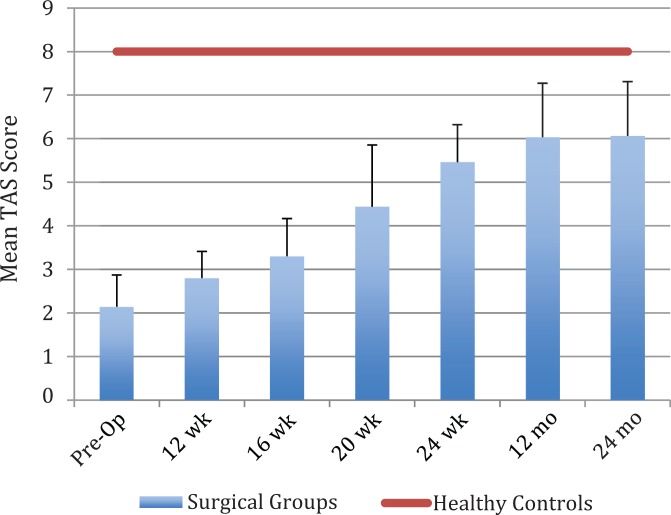
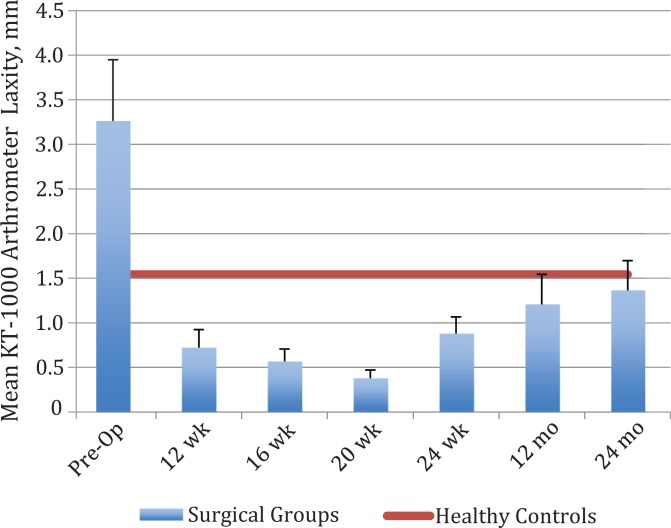
A total of 64 patients who underwent ACL reconstruction (32 LARS, 32 2ST/2GR autograft) and 32 healthy reference participants were assessed for joint laxity (KT-1000 arthrometer), clinical outcome (2000 International Knee Documentation Committee [IKDC] knee examination), and activity (TAS score) preoperatively and at 12, 16, 20, and 24 weeks and 12 and 24 months postoperatively.
There was no significant correlation observed between clinical results using the 2000 IKDC knee examination and TAS score at 24 months ( = 0.188, = .137), nor were results for side-to-side difference ( = 0.030, = .814) or absolute KT-1000 arthrometer laxity of the surgical leg at 24 months postoperatively ( = 0.076, = .553) correlated with return-to-sport activity. Nonetheless, return-to-sport rates within the surgical cohort were 81% at 12 months and 83% at 24 months, respectively. No statistically significant differences were observed between physiological laxity of the uninjured knee within the surgical group compared with healthy knees within the reference group ( = .522).
The results indicate that although relatively high levels of return-to-sport outcomes were achieved at 24 months compared with those previously reported in the literature, correlations between objective clinical tests and return-to-sport outcomes may not occur. Clinical outcome measures may provide suitable baseline information; however, the results of this study suggest that clinicians may need to place greater emphasis on other outcome measures when seeking to objectively promote safe return to sport.
需要更多高质量的前瞻性研究,以更好地确定在活跃人群中进行人工韧带(韧带增强系统[LARS])和自体移植物(腘绳肌腱[2ST/2GR])前交叉韧带(ACL)重建后与恢复运动决策相关的客观标准。
前瞻性研究并描述自体移植物(2ST/2GR)和人工韧带(LARS)ACL重建后客观临床结果的恢复情况,并研究这些临床测量测试结果与术后12个月和24个月恢复运动活动(Tegner活动量表[TAS]评分)之间的关系。
病例系列;证据等级,4级。
对64例行ACL重建的患者(32例LARS,32例2ST/2GR自体移植物)和32名健康对照参与者进行术前、术后12周、16周、20周、24周、12个月和24个月的关节松弛度(KT-1000关节测量仪)、临床结果(2000版国际膝关节文献委员会[IKDC]膝关节检查)和活动情况(TAS评分)评估。
术后24个月时,使用2000版IKDC膝关节检查的临床结果与TAS评分之间未观察到显著相关性(r = 0.188,P = 0.137),术后24个月时手术侧与对侧的差值结果(r = 0.030,P = 0.814)或手术侧绝对KT-1000关节测量仪松弛度(r = 0.076,P = 0.553)与恢复运动活动也无相关性。尽管如此,手术队列中的恢复运动率在12个月时为81%,在24个月时为83%。手术组未受伤膝关节的生理松弛度与对照组健康膝关节相比,未观察到统计学显著差异(P = 0.522)。
结果表明,尽管与文献中先前报道的相比,24个月时恢复运动的结果相对较高,但客观临床测试与恢复运动结果之间可能不存在相关性。临床结果测量可能提供合适的基线信息;然而,本研究结果表明,临床医生在寻求客观促进安全恢复运动时,可能需要更加强调其他结果测量。