Hurtado-Melgoza M L, Ramos-Ligonio A, Álvarez-Rodríguez L M, Meza-Menchaca T, López-Monteon A
Doctorado en Ciencias Biomédicas, Universidad Veracruzana, Xalapa, Veracruz, Mexico.
LADISER Inmunología y Biología Molecular, Facultad de Ciencias Químicas, Universidad Veracruzana, Orizaba, Veracruz, Mexico.
J Biomed Sci. 2016 Dec 1;23(1):85. doi: 10.1186/s12929-016-0302-z.
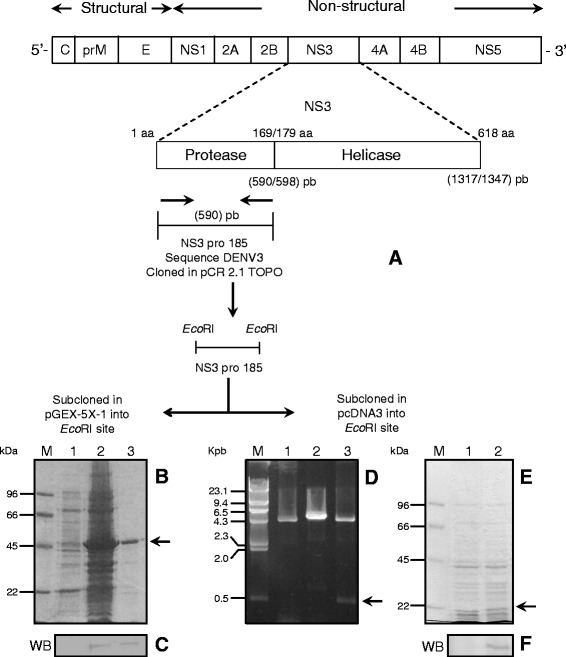
The dengue non-structural 3 (NS3) is a multifunctional protein, containing a serine-protease domain, located at the N-terminal portion, and helicase, NTPase and RTPase domains present in the C-terminal region. This protein is considered the main target for CD4+ and CD8+ T cell responses during dengue infection, which may be involved in protection. However, few studies have been undertaken evaluating the use of this protein as a protective antigen against dengue, as well as other flavivirus. In the present work we evaluated the potential of the NS3 (protease domain) as a protective antigen by comparing the administration of a recombinant protein versus a DNA vaccine in the mouse model.
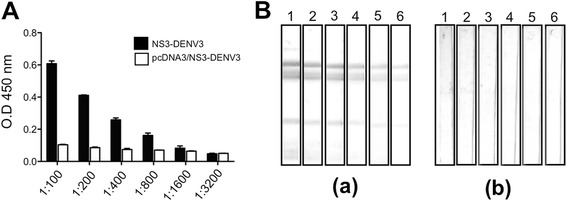
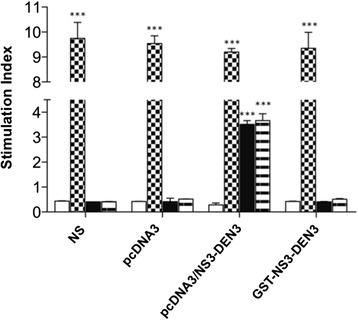
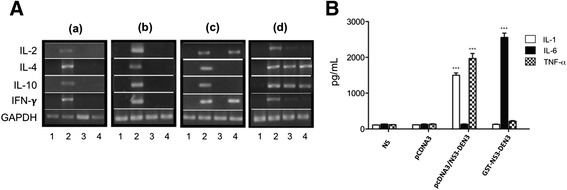
BALB/c mice were immunized with the recombinant protein NS3-DEN3 via intraperitoneal and with plasmid pcDNA3/NS3-DEN3 intramuscularly and the immune response was evaluated. The activity of T lymphocytes was analyzed by the MTT assay, and cells of mice immunized with the recombinant protein showed no activity when stimulated with the homologous protein. However, cells from mice immunized with DNA, responded to stimulation with the recombinant protein. When the expression (RT-PCR) and cytokine production (ELISA) was evaluated in the splenocytes, different behavior depending on the type of immunization was observed, splenocytes of mice immunized with the recombinant protein expressed cytokines such as IL-4, IL-10 and produced high concentrations of IL-1, IL-6 and TNFα. Splenocytes from mice immunized with DNA expressed IL-2 and IFNγ and did not produce IL-6. In addition, immunization with the recombinant protein induced the production of antibodies that are detected up to a dilution 1:3200 by ELISA and Western blot assays, however, the serum of mice immunized with DNA presented no detectable antibody titers.
The results obtained in this study show that administration of pcDNA3/NS3-DEN3 induces a favorable response in the activation of T lymphocytes with low production of specific antibodies against NS3-DEN3.
登革病毒非结构蛋白3(NS3)是一种多功能蛋白,其N端部分含有丝氨酸蛋白酶结构域,C端区域存在解旋酶、NTP酶和RTP酶结构域。该蛋白被认为是登革热感染期间CD4 +和CD8 + T细胞反应的主要靶点,可能参与保护作用。然而,很少有研究评估该蛋白作为抗登革热以及其他黄病毒的保护性抗原的用途。在本研究中,我们通过在小鼠模型中比较重组蛋白与DNA疫苗的给药情况,评估了NS3(蛋白酶结构域)作为保护性抗原的潜力。
通过腹腔注射用重组蛋白NS3 - DEN3免疫BALB / c小鼠,并通过肌肉注射用质粒pcDNA3 / NS3 - DEN3免疫,然后评估免疫反应。通过MTT法分析T淋巴细胞的活性,用重组蛋白免疫的小鼠细胞在用同源蛋白刺激时未显示活性。然而,用DNA免疫的小鼠细胞对重组蛋白刺激有反应。当在脾细胞中评估表达(RT - PCR)和细胞因子产生(ELISA)时,观察到取决于免疫类型的不同行为,用重组蛋白免疫的小鼠脾细胞表达细胞因子如IL - 4、IL - 10,并产生高浓度的IL - 1、IL - 6和TNFα。用DNA免疫的小鼠脾细胞表达IL - 2和IFNγ,不产生IL - 6。此外,用重组蛋白免疫诱导产生的抗体通过ELISA和蛋白质印迹分析可检测到稀释至1:3200,然而,用DNA免疫的小鼠血清未呈现可检测到的抗体滴度。
本研究获得的结果表明,pcDNA3 / NS3 - DEN3的给药在激活T淋巴细胞方面诱导了良好的反应,同时针对NS3 - DEN3产生的特异性抗体较少。