
印度尼西亚雅加达湾优势软珊瑚的丰度和生理特征与水质的关系
Abundance and physiology of dominant soft corals linked to water quality in Jakarta Bay, Indonesia.
作者信息
Baum Gunilla, Januar Indra, Ferse Sebastian C A, Wild Christian, Kunzmann Andreas
机构信息
Department of Ecology, Leibniz Center for Tropical Marine Ecology, Bremen, Germany; Faculty of Biology and Chemistry, University of Bremen, Bremen, Germany.
Indonesian Research Center for Marine and Fisheries Products Processing and Biotechnology , Jakarta, Jakarta Pusat , Indonesia.
出版信息
PeerJ. 2016 Nov 29;4:e2625. doi: 10.7717/peerj.2625. eCollection 2016.
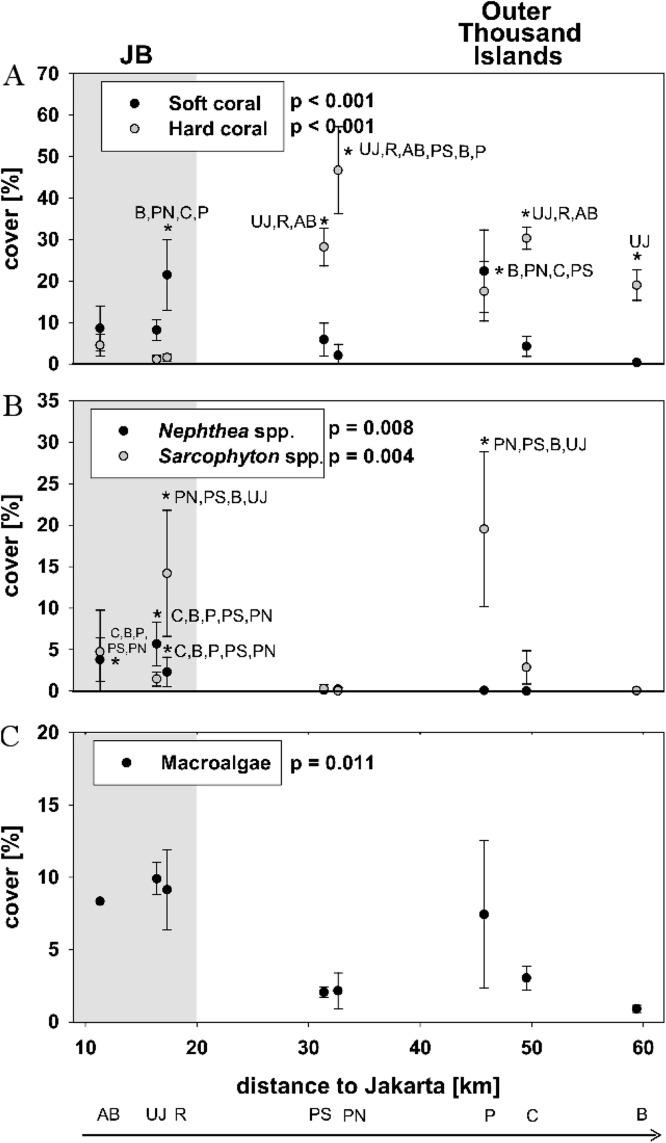
Declining water quality is one of the main reasons of coral reef degradation in the Thousand Islands off the megacity Jakarta, Indonesia. Shifts in benthic community composition to higher soft coral abundances have been reported for many degraded reefs throughout the Indo-Pacific. However, it is not clear to what extent soft coral abundance and physiology are influenced by water quality. In this study, live benthic cover and water quality (i.e. dissolved inorganic nutrients (DIN), turbidity (NTU), and sedimentation) were assessed at three sites (< 20 km north of Jakarta) in Jakarta Bay (JB) and five sites along the outer Thousand Islands (20-60 km north of Jakarta). This was supplemented by measurements of photosynthetic yield and, for the first time, respiratory electron transport system (ETS) activity of two dominant soft coral genera, spp. and spp. Findings revealed highly eutrophic water conditions in JB compared to the outer Thousand Islands, with 44% higher DIN load (7.65 μM/L), 67% higher NTU (1.49 NTU) and 47% higher sedimentation rate (30.4 g m d). Soft corals were the dominant type of coral cover within the bay (2.4% hard and 12.8% soft coral cover) compared to the outer Thousand Islands (28.3% hard and 6.9% soft coral cover). Soft coral abundances, photosynthetic yield, and ETS activity were highly correlated with key water quality parameters, particularly DIN and sedimentation rates. The findings suggest water quality controls the relative abundance and physiology of dominant soft corals in JB and may thus contribute to phase shifts from hard to soft coral dominance, highlighting the need to better manage water quality in order to prevent or reverse phase shifts.
水质下降是印度尼西亚大城市雅加达附近千岛珊瑚礁退化的主要原因之一。据报道,在整个印度-太平洋地区,许多退化珊瑚礁的底栖生物群落组成已向软珊瑚丰度更高的方向转变。然而,软珊瑚的丰度和生理机能受水质影响的程度尚不清楚。在本研究中,对雅加达湾(JB)三个地点(雅加达以北<20公里)和千岛群岛外缘五个地点(雅加达以北20-60公里)的活底栖生物覆盖率和水质(即溶解无机养分(DIN)、浊度(NTU)和沉积)进行了评估。此外,还测量了两种优势软珊瑚属( 属和 属)的光合产量,并首次测量了其呼吸电子传递系统(ETS)活性。研究结果显示,与千岛群岛外缘相比,雅加达湾的水体富营养化程度很高,DIN负荷高44%(7.65 μM/L),NTU高67%(1.49 NTU),沉积速率高47%(30.4 g m d)。与千岛群岛外缘(硬珊瑚覆盖率28.3%,软珊瑚覆盖率6.9%)相比,软珊瑚是海湾内主要的珊瑚覆盖类型(硬珊瑚覆盖率2.4%,软珊瑚覆盖率12.8%)。软珊瑚的丰度、光合产量和ETS活性与关键水质参数高度相关,尤其是DIN和沉积速率。研究结果表明,水质控制着雅加达湾优势软珊瑚的相对丰度和生理机能,因此可能导致从硬珊瑚主导向软珊瑚主导的相位转变,这突出表明需要更好地管理水质,以防止或扭转相位转变。




 Zotero 插件