Grieshaber Philippe, Lipp Stella, Arnold Andreas, Görlach Gerold, Wollbrück Matthias, Roth Peter, Niemann Bernd, Wilhelm Jochen, Böning Andreas
Department of Adult and Pediatric Cardiovascular Surgery, University Hospital Giessen, Rudolf-Buchheim-Str. 7, DE-35392, Giessen, Germany.
Department of Neurology, University Hospital Giessen, Giessen, Germany.
J Cardiothorac Surg. 2016 Dec 1;11(1):162. doi: 10.1186/s13019-016-0556-2.
Patients with severely reduced left-ventricular ejection fraction carry a high risk of morbidity and mortality after cardiac surgery. Levosimendan can be used prophylactically in these patients having shown positive effects on short-term outcome. However, effects on long-term outcome and patient subgroups benefiting the most are unknown. We aim to address these topics with real-life data from our clinical practice.
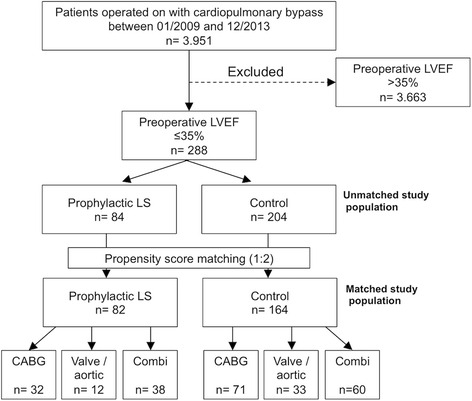
Two hundred eigthy eight patients with preoperative LVEF ≤ 35% underwent cardiac surgery with cardiopulmonary bypass between 2009 and 2013. Thereof, 246 were included in the matched analysis. Eigthy two patients received 12.5mg Levosimendan starting at induction of anesthesia. Outcomes of patients undergoing coronary artery bypass grafting surgery (n = 103), isolated valve surgery/ascending aortic surgery (n = 45) and those undergoing combination procedures (n = 98) were analyzed separately. Additionally, multivariate regression analysis was conducted in order to identify predictors of short-term outcome parameters for different subgroups of patients.
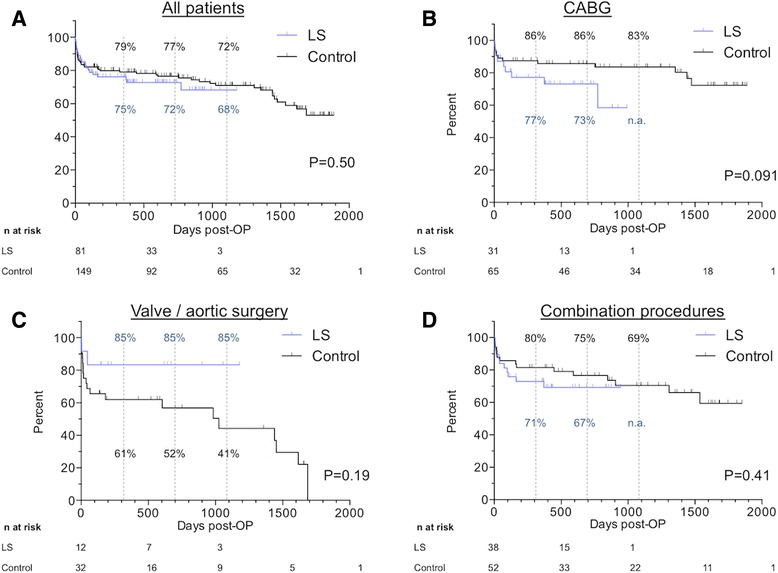
Thirty days mortality rates of 16% in the Levosimendan group and 21% in the control group (OR 0.7; 95%-CI 0.36-1.5; p = 0.37) were observed. Levosimendan showed a positive effect on postoperative renal function. A higher rate of new-onset atrial fibrillation (OR 4.0; 95%-CI 2.2-7-2; p < 0.0001) was observed in the Levosimendan group. Follow-up until three years postoperatively showed no differences in long-term survival between the groups.
Prophylactic administration of Levosimendan did not affect overall short- and long-term outcomes. The value of prophylactic use of Levosimendan remains questionable and more data is needed to confirm subgroups that might benefit most.
左心室射血分数严重降低的患者心脏手术后发病率和死亡率风险较高。左西孟旦可预防性用于这些患者,已显示对短期预后有积极影响。然而,其对长期预后的影响以及最受益的患者亚组尚不清楚。我们旨在利用临床实践中的实际数据解决这些问题。
2009年至2013年间,288例术前左心室射血分数≤35%的患者接受了体外循环心脏手术。其中,246例纳入匹配分析。82例患者在麻醉诱导时开始接受12.5mg左西孟旦治疗。分别分析接受冠状动脉搭桥手术(n = 103)、单纯瓣膜手术/升主动脉手术(n = 45)和联合手术(n = 98)患者的预后。此外,进行多因素回归分析以确定不同患者亚组短期预后参数的预测因素。
观察到左西孟旦组30天死亡率为16%,对照组为21%(比值比0.7;95%可信区间0.36 - 1.5;p = 0.37)。左西孟旦对术后肾功能有积极影响。左西孟旦组新发房颤发生率较高(比值比4.0;95%可信区间2.2 - 7.2;p < 0.0001)。术后三年随访显示两组长期生存率无差异。
预防性使用左西孟旦不影响总体短期和长期预后。预防性使用左西孟旦的价值仍存在疑问,需要更多数据来确认可能最受益的亚组。