Sun Margaret Man-Ger, Beier Frank, Pest Michael A
Department of Physiology & Pharmacology, Schulich School of Medicine & Dentistry, University of Western Ontario, London, Ontario, Canada.
Curr Opin Rheumatol. 2017 Jan;29(1):96-102. doi: 10.1097/BOR.0000000000000351.
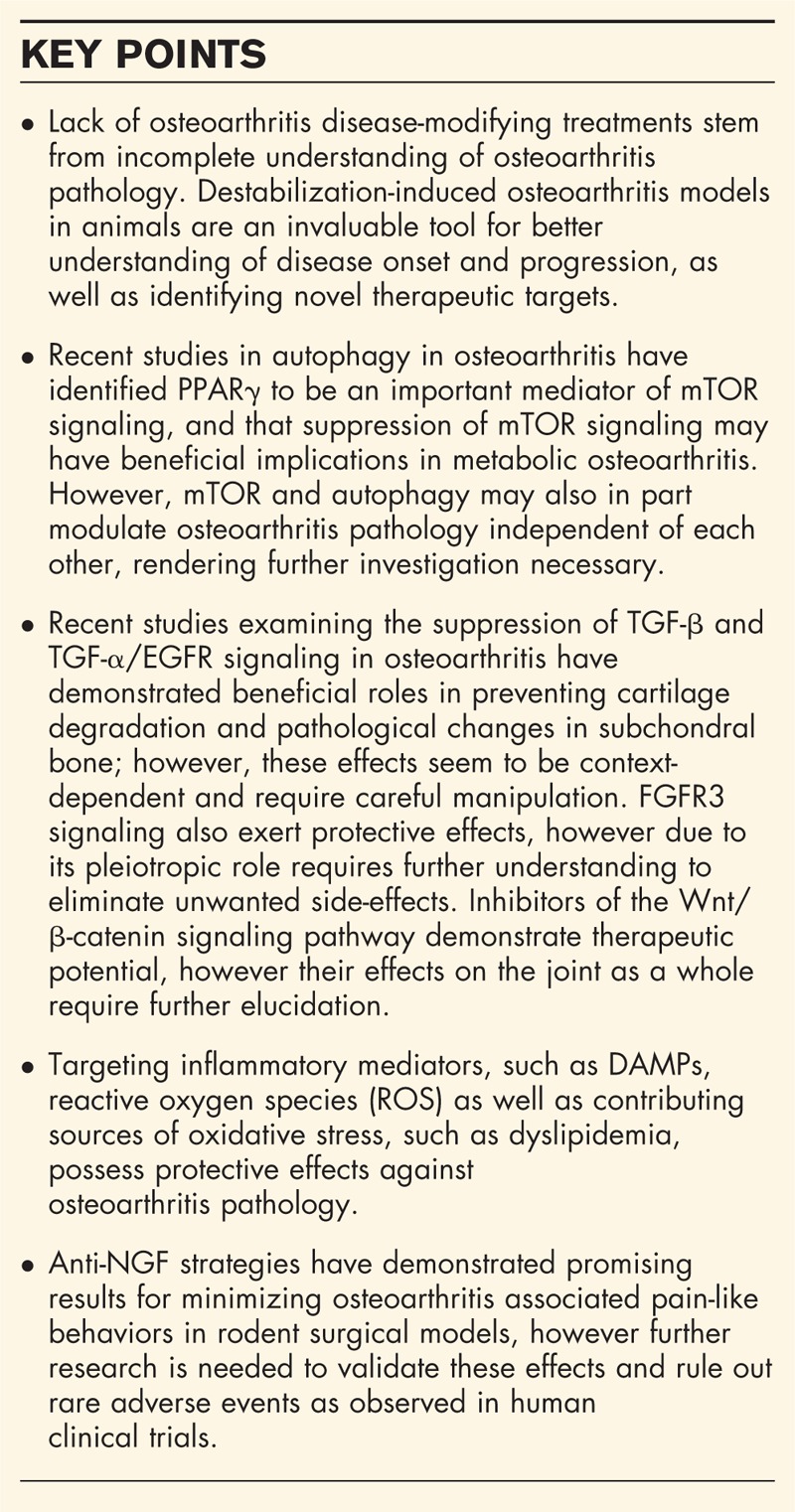
Despite the tremendous individual suffering and socioeconomic burden caused by osteoarthritis, there are currently no effective disease-modifying treatment options. This is in part because of our incomplete understanding of osteoarthritis disease mechanism. This review summarizes recent developments in therapeutic targets identified from surgical animal models of osteoarthritis that provide novel insight into osteoarthritis pathology and possess potential for progression into preclinical studies.
Several candidate pathways and processes that have been identified include chondrocyte autophagy, growth factor signaling, inflammation, and nociceptive signaling. Major strategies that possess therapeutic potential at the cellular level include inhibiting autophagy suppression and decreasing reactive oxygen species (ROS) production. Cartilage anabolism and prevention of cartilage degradation has been shown to result from growth factor signaling modulation, such as TGF-β, TGF-α, and FGF; however, the results are context-dependent and require further investigation. Pain assessment studies in rodent surgical models have demonstrated potential in employing anti-NGF strategies for minimizing osteoarthritis-associated pain.
Studies of potential therapeutic targets in osteoarthritis using animal surgical models are helping to elucidate osteoarthritis pathology and propel therapeutics development. Further studies should continue to elucidate pathological mechanisms and therapeutic targets in various joint tissues to improve overall joint health.
尽管骨关节炎给个人带来巨大痛苦并造成社会经济负担,但目前尚无有效的疾病缓解治疗方案。部分原因在于我们对骨关节炎发病机制的理解尚不完整。本综述总结了从骨关节炎手术动物模型中确定的治疗靶点的最新进展,这些进展为骨关节炎病理学提供了新的见解,并具有推进到临床前研究的潜力。
已确定的几个候选途径和过程包括软骨细胞自噬、生长因子信号传导、炎症和伤害性信号传导。在细胞水平上具有治疗潜力的主要策略包括抑制自噬抑制和减少活性氧(ROS)产生。已证明生长因子信号调节(如TGF-β、TGF-α和FGF)可导致软骨合成代谢和防止软骨降解;然而,结果取决于具体情况,需要进一步研究。在啮齿动物手术模型中的疼痛评估研究表明,采用抗NGF策略减轻骨关节炎相关疼痛具有潜力。
使用动物手术模型对骨关节炎潜在治疗靶点的研究有助于阐明骨关节炎病理学并推动治疗学发展。进一步的研究应继续阐明各种关节组织中的病理机制和治疗靶点,以改善整体关节健康。