Salek Nafise, Shamsaei Mojtaba, Ghannadi Maragheh Mohammad, Shirvani Arani Simindokht, Bahrami Samani Ali
Amirkabir University of Technology.
J Appl Clin Med Phys. 2016 Nov 8;17(6):128-139. doi: 10.1120/jacmp.v17i6.6375.
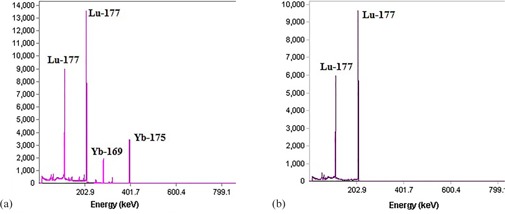
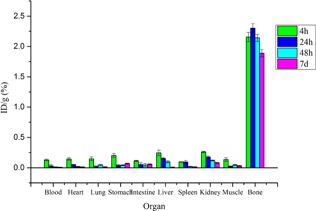
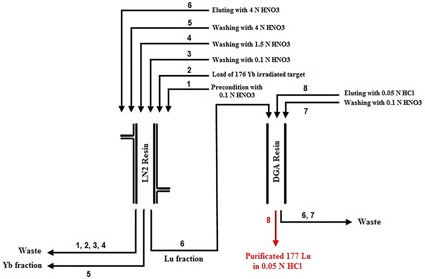
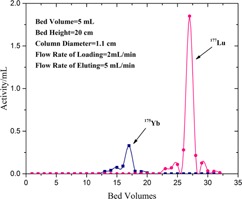
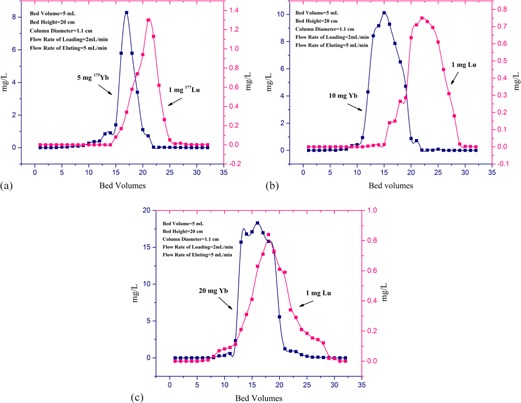
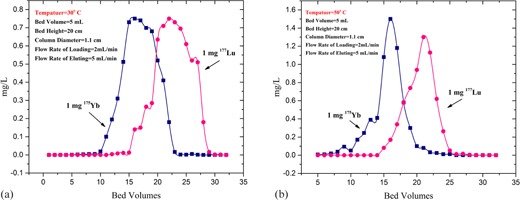
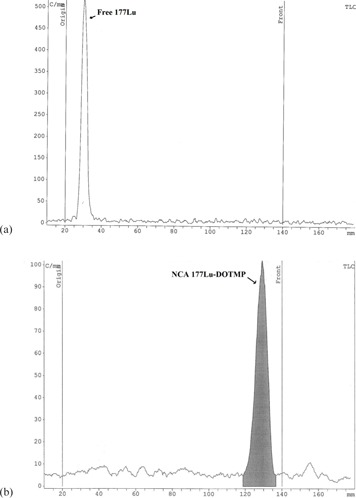
Skeletal uptake of radiolabeled-1, 4, 7, 10-tetraazacyclododecane-1, 4, 7, 10-tetramethylene phosphoric acid (e.g., 177Lu-DOTMP) complex, is used for bone pain palliation. The moderate energy of β-emitting 177Lu (T½ = 6.7 d, Eβmax = 497keV) has been considered as a potential radionuclide for development of the bone-seeking radiopharmaceutical. Since the specific activity of the radiolabeled carrier molecules should be high, the "no-carrier-added radionuclides" have sig-nificant roles in nuclear medicine. Many researchers illustrated no-carrier-added 177Lu production; among these separation techniques such as ion exchange chromatography, reversed phase ion-pair, and electrochemical method, extraction chromatography has been considered more capable than other methods. In order to optimize the conditions, some effective factors on separation of Lu/Yb were investigated by EXC. The NCA 177Lu, produced by this method, was mixed with 300 μl of DOTMP solution (20 mg in 1 mL of 0.5 M NaHCO3, pH = 8) and incu-bated under stirring at room temperature for 45 min. Radiochemical purity of the 177Lu-DOTMP complex was determined using radio-thin-layer chromatography (RTLC) method. The complex was injected to wild-type rats and biodistribution was then studied for seven days. The NCA 177Lu was produced with specific activ-ity of 48 Ci/mg and with a radinuclidic purity of 99.99% through irradiation of enriched 176Yb target (1 mg) in a thermal neutron flux of 4 × 10¹³ n.cm-2.s-1 for 14 days. 177Lu-DOTMP was obtained with high radiochemical purities (> 98%) under optimized reaction conditions. The radiolabeled complex exhibited excellent stability at room temperature. Biodistribution of the radiolabeled complex studies in rats showed favorable selective skeletal uptake with rapid clearance from blood along with insignificant accumulation within the other nontargeted organs.
放射性标记的1,4,7,10-四氮杂环十二烷-1,4,7,10-四亚甲基磷酸(如177Lu-DOTMP)配合物在骨骼中的摄取,用于缓解骨痛。发射β射线的177Lu的中等能量(T½ = 6.7天,Eβmax = 497keV)被认为是开发亲骨性放射性药物的一种潜在放射性核素。由于放射性标记载体分子的比活度应较高,“无载体添加放射性核素”在核医学中具有重要作用。许多研究人员阐述了无载体添加177Lu的生产方法;在这些分离技术中,如离子交换色谱法、反相离子对法和电化学法,萃取色谱法被认为比其他方法更有效。为了优化条件,通过萃取色谱法研究了一些影响Lu/Yb分离的有效因素。用这种方法生产的无载体添加177Lu与300μl的DOTMP溶液(20mg溶于1mL 0.5M NaHCO3,pH = 8)混合,并在室温下搅拌孵育45分钟。使用放射性薄层层析(RTLC)法测定177Lu-DOTMP配合物的放射化学纯度。将该配合物注射到野生型大鼠体内,然后研究其七天的生物分布情况。通过在热中子通量为4×10¹³ n.cm-2.s-1的条件下对富集的176Yb靶(1mg)进行14天的辐照,生产出比活度为48Ci/mg、放射性核素纯度为99.99%的无载体添加177Lu。在优化的反应条件下,获得了放射化学纯度高(>98%)的177Lu-DOTMP。放射性标记的配合物在室温下表现出优异的稳定性。在大鼠体内进行的放射性标记配合物生物分布研究表明,其在骨骼中具有良好的选择性摄取,血液清除迅速且在其他非靶器官中的蓄积不明显。