Rausch Jessica L, Boichuk Sergei, Ali Areej A, Patil Sneha S, Liu Lijun, Lee Donna M, Brown Matthew F, Makielski Kathleen R, Liu Ying, Taguchi Takahiro, Kuan Shih-Fan, Duensing Anette
Cancer Therapeutics Program, University of Pittsburgh Cancer Institute, Hillman Cancer Center, Pittsburgh, PA, USA.
Current address: Department of Pathology, Kazan State Medical University, Kazan, Russia.
Oncotarget. 2017 Jan 17;8(3):4471-4483. doi: 10.18632/oncotarget.13882.
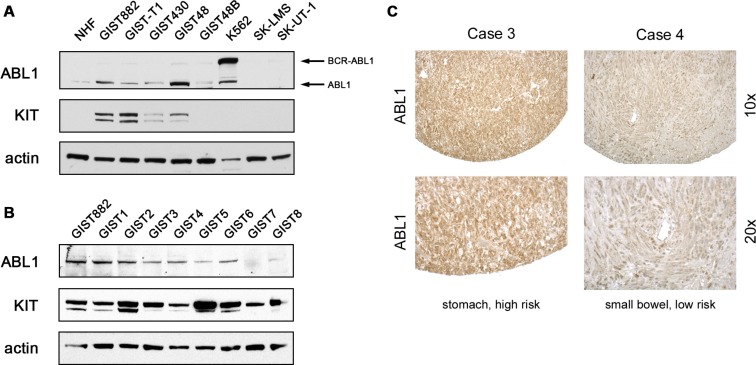
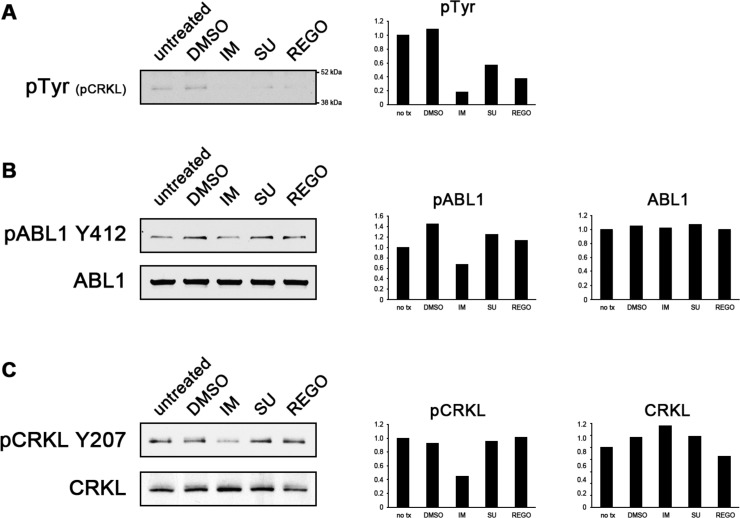
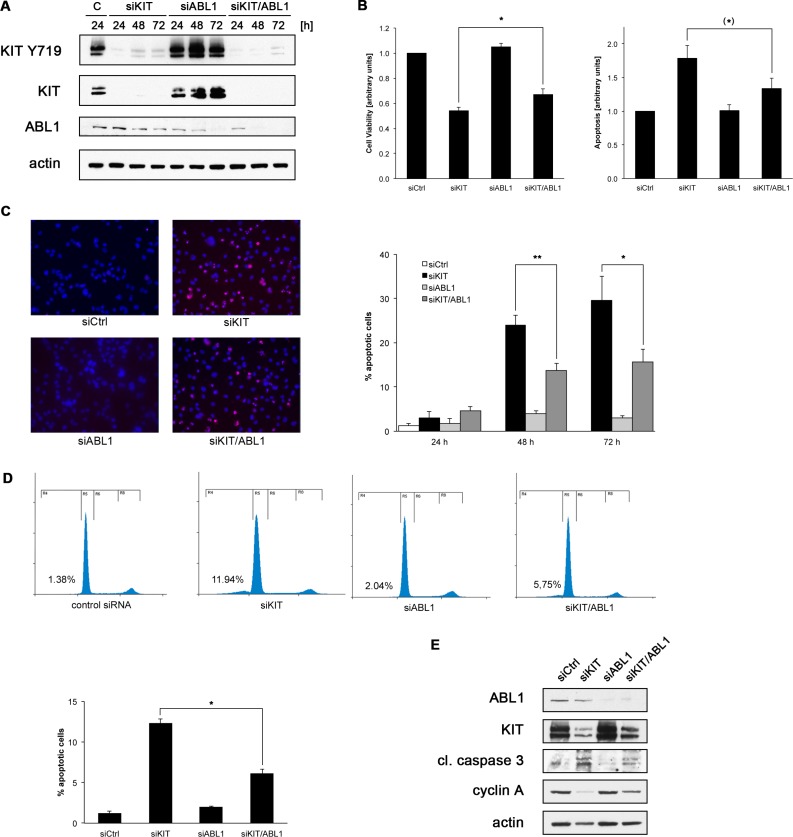
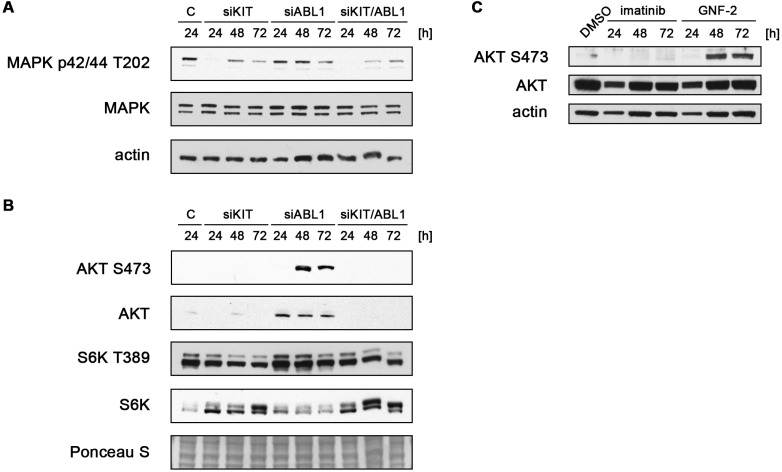
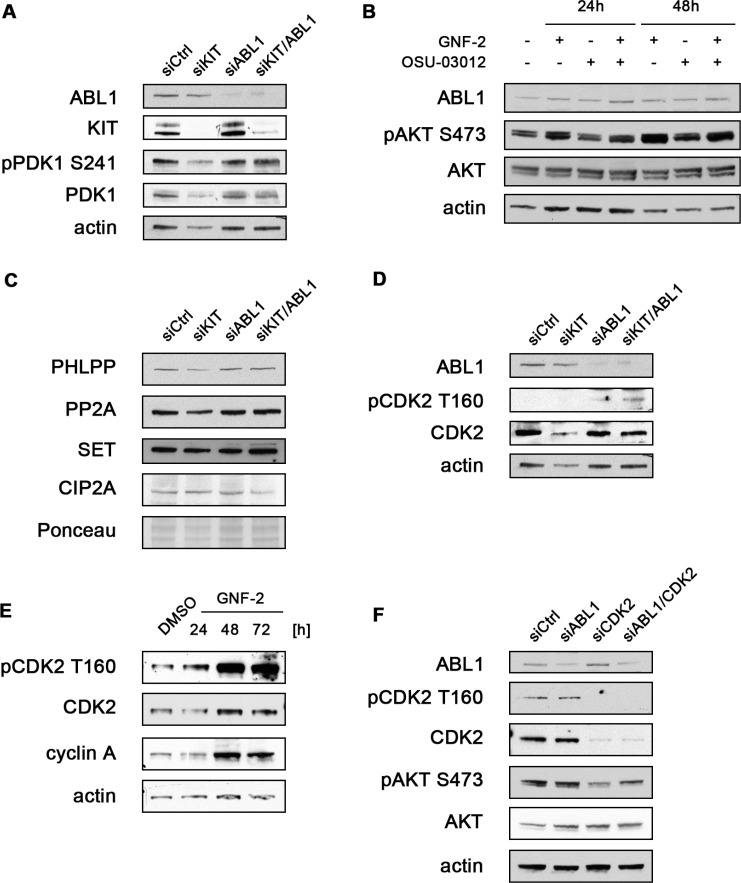
Most gastrointestinal stromal tumors (GISTs) are caused by activating mutations of the KIT receptor tyrosine kinase. The small molecule inhibitor imatinib mesylate was initially developed to target the ABL1 kinase, which is constitutively activated through chromosomal translocation in BCR-ABL1-positive chronic myeloid leukemia. Because of cross-reactivity of imatinib against the KIT kinase, the drug is also successfully used for the treatment of GIST. Although inhibition of KIT clearly has a major role in the therapeutic response of GIST to imatinib, the contribution of concomitant inhibition of ABL in this context has never been explored. We show here that ABL1 is expressed in the majority of GISTs, including human GIST cell lines. Using siRNA-mediated knockdown, we demonstrate that depletion of KIT in conjunction with ABL1 - hence mimicking imatinib treatment - leads to reduced apoptosis induction and attenuated inhibition of cellular proliferation when compared to depletion of KIT alone. These results are explained by an increased activity of the AKT survival kinase, which is mediated by the cyclin-dependent kinase CDK2, likely through direct phosphorylation. Our results highlight that distinct inhibitory properties of targeted agents can impede antitumor effects and hence provide insights for rational drug development. Novel KIT-targeted agents to treat GIST should therefore comprise an increased specificity for KIT while at the same time displaying a reduced ability to inhibit ABL1.
大多数胃肠道间质瘤(GIST)由KIT受体酪氨酸激酶的激活突变引起。小分子抑制剂甲磺酸伊马替尼最初是为靶向ABL1激酶而开发的,ABL1激酶在BCR-ABL1阳性慢性髓性白血病中通过染色体易位而持续激活。由于伊马替尼对KIT激酶具有交叉反应性,该药物也成功用于GIST的治疗。尽管抑制KIT显然在GIST对伊马替尼的治疗反应中起主要作用,但在这种情况下ABL的协同抑制作用从未被探究过。我们在此表明,ABL1在大多数GIST中表达,包括人GIST细胞系。使用小干扰RNA(siRNA)介导的敲低,我们证明,与单独敲低KIT相比,KIT与ABL1一起缺失(从而模拟伊马替尼治疗)会导致凋亡诱导减少和细胞增殖抑制减弱。这些结果可通过AKT存活激酶活性增加来解释,AKT存活激酶活性增加由细胞周期蛋白依赖性激酶CDK2介导,可能是通过直接磷酸化。我们的结果突出表明,靶向药物的不同抑制特性可阻碍抗肿瘤作用,从而为合理的药物开发提供见解。因此,用于治疗GIST的新型KIT靶向药物应提高对KIT的特异性,同时降低抑制ABL1的能力。