Zeng Tao, Zhang Cui-Li, Xiao Mo, Yang Rui, Xie Ke-Qin
Institute of Toxicology, School of Public Health, Shandong University , Jinan , China.
Front Immunol. 2016 Nov 29;7:538. doi: 10.3389/fimmu.2016.00538. eCollection 2016.
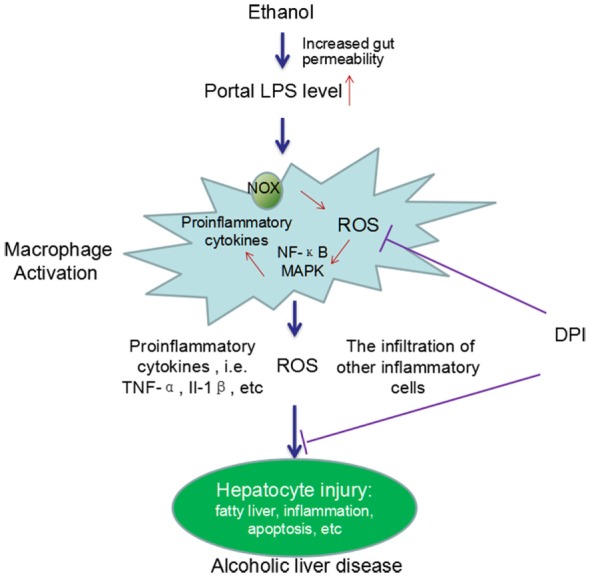
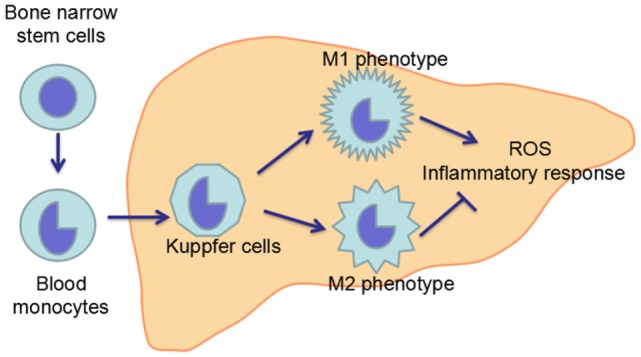
Alcoholic liver disease (ALD) encompasses a spectrum of liver injury ranging from steatosis to steatohepatitis, fibrosis, and finally cirrhosis. Accumulating evidences have demonstrated that Kupffer cells (KCs) play critical roles in the pathogenesis of both chronic and acute ALD. It has become clear that alcohol exposure can result in increased hepatic translocation of gut-sourced endotoxin/lipopolysaccharide, which is a strong M1 polarization inducer of KCs. The activated KCs then produce a large amount of reactive oxygen species (ROS), pro-inflammatory cytokines, and chemokines, which finally lead to liver injury. The critical roles of KCs and related inflammatory cascade in the pathogenesis of ALD make it a promising target in pharmaceutical drug developments for ALD treatment. Several drugs (such as rifaximin, pentoxifylline, and infliximab) have been evaluated or are under evaluation for ALD treatment in randomized clinical trials. Furthermore, screening pharmacological regulators for KCs toward M2 polarization may provide additional therapeutic agents. The combination of these potentially therapeutic drugs with hepatoprotective agents (such as zinc, melatonin, and silymarin) may bring encouraging results.
酒精性肝病(ALD)涵盖了一系列肝脏损伤,从脂肪变性到脂肪性肝炎、纤维化,最终发展为肝硬化。越来越多的证据表明,库普弗细胞(KCs)在慢性和急性ALD的发病机制中都起着关键作用。目前已经明确,酒精暴露会导致肠道来源的内毒素/脂多糖的肝脏转运增加,而这是KCs的强烈M1极化诱导剂。激活的KCs随后会产生大量活性氧(ROS)、促炎细胞因子和趋化因子,最终导致肝脏损伤。KCs及相关炎症级联反应在ALD发病机制中的关键作用使其成为ALD治疗药物研发中一个有前景的靶点。几种药物(如利福昔明、己酮可可碱和英夫利昔单抗)已在随机临床试验中进行了评估或正在接受ALD治疗评估。此外,筛选针对KCs向M2极化的药理调节剂可能会提供额外的治疗药物。这些潜在治疗药物与肝脏保护剂(如锌、褪黑素和水飞蓟宾)联合使用可能会带来令人鼓舞的结果。