Sobhanifar Solmaz, Worrall Liam J, King Dustin T, Wasney Gregory A, Baumann Lars, Gale Robert T, Nosella Michael, Brown Eric D, Withers Stephen G, Strynadka Natalie C J
Department of Biochemistry and Center for Blood Research, University of British Columbia, Vancouver, British Columbia, Canada.
Department of Chemistry, University of British Columbia, Vancouver, British Columbia, Canada.
PLoS Pathog. 2016 Dec 14;12(12):e1006067. doi: 10.1371/journal.ppat.1006067. eCollection 2016 Dec.
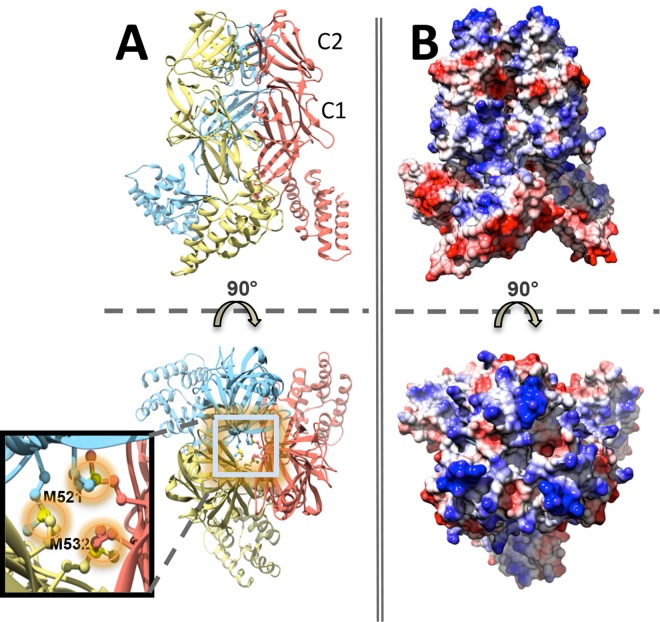
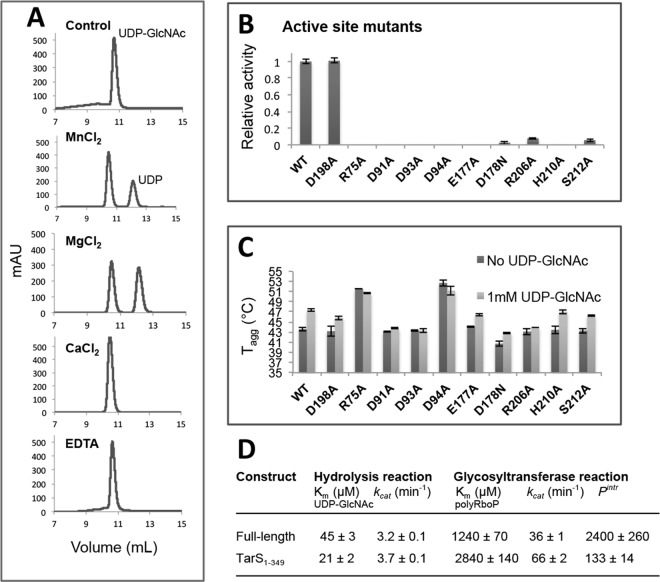
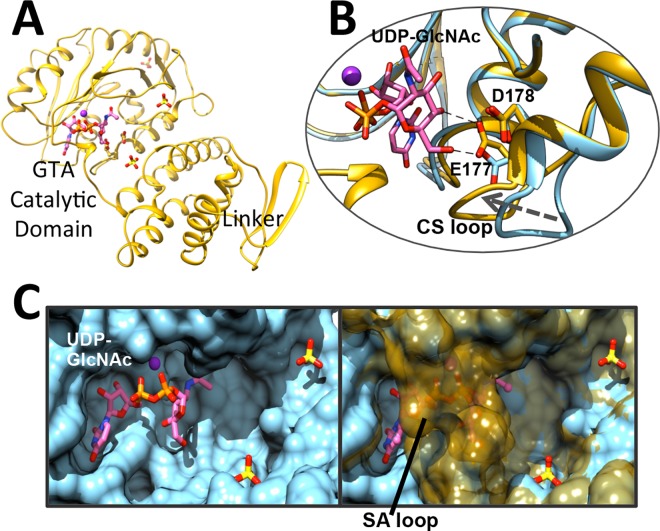
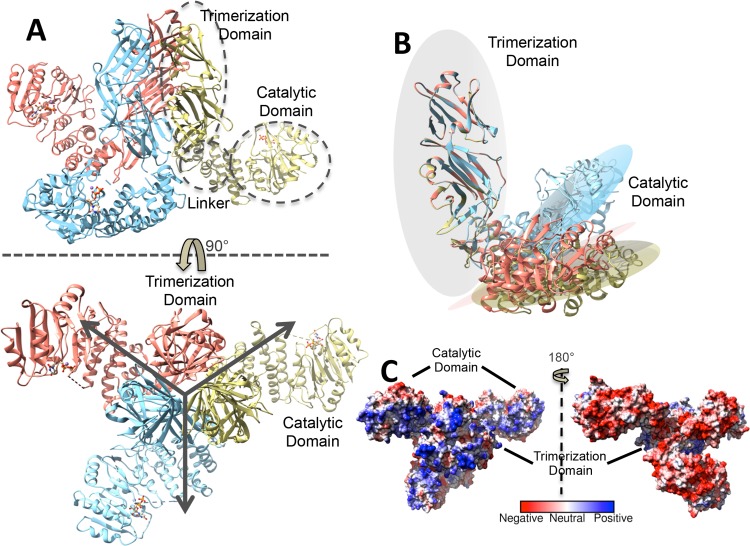
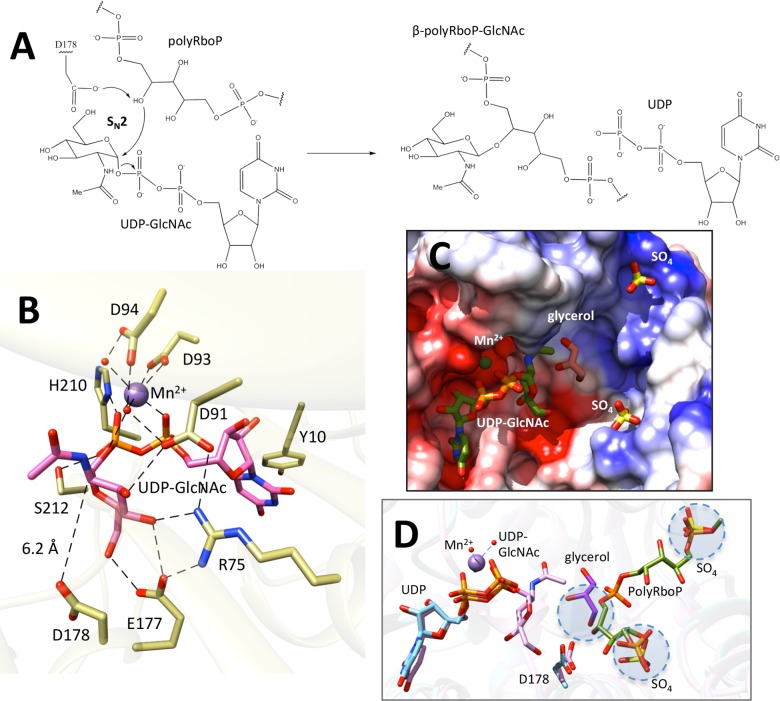
In recent years, there has been a growing interest in teichoic acids as targets for antibiotic drug design against major clinical pathogens such as Staphylococcus aureus, reflecting the disquieting increase in antibiotic resistance and the historical success of bacterial cell wall components as drug targets. It is now becoming clear that β-O-GlcNAcylation of S. aureus wall teichoic acids plays a major role in both pathogenicity and antibiotic resistance. Here we present the first structure of S. aureus TarS, the enzyme responsible for polyribitol phosphate β-O-GlcNAcylation. Using a divide and conquer strategy, we obtained crystal structures of various TarS constructs, mapping high resolution overlapping N-terminal and C-terminal structures onto a lower resolution full-length structure that resulted in a high resolution view of the entire enzyme. Using the N-terminal structure that encapsulates the catalytic domain, we furthermore captured several snapshots of TarS, including the native structure, the UDP-GlcNAc donor complex, and the UDP product complex. These structures along with structure-guided mutants allowed us to elucidate various catalytic features and identify key active site residues and catalytic loop rearrangements that provide a valuable platform for anti-MRSA drug design. We furthermore observed for the first time the presence of a trimerization domain composed of stacked carbohydrate binding modules, commonly observed in starch active enzymes, but adapted here for a poly sugar-phosphate glycosyltransferase.
近年来,磷壁酸作为针对金黄色葡萄球菌等主要临床病原体的抗生素药物设计靶点,受到越来越多的关注,这反映出抗生素耐药性令人不安地增加,以及细菌细胞壁成分作为药物靶点在历史上取得的成功。现在越来越清楚的是,金黄色葡萄球菌壁磷壁酸的β -O- 糖基化在致病性和抗生素耐药性中都起着重要作用。在此,我们展示了金黄色葡萄球菌TarS的首个结构,TarS是负责多聚核糖醇磷酸β -O- 糖基化的酶。我们采用分而治之的策略,获得了各种TarS构建体的晶体结构,将高分辨率的重叠N端和C端结构映射到较低分辨率的全长结构上,从而得到了整个酶的高分辨率视图。利用包含催化结构域的N端结构,我们还捕获了TarS的几个瞬间结构,包括天然结构、UDP - GlcNAc供体复合物和UDP产物复合物。这些结构以及基于结构的突变体使我们能够阐明各种催化特征,并确定关键的活性位点残基和催化环重排,为抗耐甲氧西林金黄色葡萄球菌(MRSA)药物设计提供了一个有价值的平台。我们还首次观察到存在一个由堆叠的碳水化合物结合模块组成的三聚化结构域,这种结构域在淀粉活性酶中常见,但在此处适用于一种多糖磷酸糖基转移酶。